- Scheduling
- Viewing the Schedule
Viewing the Schedule
Overview
Use the Schedule to review, create, and update Direct Supports, Group Supports, internal shifts, and breaks for a chosen period. Group rows by Support Worker, Participant, or Site.
Viewing the Schedule
Each row shows its shifts across the selected day, week, or fortnight.
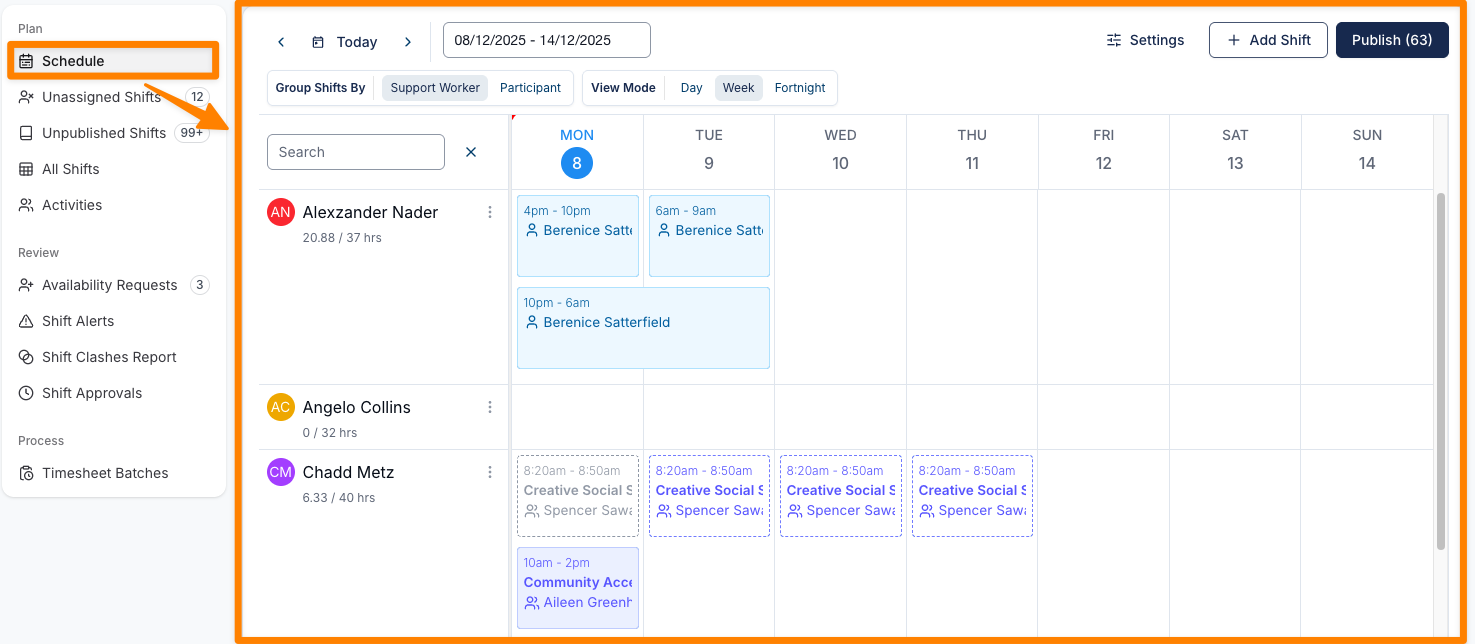
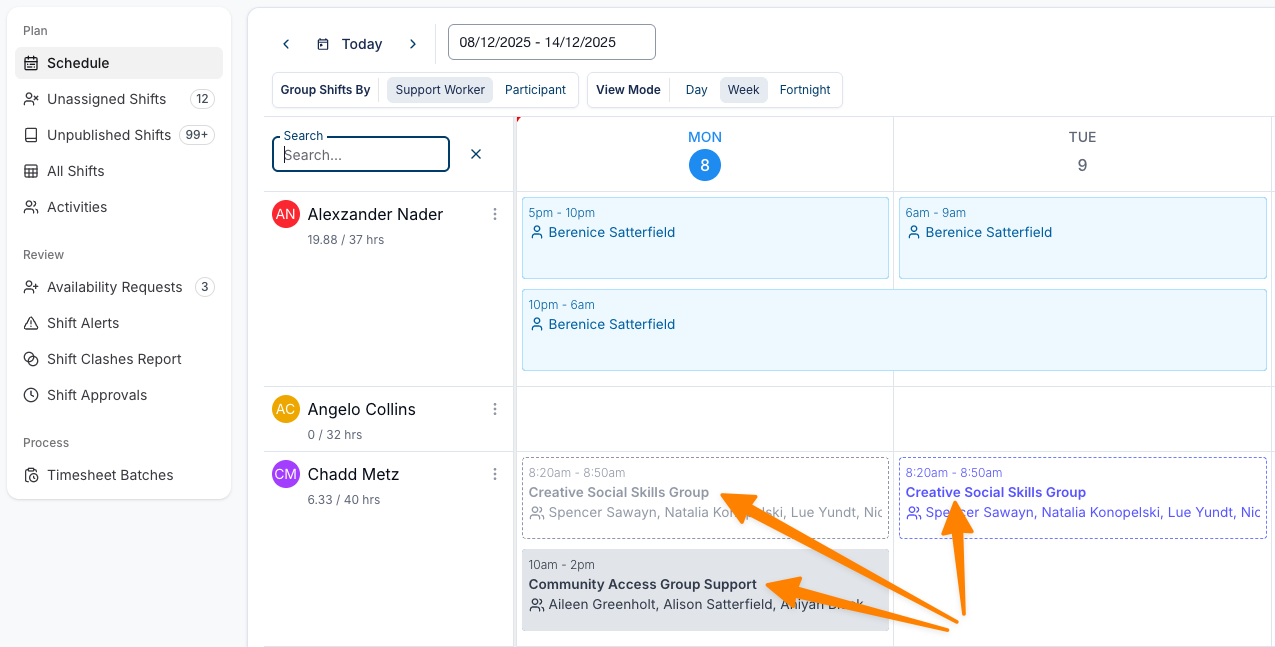
Activity shifts show the Activity name on the shift.
Group Shifts By
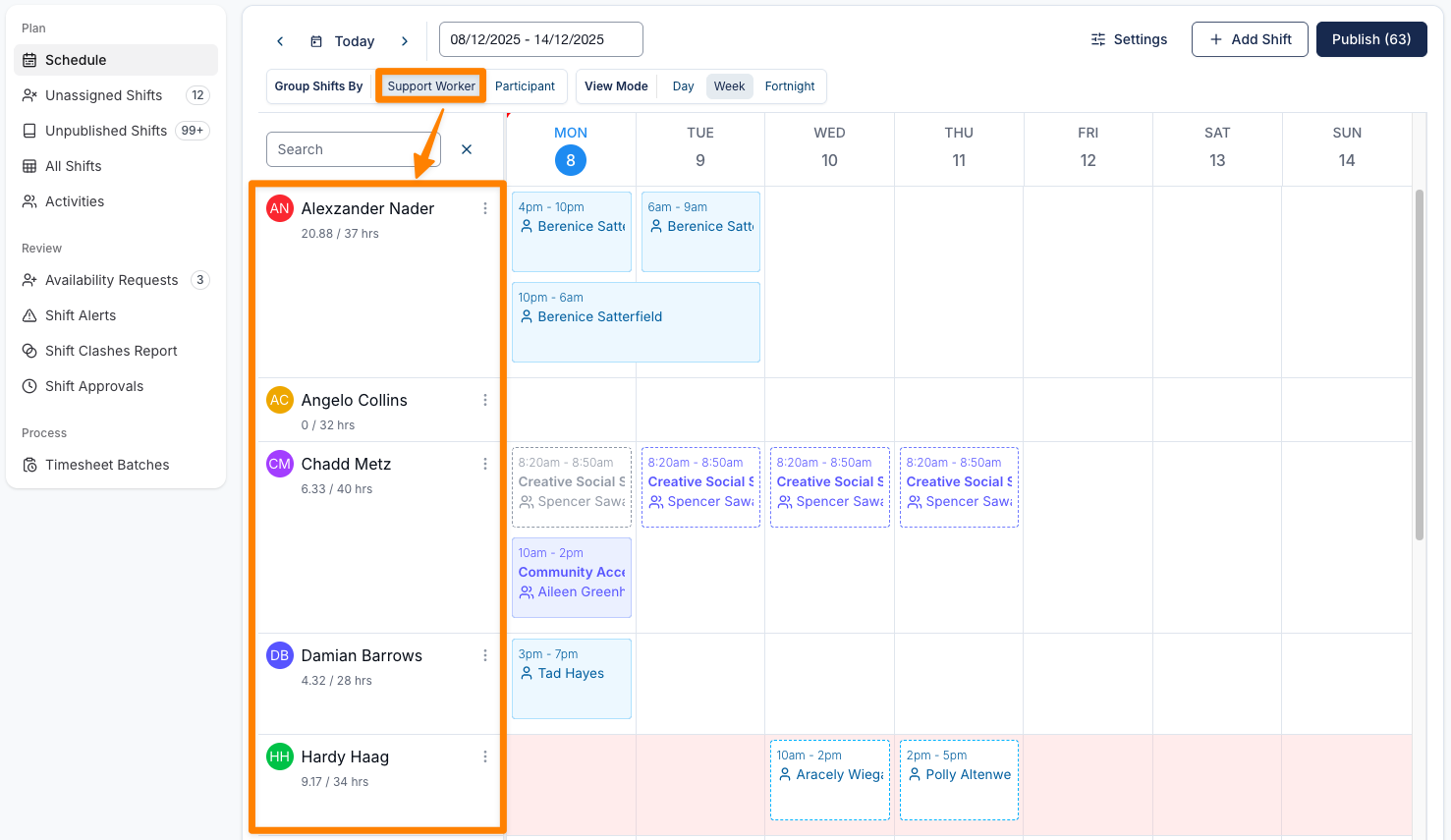
Group Shifts By sets what each row of the Schedule is - a Support Worker, a Participant, or a Site. Your choice is remembered in your browser.
Support Worker View
Support Worker view shows each worker's scheduled hours against their contracted hours.
- Day and Week show weekly scheduled and contracted hours.
- Fortnight shows scheduled hours for that fortnight against two weeks of contracted hours.
Scheduled hours breakdown
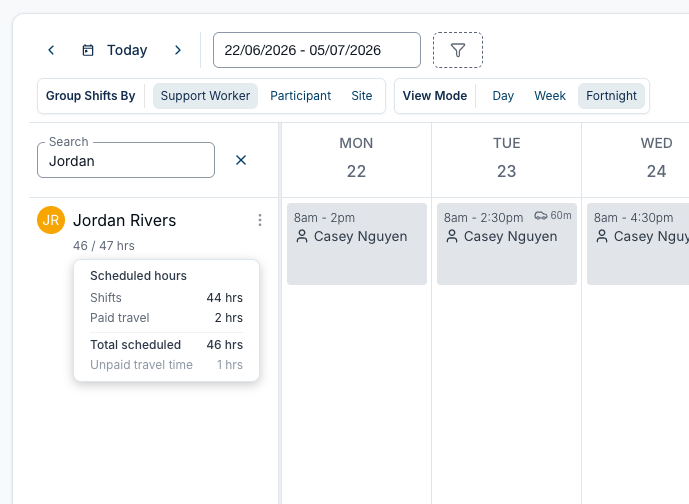
Hover the X / Y hrs counter to see how a worker's scheduled hours are made up. The Scheduled hours tooltip breaks the total down by category:
- Shifts - the time rostered on shifts (excluding unpaid breaks).
- Paid travel - travel that's paid as time.
- Sleepover - the active (awake) portion of sleepover supports.
- Total scheduled - the sum of the categories above. This is the current-hours figure (the
X) shown in the counter, and it only counts hours that are paid as time.
Categories with no hours are hidden, so you'll only see the lines that apply to that worker.
If any travel is paid as a kilometre allowance rather than as time, it appears as a separate, muted Unpaid travel time line. This time isn't included in the Total scheduled figure - it's shown for context, and it's usually what explains a gap between the schedule counter and the pay run.
Use the three-dot menu beside a Support Worker's name to open their Profile or Schedule.
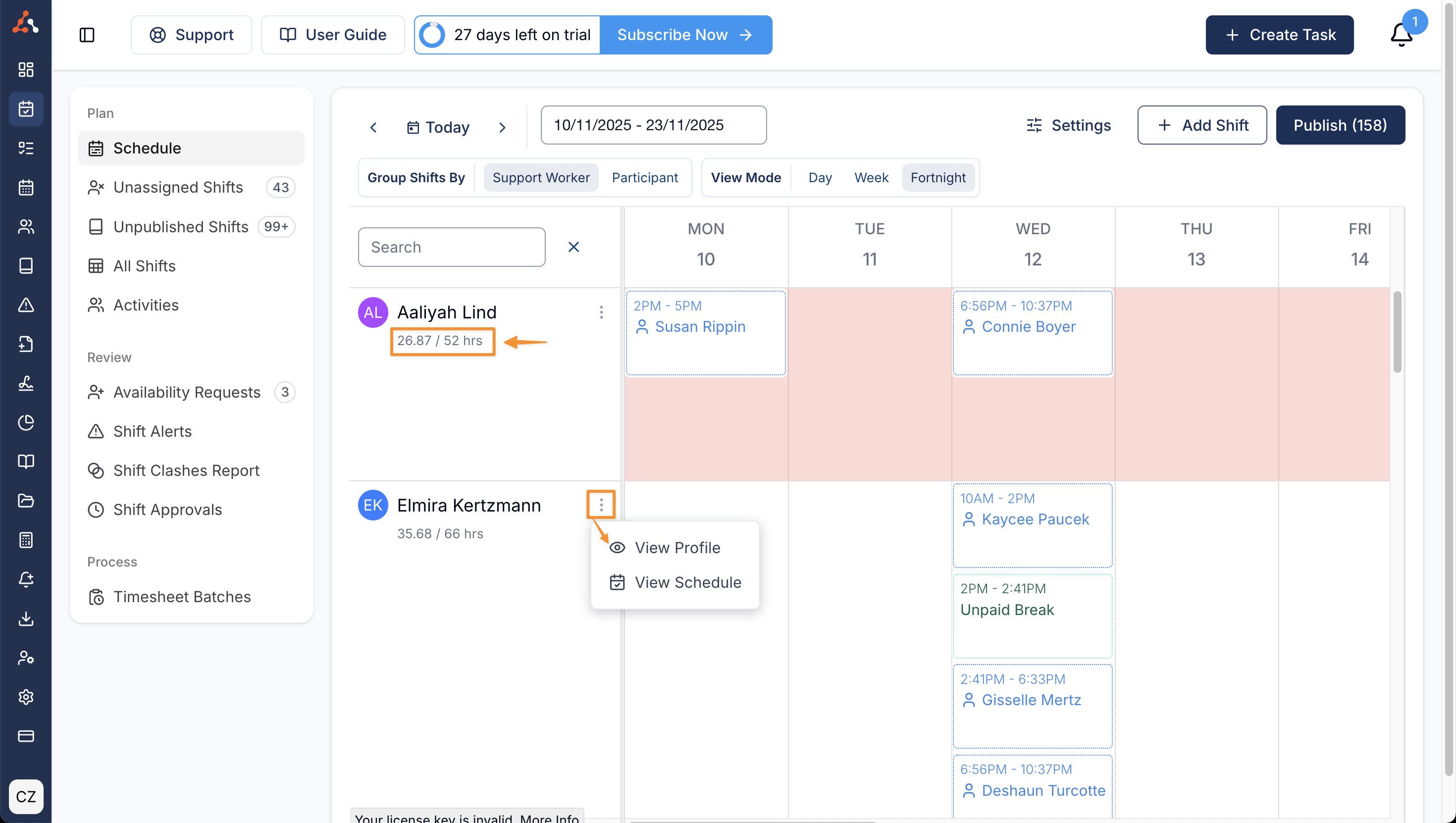
Hover over the dot on a shift's travel line to see its travel time or distance and check for travel overlaps. See Travel on the Schedule for how travel appears in each view.
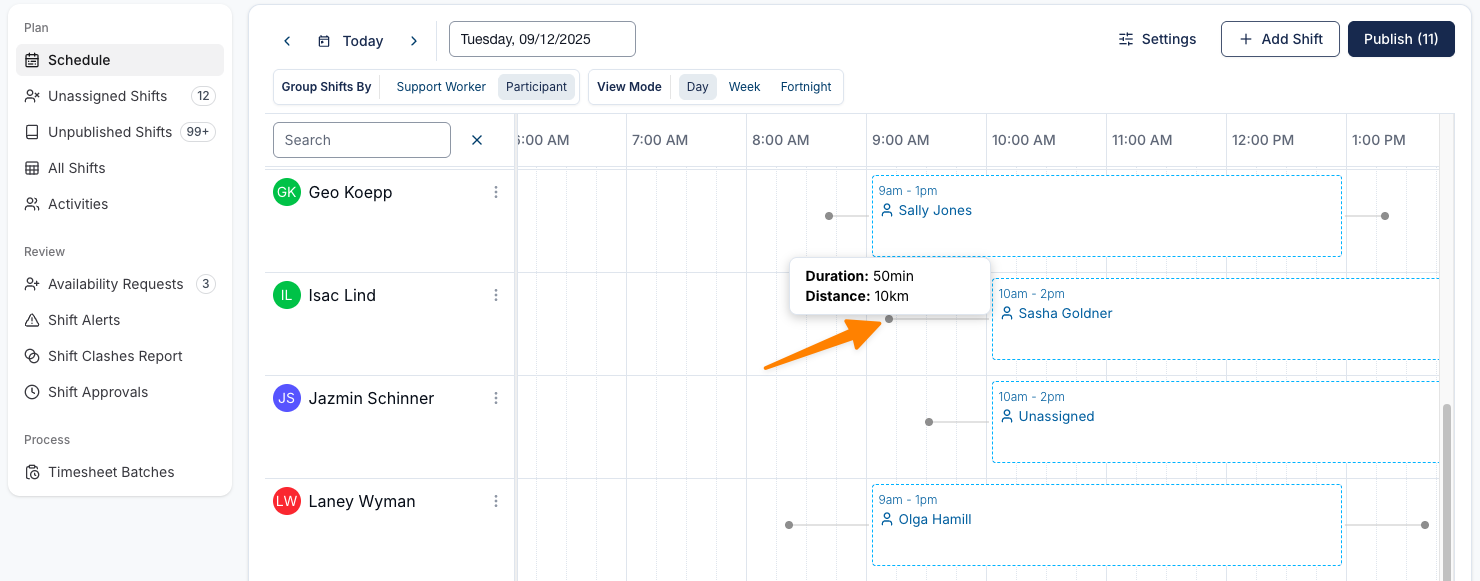
Each worker's row shows rostered times and attached Participants. Select an empty time in the relevant row to add a shift. See Adding a 1:1 Shift.
Participant View
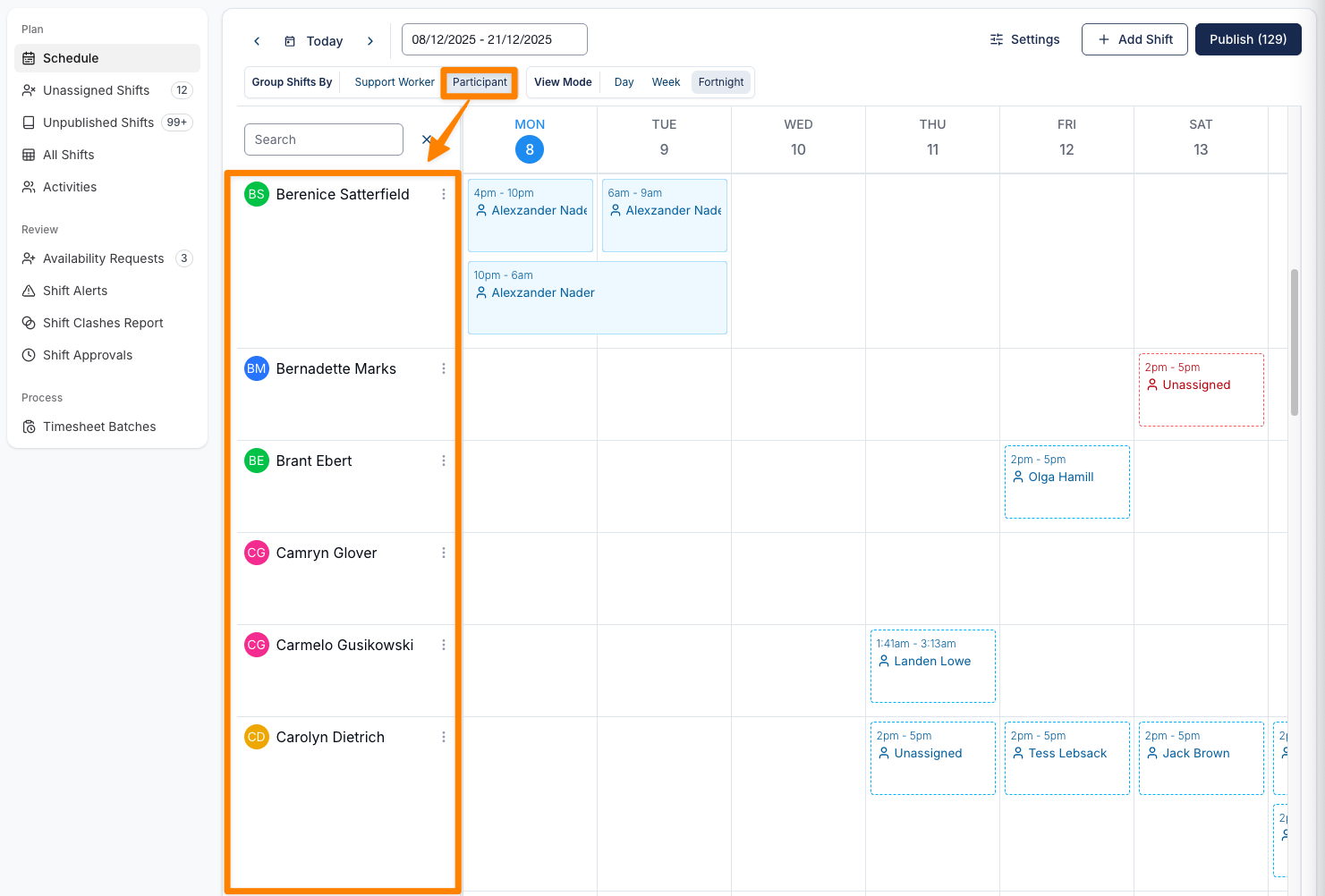
Each Participant's row shows rostered times and the assigned Support Worker. A shift without a worker shows Unassigned.
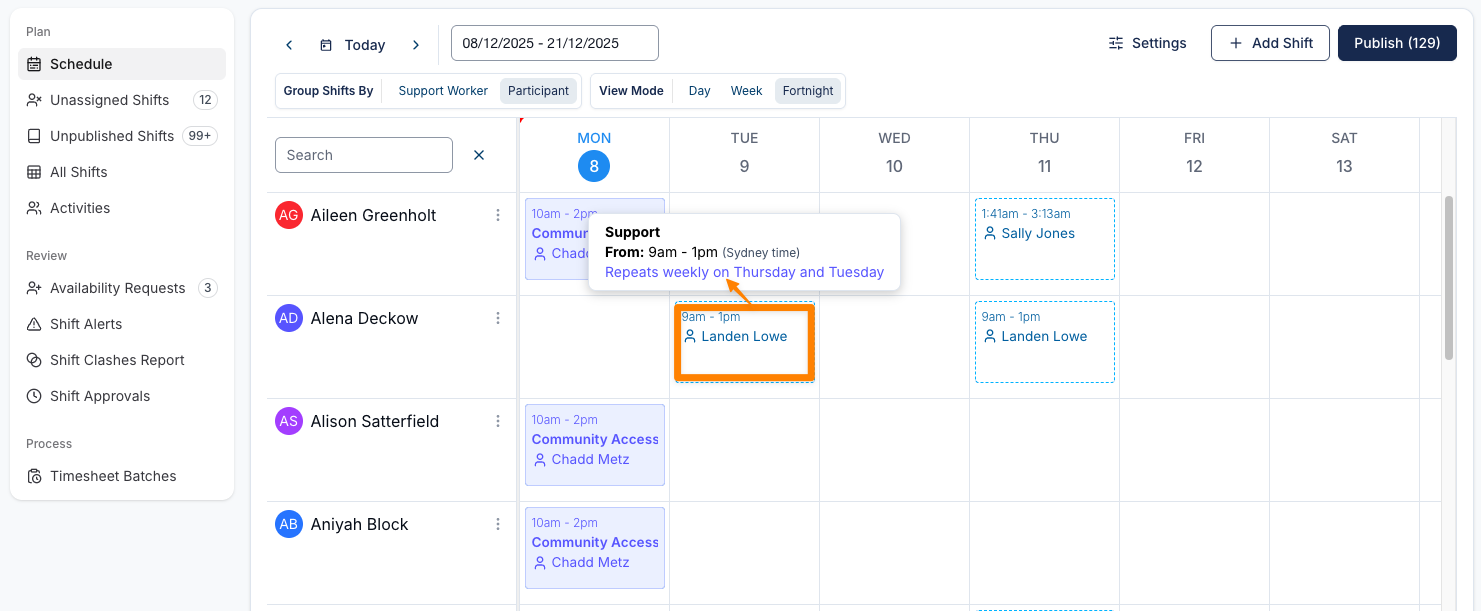
Hover over a shift to see its type, time zone, and recurring series details.
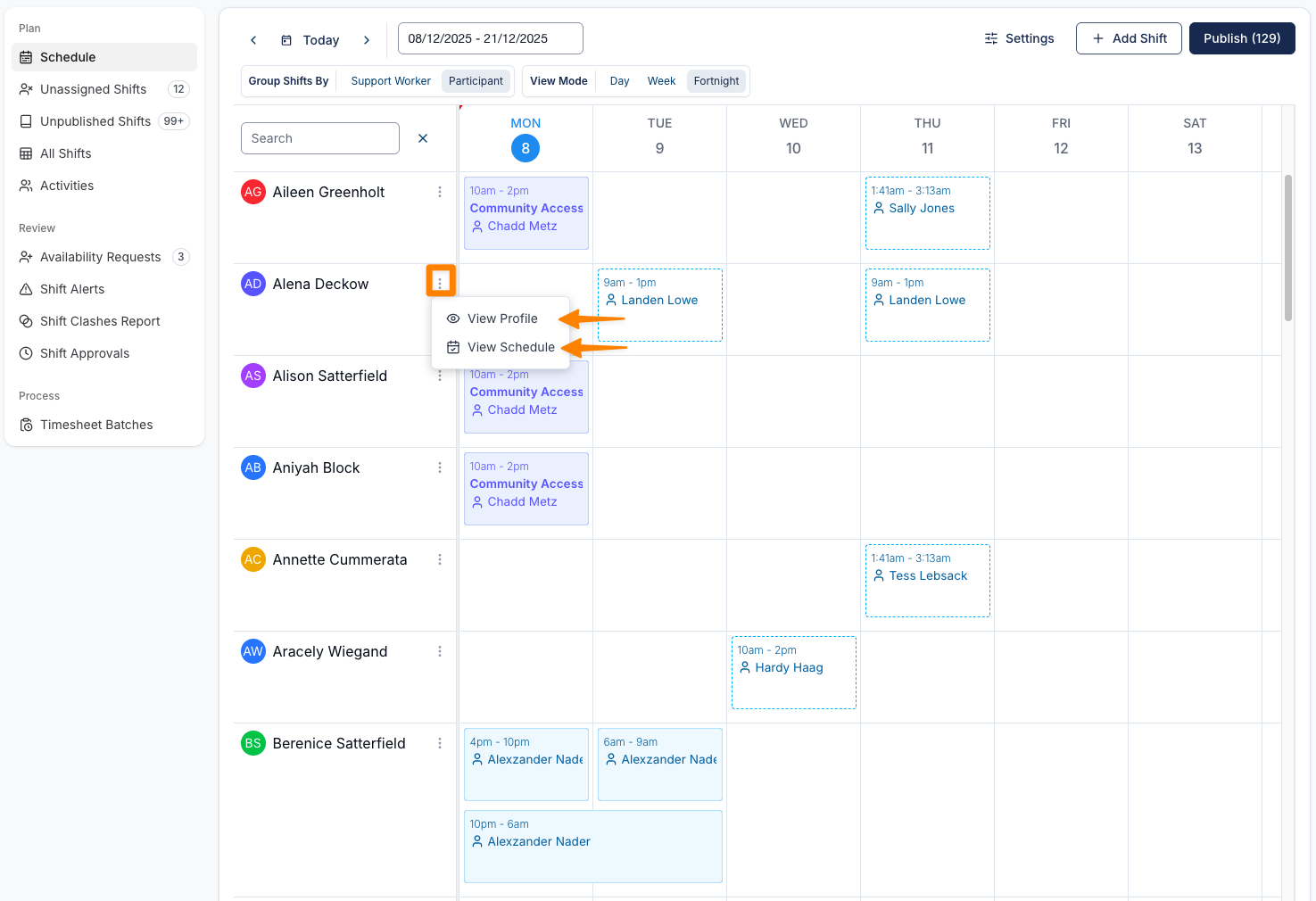
In Participant view, use the three-dot menu beside a Participant's name to open their Profile or Schedule.
Site View
Grouping by Site puts a site's whole schedule on one row instead of spreading it across a row per Support Worker - the condensed view for SIL houses, though it works for any site.
A shift only appears here if it has a Site set on it (see Sites - Scheduling). Shifts with no Site are left out of this view, and there is no Unassigned row. Rows are ordered by site name, and only sites with at least one shift in the date range you're viewing are listed.
Each support appears once, rather than once per worker rostered to it:
- A Group Support covered by several Support Workers is a single tile, listing every worker's name under the Group Support name.
- A 1:1 Direct Support tile names the Support Worker assigned, or Unassigned if nobody is. It doesn't name the Participant - open the support to see who it's for.
- Internal shifts and unpaid breaks appear once each.
Selecting blank space in a site's row opens the shift form with that Site already filled in. The three dot menu next to a site name gives View Profile (the site's page) and View Schedule (that site's own Schedule tab).
Two things behave differently in this view:
- Shifts can't be dragged between sites. You can still drag a shift to a different time, but the row it sits in is fixed. To move a shift to another site, open it and change the Site field.
- Unavailability and leave aren't shown. Those blocks sit on a Support Worker's row, so they only appear when grouped by Support Worker.
Search
Depending on your current view, you can 'Search' by the name of the Support Worker, Participant or site.
Adjusting the view
View Date Toggle
Jump to 'Today' or move forwards or backward depending on the View Mode you have selected (Day, Week, or Fortnight).
View Mode
You can adjust the Schedule view by Day, Week or Fortnight.
- Day uses the Increments selected in the Schedule settings toolbar.
- Week shows a full week. It starts on the configured Week starts on day, or falls back to the pay period start day and then Monday. See Schedule Week.
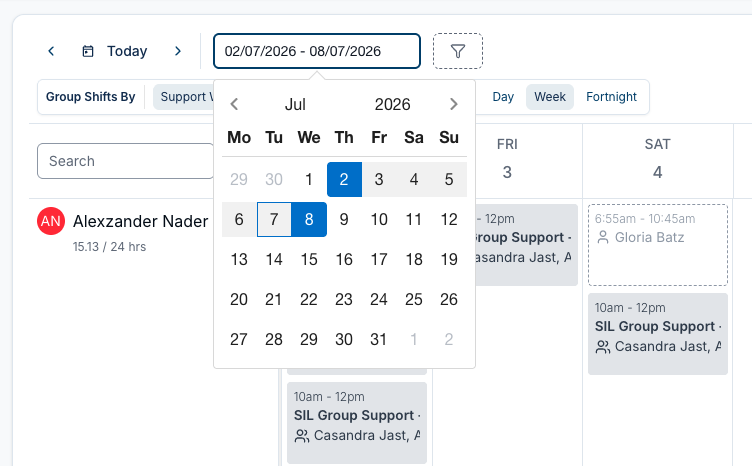
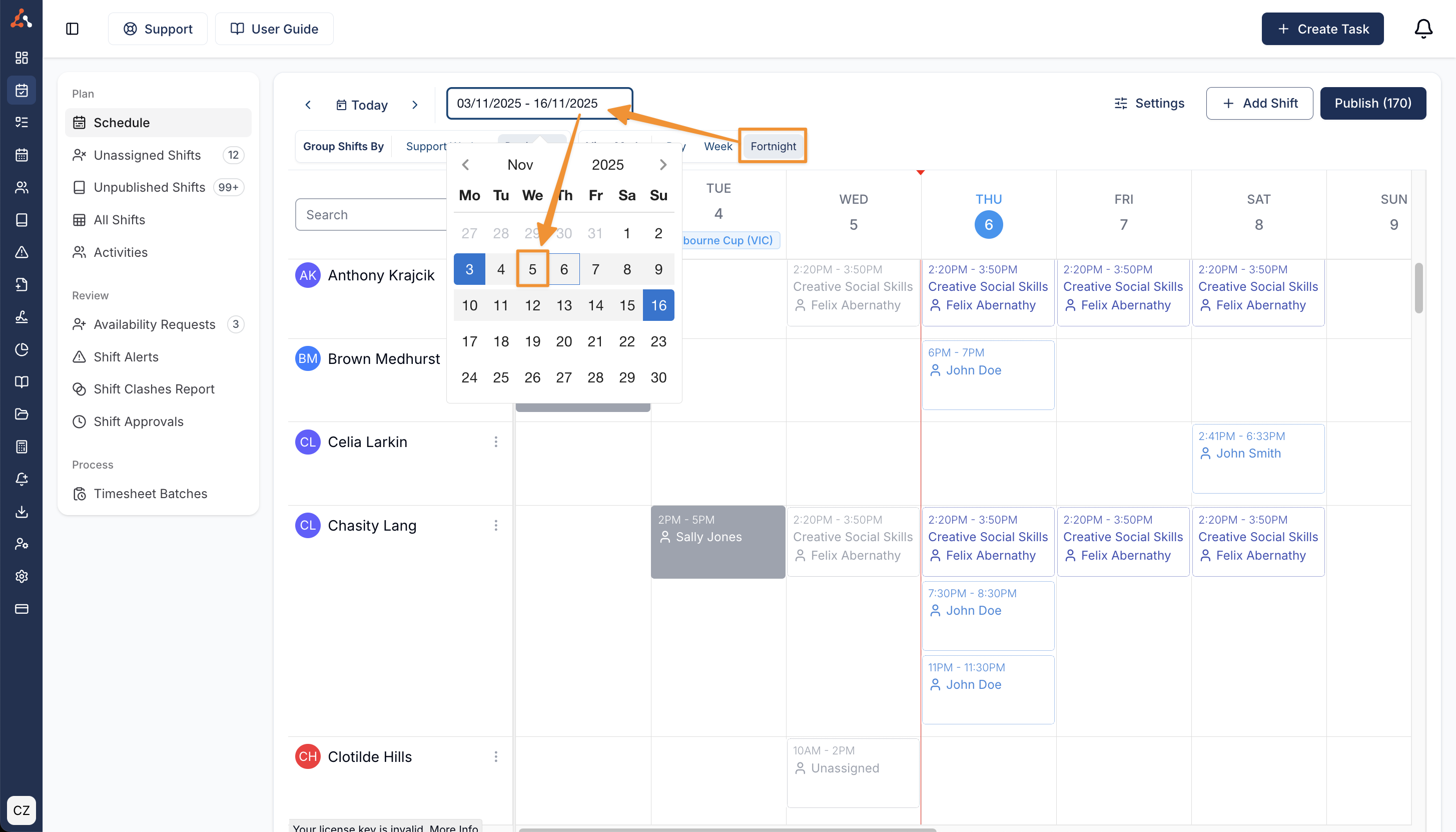
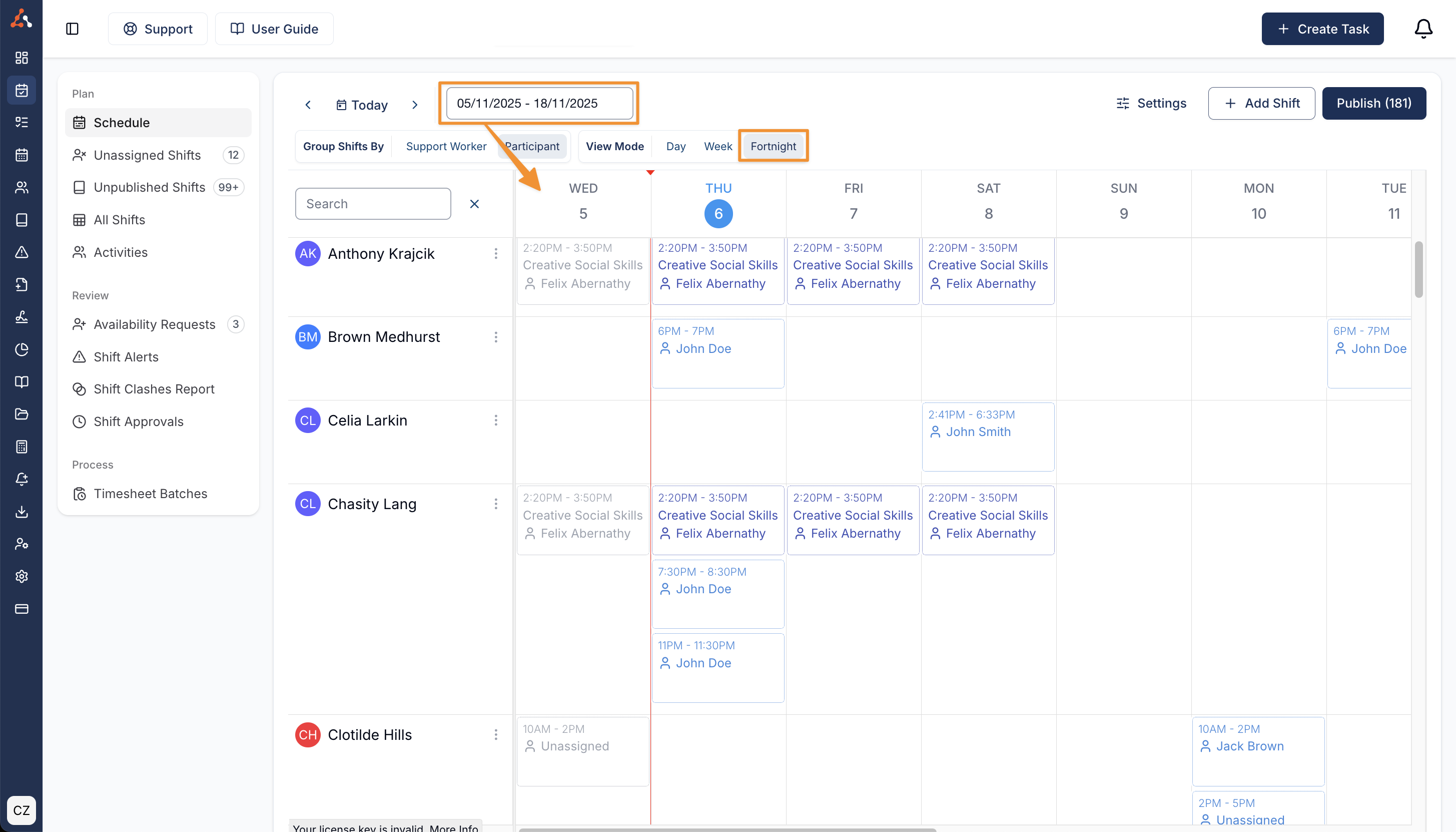
- The Fortnightly view begins on the same start day as your Week view and runs for two weeks. You can also select your fortnight by using the date range to select the day of the fortnight it begins.
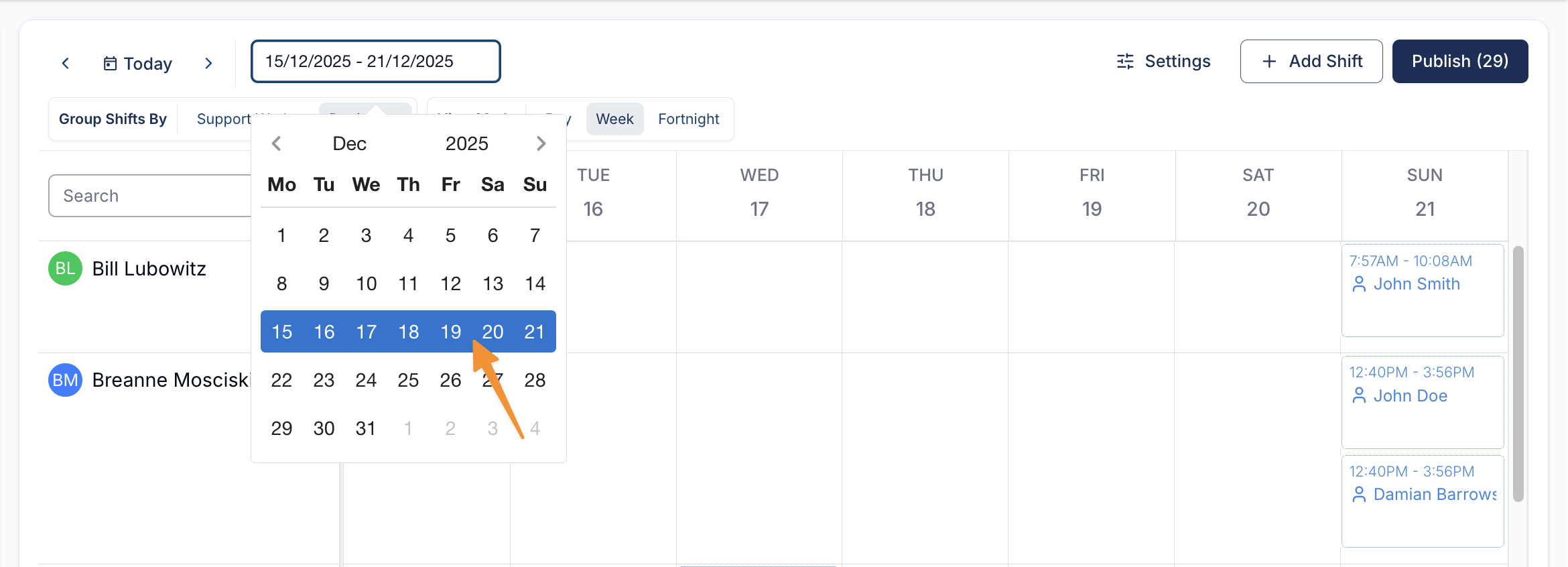
- Use the date picker to jump directly to any date outside your current view. For example, if you're in Week View and choose Wednesday from the previous week, the schedule will automatically shift to that week and display the selected Wednesday.
Adjusting the Fortnight date range
If you have selected Fortnightly view, you can select when you want your fortnight to start by selecting the day of the fortnight it begins.
Adjusting the Week date range
If you have selected Week view, you can select the week by selecting the row within the calendar.
Filters
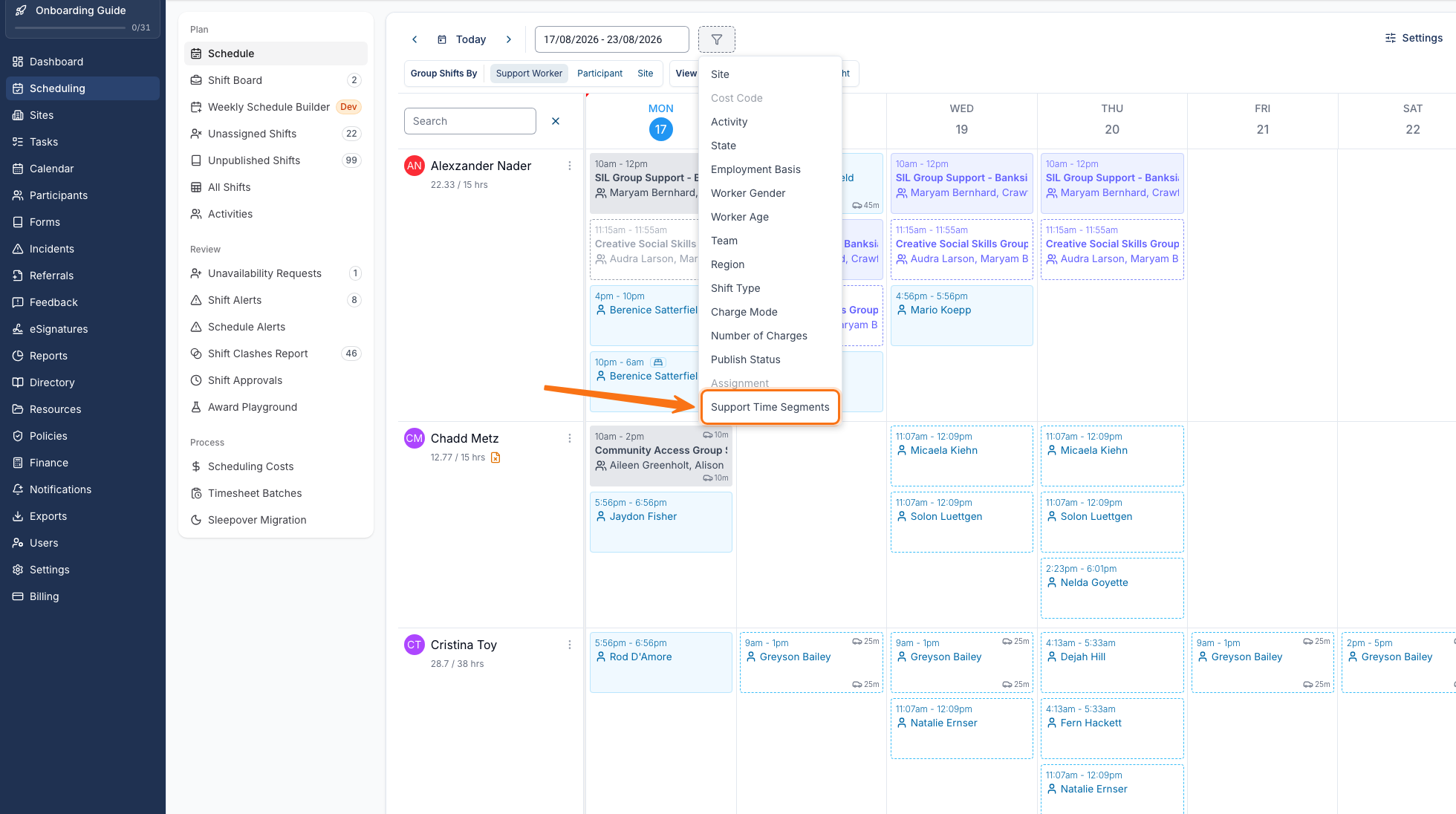
The Schedule view includes filters for Sites, Activities, Cost Codes, worker details, shift details, publishing, assignment, charges, and Support Time Segments. The filters available depend on how the Schedule is grouped and which features your organisation uses.
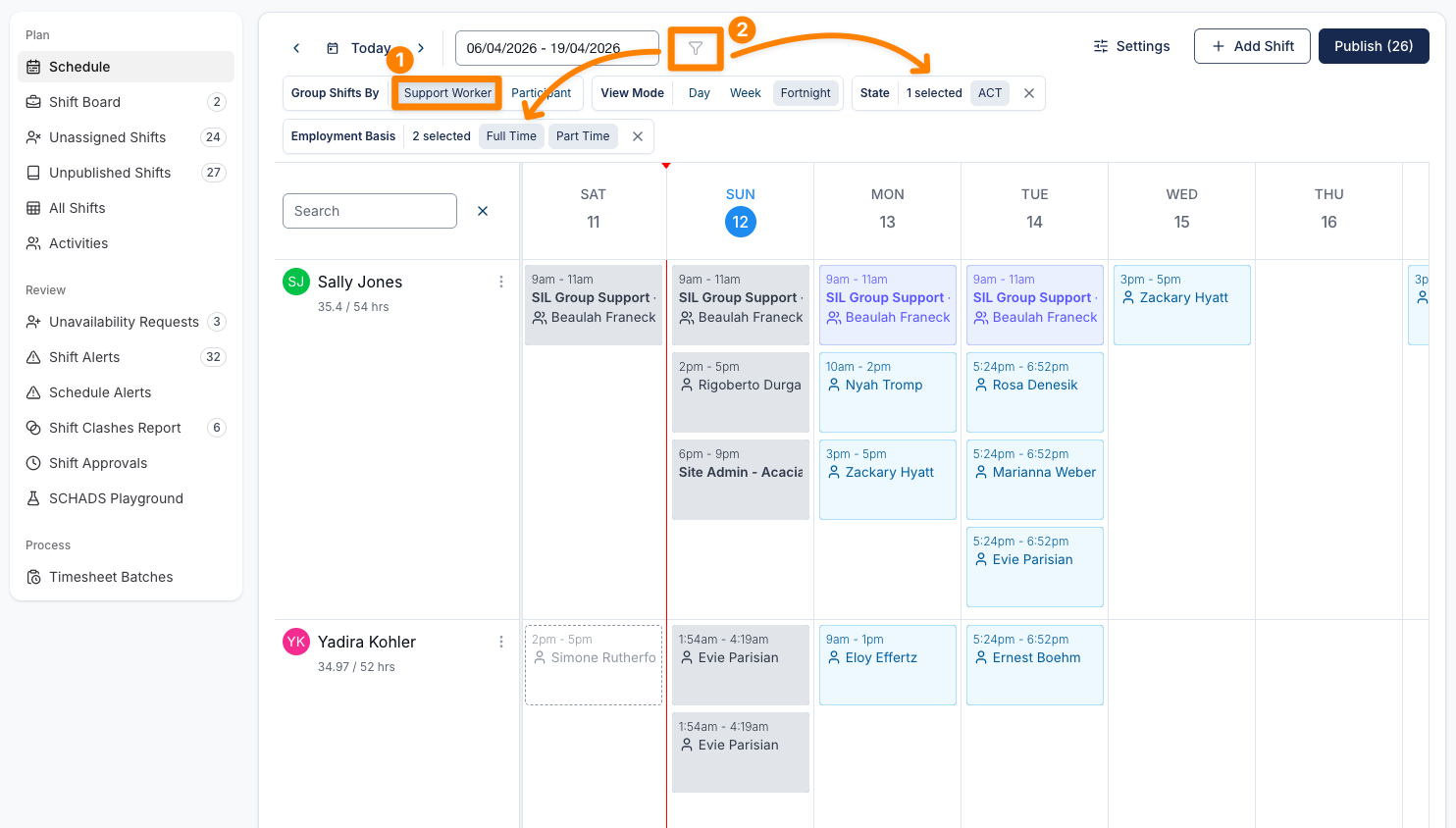
How to Use
- Open Schedule and select the Support Worker view.
- Select the filter icon.
- Apply one or more of the following:
- State - Filter by one or more states.
- Employment Basis - Filter by:
- Full Time
- Part Time
- Casual
Both filters support multi-selection.
Availability
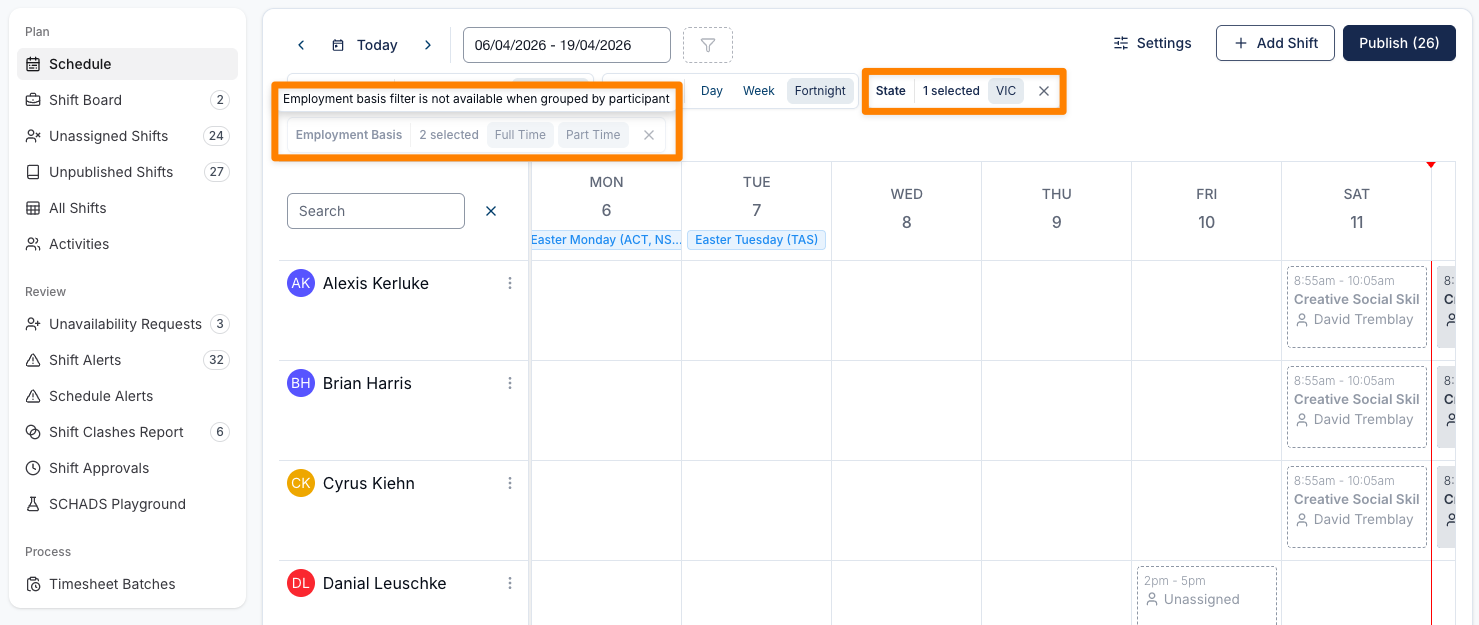
- State filter: Available in all views. What it matches depends on how the Schedule is grouped - the Support Worker's address state when grouped by Support Worker, a Participant's when grouped by Participant, and either of the two when grouped by Site.
- Employment Basis filter: Only available when grouped by Support Worker.
Grouped by Participant or Site, the Employment Basis filter appears greyed out with a tooltip on hover explaining why. A selection you made earlier is kept, but not applied until you group by Support Worker again.
Other Schedule Filters
The main Schedule can also include:
| Filter | What it narrows |
|---|---|
| Site | Shifts linked to selected Sites |
| Cost Code | Shifts carrying selected Cost Codes |
| Activity | Shifts linked to selected Activities |
| Worker Gender and Worker Age | Support Workers matching the selected values; available only in Support Worker view |
| Team | Support Workers in selected Teams; available only in Support Worker view when Teams is enabled |
| Region | Rows and shifts linked to selected Regions |
| Number of Charges | Shifts with a charge count equal to, less than, or greater than a value |
| Publish Status | Published or unpublished shifts |
| Assignment | Assigned or unassigned shifts; available only in Participant view |
Your active filters are remembered in the same browser. A filter that is not valid for the current grouping is disabled or not applied until you return to a compatible view.
Shift Type filter
The Shift Type filter lets you narrow the Schedule to particular kinds of shift - handy when you want to find the shifts that aren't 1:1 or Group Supports, such as internal shifts or unpaid breaks, without scanning the whole roster.
- Go to Schedule.
- Select the filter icon, then choose Shift Type.
- Tick one or more shift types. You can start typing in the Search box to jump to a type.
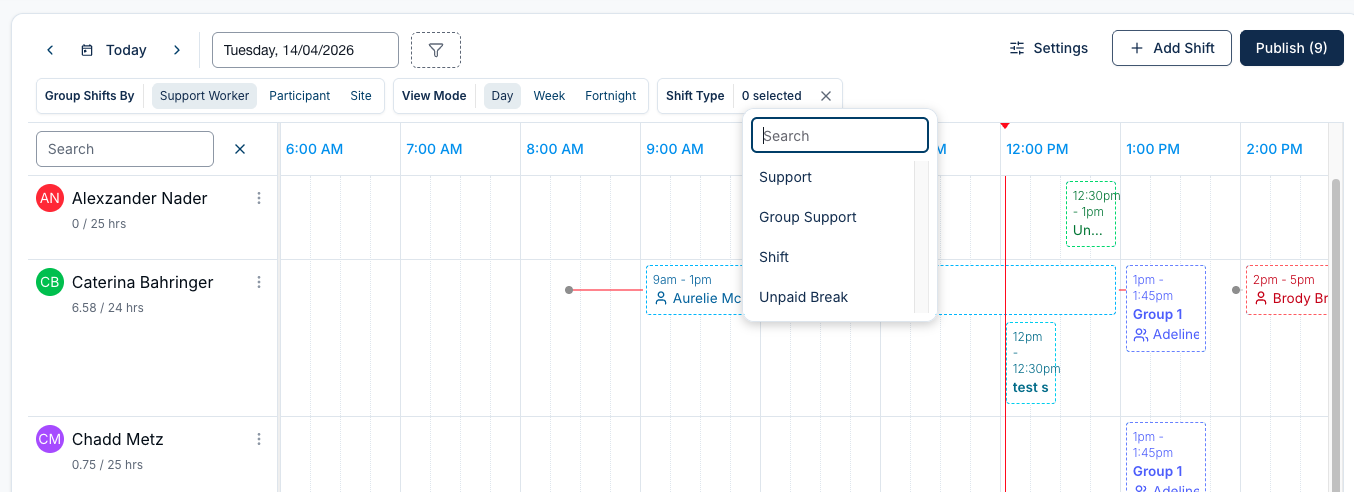
The available shift types are:
- Support - 1:1 Direct Supports. See Adding a 1:1 Shift.
- Group Support - supports delivered to more than one Participant. See Adding a Group Shift.
- Shift - internal or non-support shifts, such as training or team meetings. See Adding a Shift (Internal or Non-Support).
- Unpaid Break - unpaid breaks rostered within a shift. See Meal Break.
A few things to keep in mind:
- The filter is multi-select. Choosing more than one type shows shifts matching any of the types selected.
- With nothing selected, no shift type filtering is applied and every shift type is shown.
- Use the × on the filter to remove it and return to the full Schedule.
- Your selection is remembered in your browser, so the Shift Type filter stays applied the next time you open the Schedule.
- Unavailability and leave are not shifts, so those blocks stay visible whichever shift types you select.
Charge Mode filter
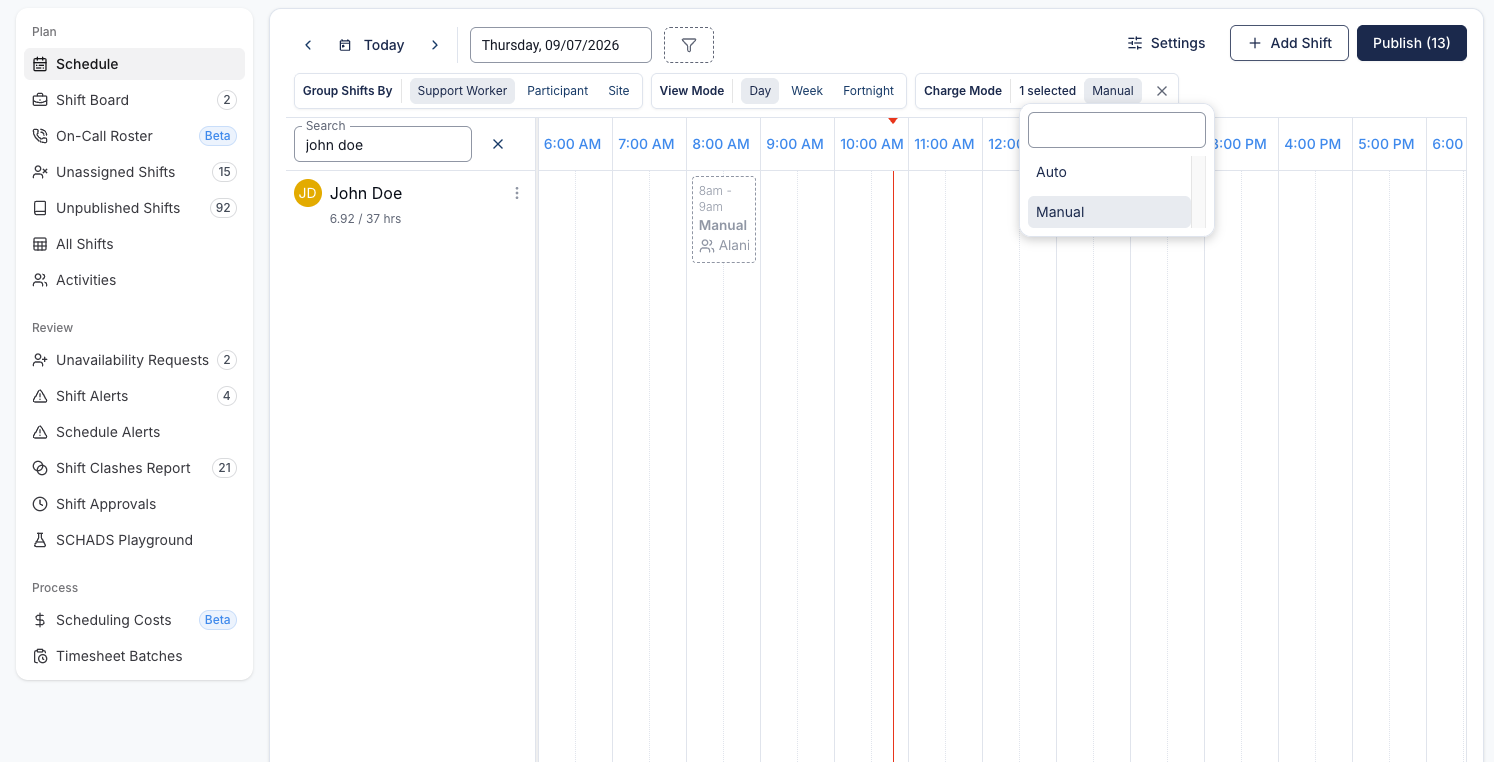
The Charge Mode filter lets you narrow the Schedule to shifts by how their charges are calculated - Auto (charges are calculated automatically) or Manual (charges are entered and controlled manually). For more on the difference, see Managing Manual Charges.
- Select Auto or Manual on its own to show only shifts with that charge mode.
- Select both to show every shift that has a charge mode.
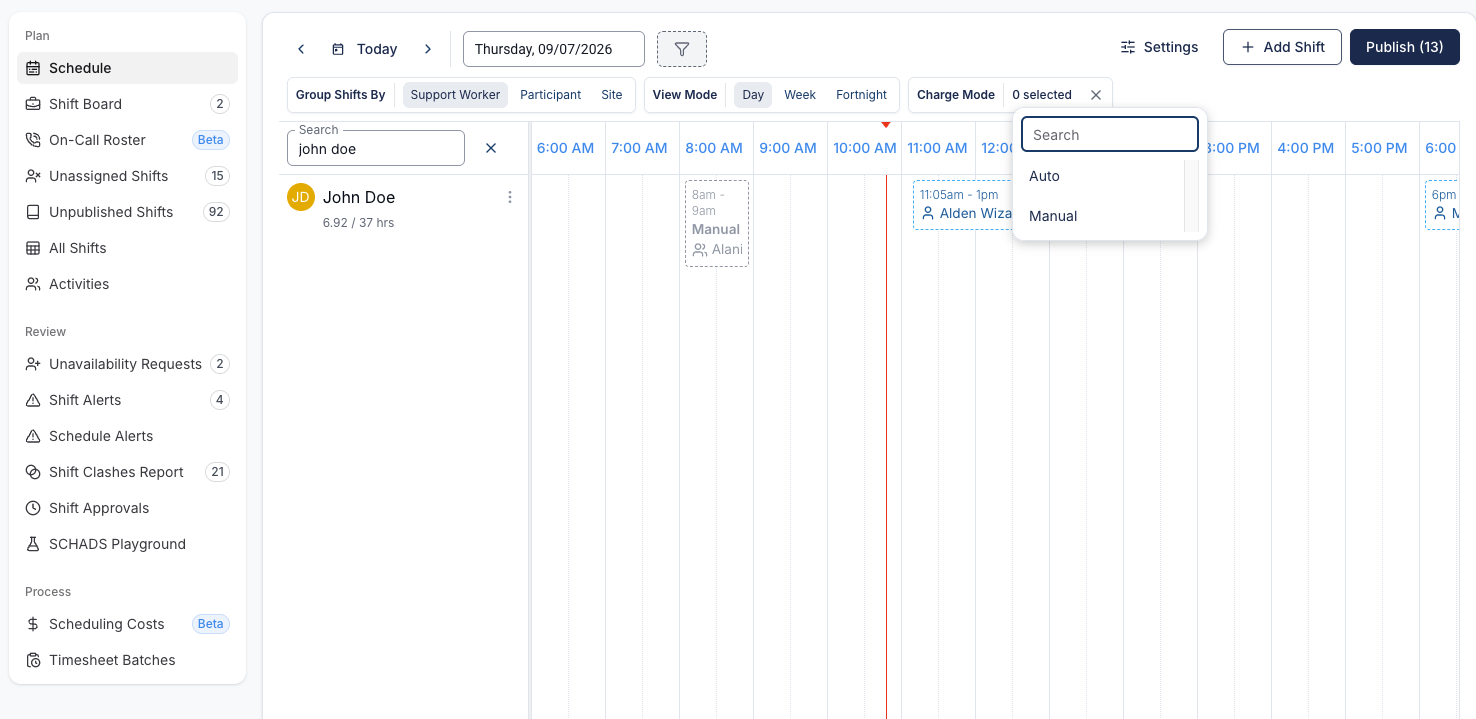
Your selection is remembered, so the Charge Mode filter stays applied the next time you open the Schedule.
Support Time Segments filter
The Support Time Segments filter lets you narrow the Schedule to shifts based on whether their support splits its billed time across more than one Charge Item Set. This saves opening supports one by one to find the segmented ones.
- Go to Schedule.
- Select the filter icon, then choose Support Time Segments.
- Choose With or Without:
- With - only shifts whose support has time segments.
- Without - only shifts whose support has no time segments.
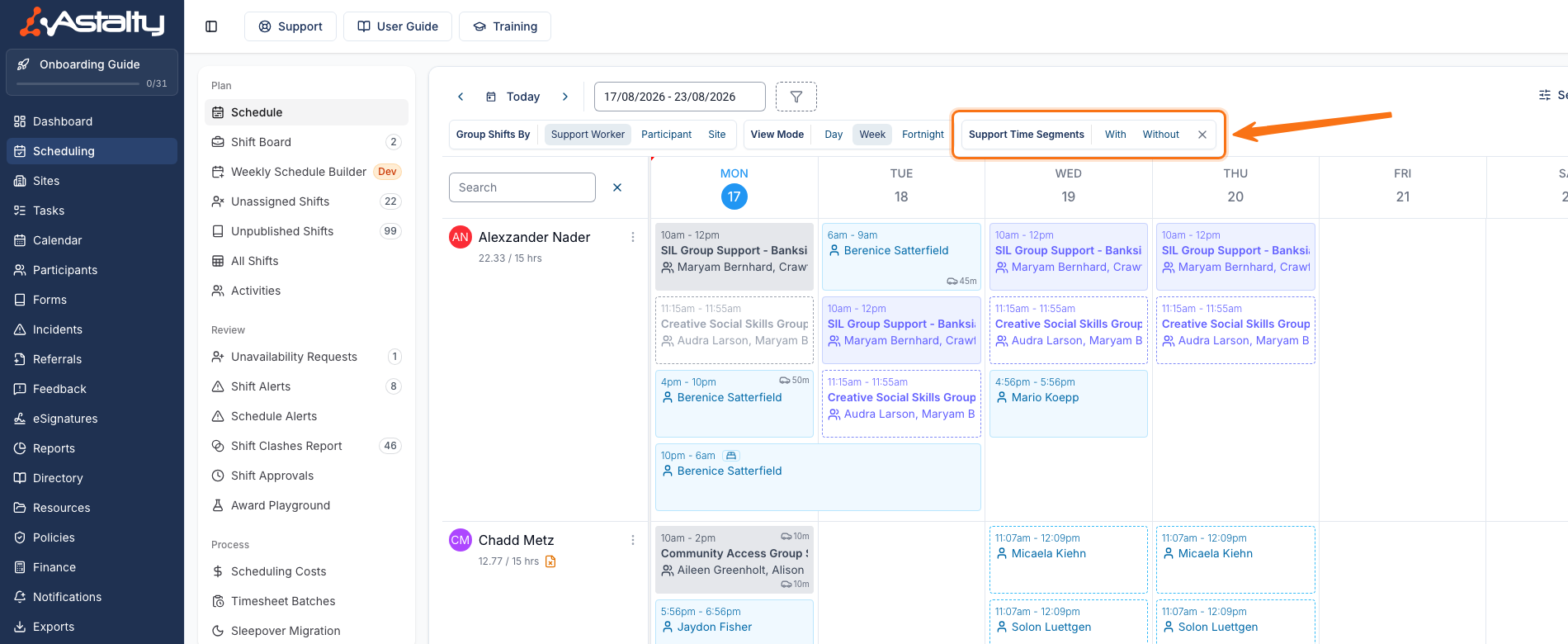
You can only choose one option at a time. Select the highlighted option again, or use the × on the filter, to clear it and return to the full Schedule.
Your selection is remembered in your browser, so the Support Time Segments filter stays applied the next time you open the Schedule.
A few things to keep in mind about what each option includes:
- Group Supports appear under With if any Participant on the group support has time segments. Segments are set on each Participant's support, not at the group level.
- A support that has been switched to manual charging counts as Without, even if segments were set up on it earlier. Time segments only apply while the support uses automatic charging, so those settings are not active.
- Shifts that aren't attached to a support at all - internal shifts, unpaid breaks, and other non-support shifts - are left out of both options. Use the Shift Type filter if you need to find those.
- Unavailability and leave blocks are not shifts, so they stay visible on the Schedule whichever option you choose.
Settings
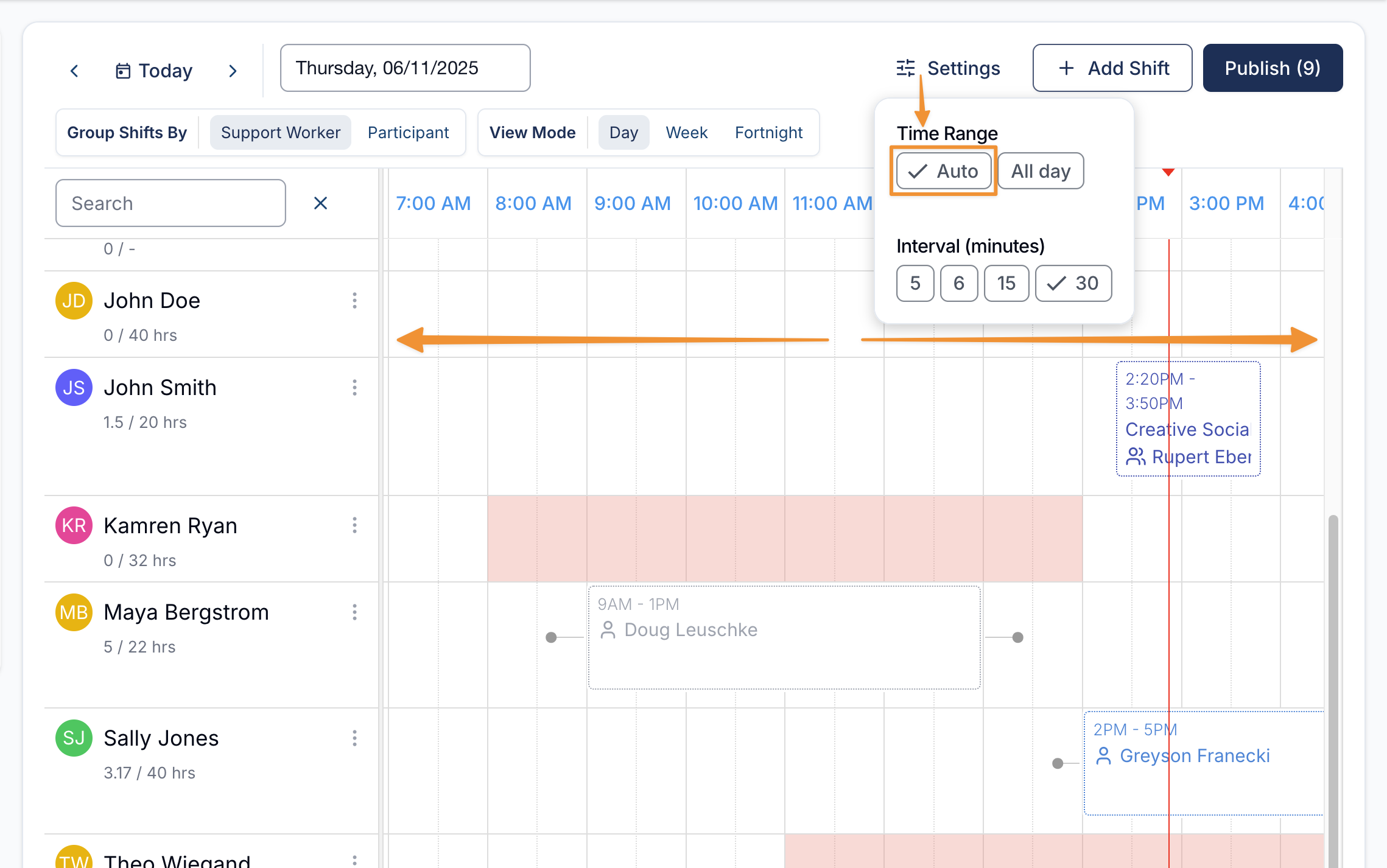
Time Range
Choose All Day to show midnight to midnight. Choose Auto to fit the visible time scale around the shifts in the selected period.
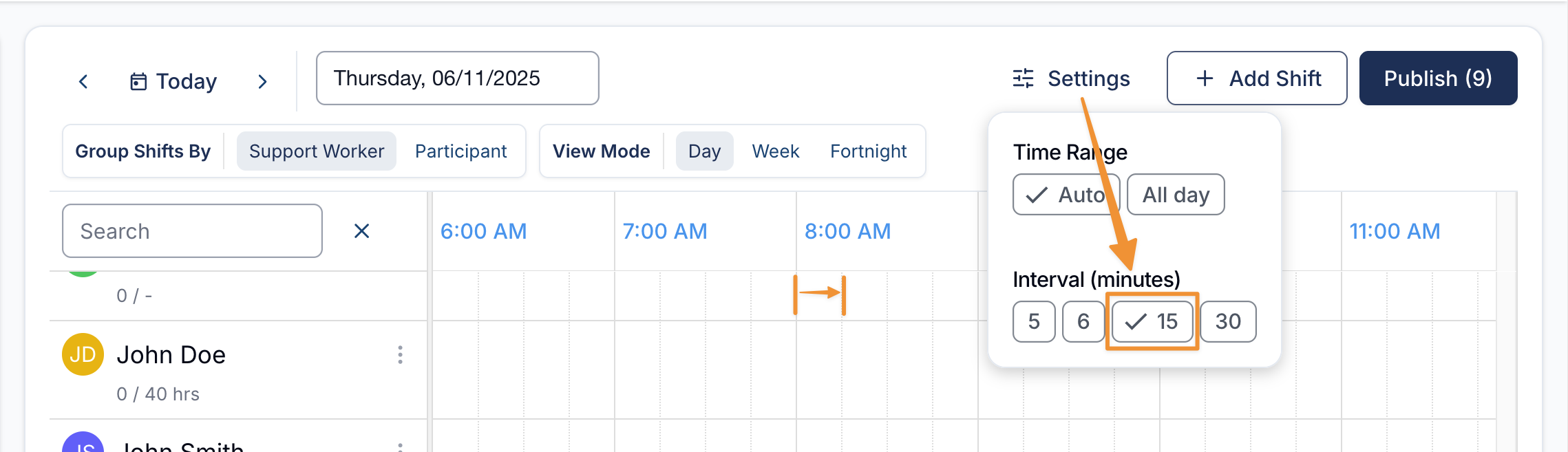
Interval (minutes)
In Day view, the time scale follows the Increments selected in the Schedule settings toolbar.
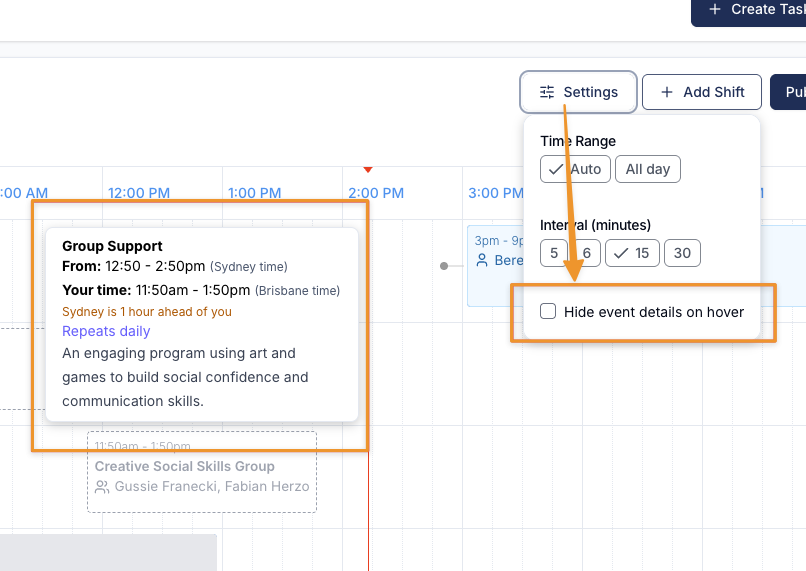
Hide Event Details on Hover
Use the “Hide Event Details on Hover” option, to turn off event descriptions from appearing when hovering over events - this is particularly helpful if you have long event details within your support
Schedule Colours
The settings menu also includes a Schedule Colours button, where you can choose your own colours for schedule events - including status colours that make things like unassigned, cancelled, or broadcasted shifts stand out. See Schedule Colours.
Travel on the Schedule
Supports that include travel are marked on the Schedule, so you can see which shifts carry travel without opening each one. This applies to both 1:1 Direct Supports and Group Supports.
Travel Lines
In Day view, travel appears as a grey line with a dot at the far end. Travel To Support appears before the shift tile and Travel From Support appears after it. The line scales to the travel duration, which makes overlaps with the next shift visible.
Hover over the line to see the leg (Travel to or Travel from), its duration and distance (for example 25min · 9km), and any Details recorded against that Travel item.
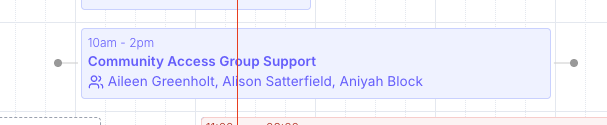
Where travel overlaps another shift on the same row - including that shift's own travel time - the line turns red. This is the warning to space the supports further apart or trim the travel, because the Support Worker can't be in two places at once.
A few things affect whether a line is drawn:
- Travel lines are drawn from the travel duration. A Travel item recorded with kilometres but no duration draws no line.
- Travel Type – During Support is never drawn as a line, because it happens while the support is running rather than before or after it.
- A shift carried over from the previous day has no line at its start, and a shift running into the next day has no line at its end, since the travel falls outside the day you're looking at.
Car Icon
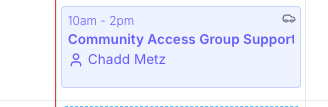
Supports that include travel are also marked with a car icon on the tile, which is what makes travel visible in the Week and Fortnight views where tiles are too narrow to draw a line.
- In Day view, a single car icon sits in the top right of the tile and covers both legs.
- In Week and Fortnight views, Travel To Support shows in the top right and Travel From Support in the bottom right, so you can tell which end of the shift the travel belongs to.
Where the travel has a duration, the total travel minutes appear next to the icon (for example 45m). Hovering the icon gives the same breakdown as the travel line - a row per leg with its duration, distance and Details.
Travel on Group Supports
Group Supports show travel lines and the car icon in the same way as 1:1 supports. Because a group support can carry several Travel items - with different Drivers, and different Participants in each vehicle - what appears on a tile depends on how you've grouped the Schedule:
- Grouped by Support Worker - the tile shows the travel that Support Worker is the Driver on. A worker who isn't driving a particular trip sees no travel against their row, even though the group support has travel on it.
- Grouped by Participant - the tile shows the travel that Participant is travelling on, meaning travel that lists them under Participants in Vehicle. A Participant who isn't in the vehicle for a trip sees no travel on their row. Where a Travel item has no Participants in Vehicle set, it shows against every Participant.
- Grouped by Site - the group support is a single tile however many workers cover it, so only one worker's travel is drawn on it. Group by Support Worker to see every trip against the person driving it.
This keeps travel on the row of the person actually doing it, which matters on the complex arrangements group supports allow - one worker collecting two Participants while another collects a third, for example. For how to set these up, see Travel (to, during and from).
Other Functions
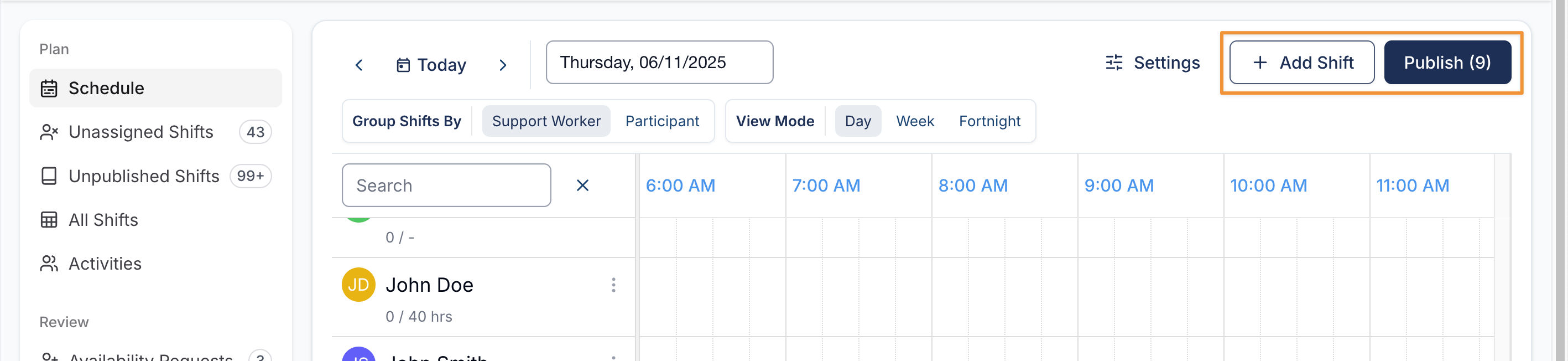
Other functions in the Schedule include Add Shift and Publish.
Add Shift Button
You can add a shift by either selecting the + Add Shift button or by selecting the blank space within the desired day and row of the Participant or Support Worker. For more on this, view our guide on Adding a 1:1 Shift.
Publish Button
To publish all shifts in the current view, use the 'Publish' button in the top right hand corner. For more on this, view our guide on Publishing Shifts.
Drag and Drop Shifts
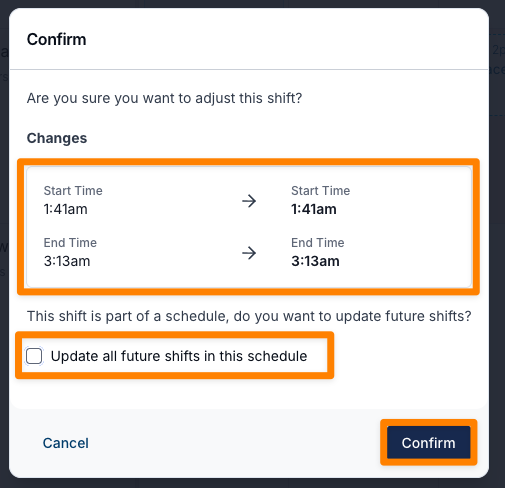
Drag a support to a new time slot to reschedule it. The confirmation shows the old and new start and finish times. For a recurring support, select Update all support times linked to this activity only when the same move should apply to the series. Select Confirm to save the change.
All Shifts View
If you prefer a list rather than a calendar, use the All Shifts sub-menu. This searchable table opens on today's shifts and can be changed to another date range.
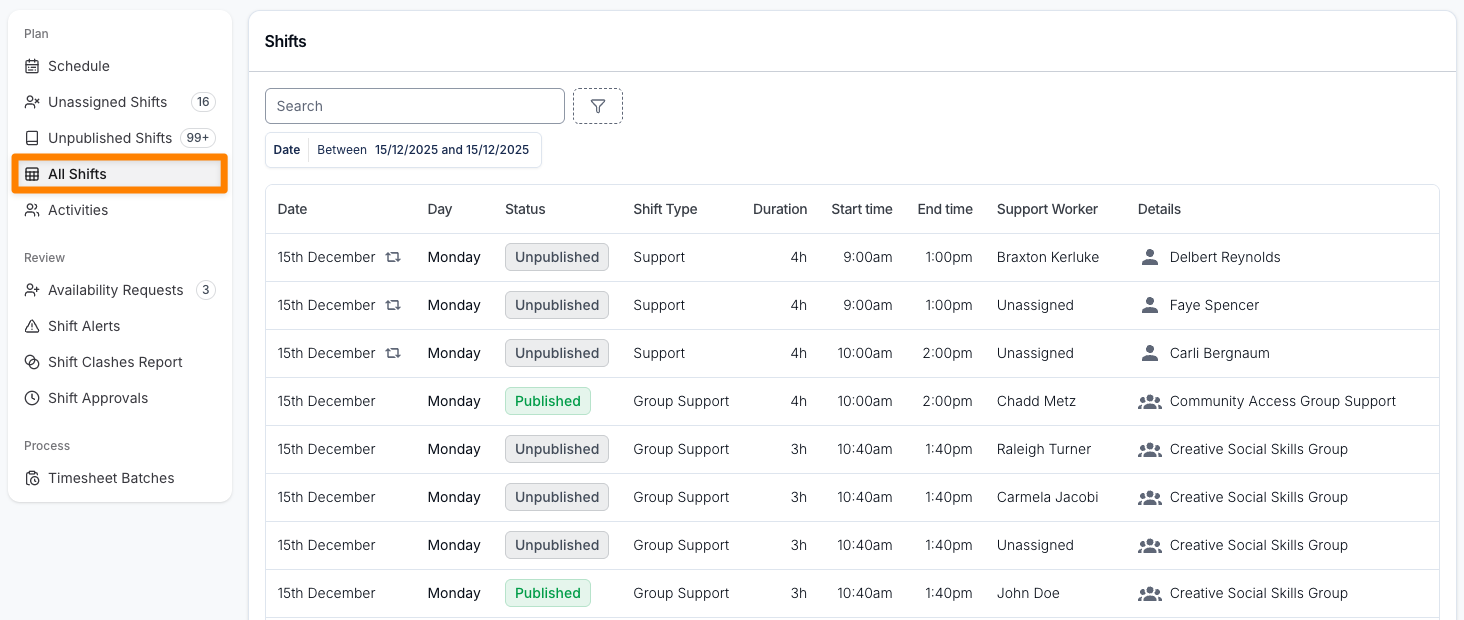
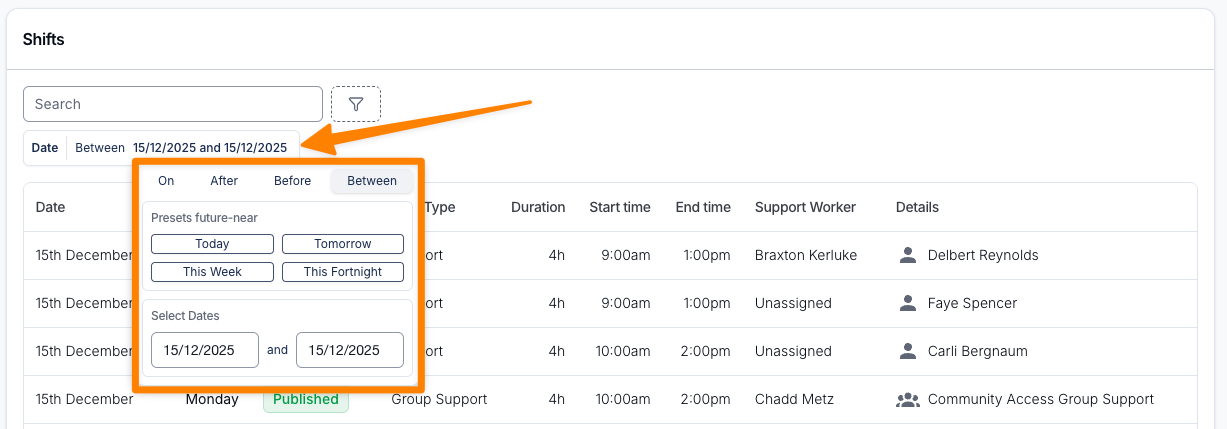
You can narrow your results by clicking on the date filter to add a specific date range or choosing from the preset options:
- Today
- Tomorrow
- This Week
- This Fortnight
You can also filter shifts based on whether they occur On, After, Before, or Between the selected dates.
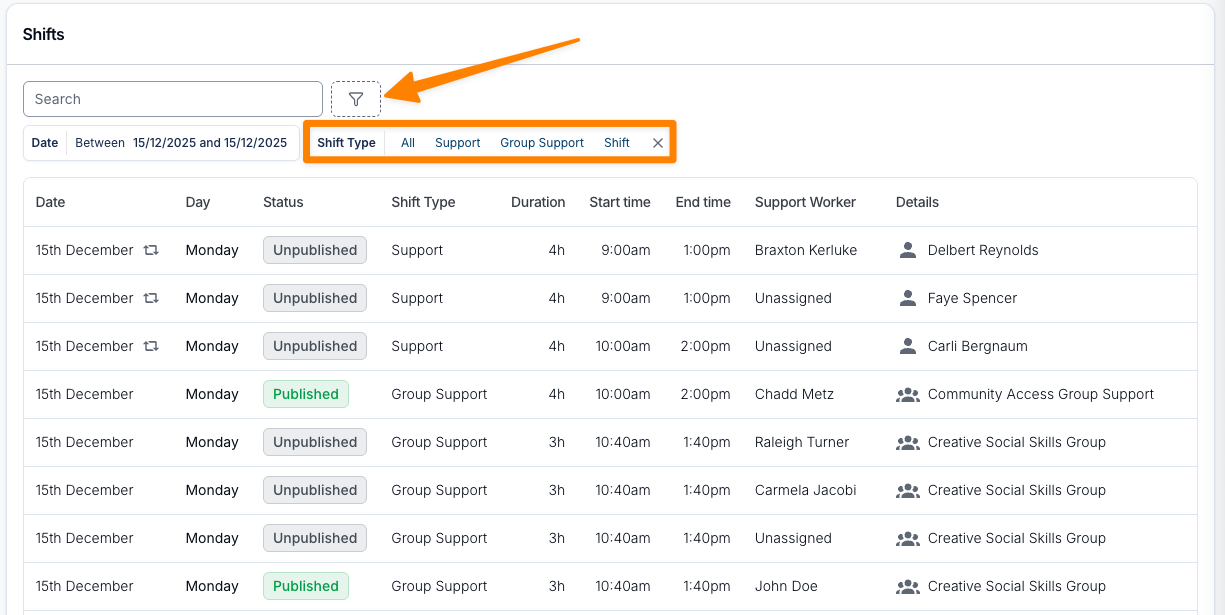
Use Shift Type to show All, Support, Group Support, or Shift events.
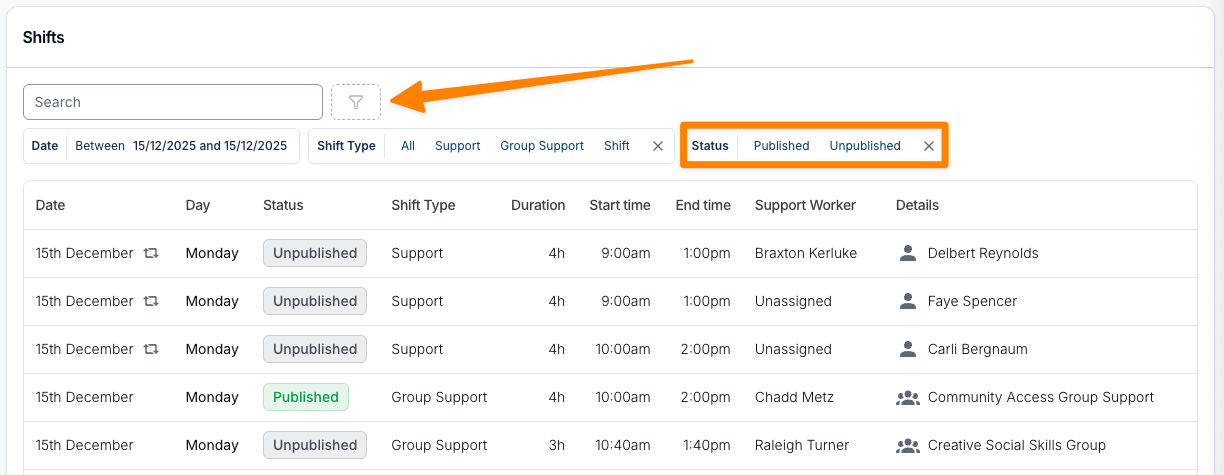
You can also refine the view further to display shifts based on their Status of either Published or Unpublished. Additional filters are available for State, Employment Basis, Team, Region, and Site.
The All Shifts view displays key details for each shift, including:
- Date
- Day
- Status
- Shift Type
- Duration
- Start Time
- End Time
- Support Worker
- Details
The Details column shows the Participant name for direct support sessions, or the Activity name for group supports and shifts. If a support is Recurring, hovering over the recurring icon will display how often it occurs.
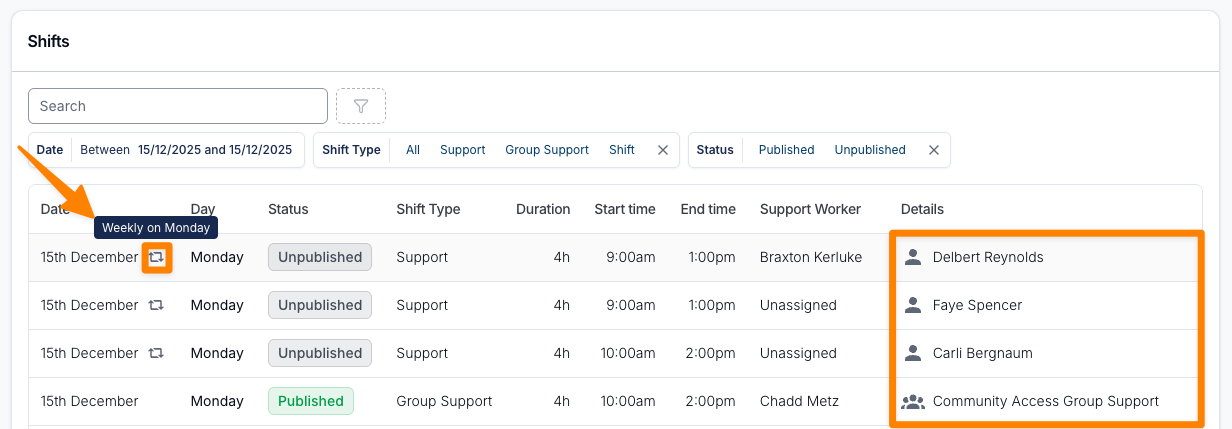
Select anywhere on a row to open the support.
Mini Schedule
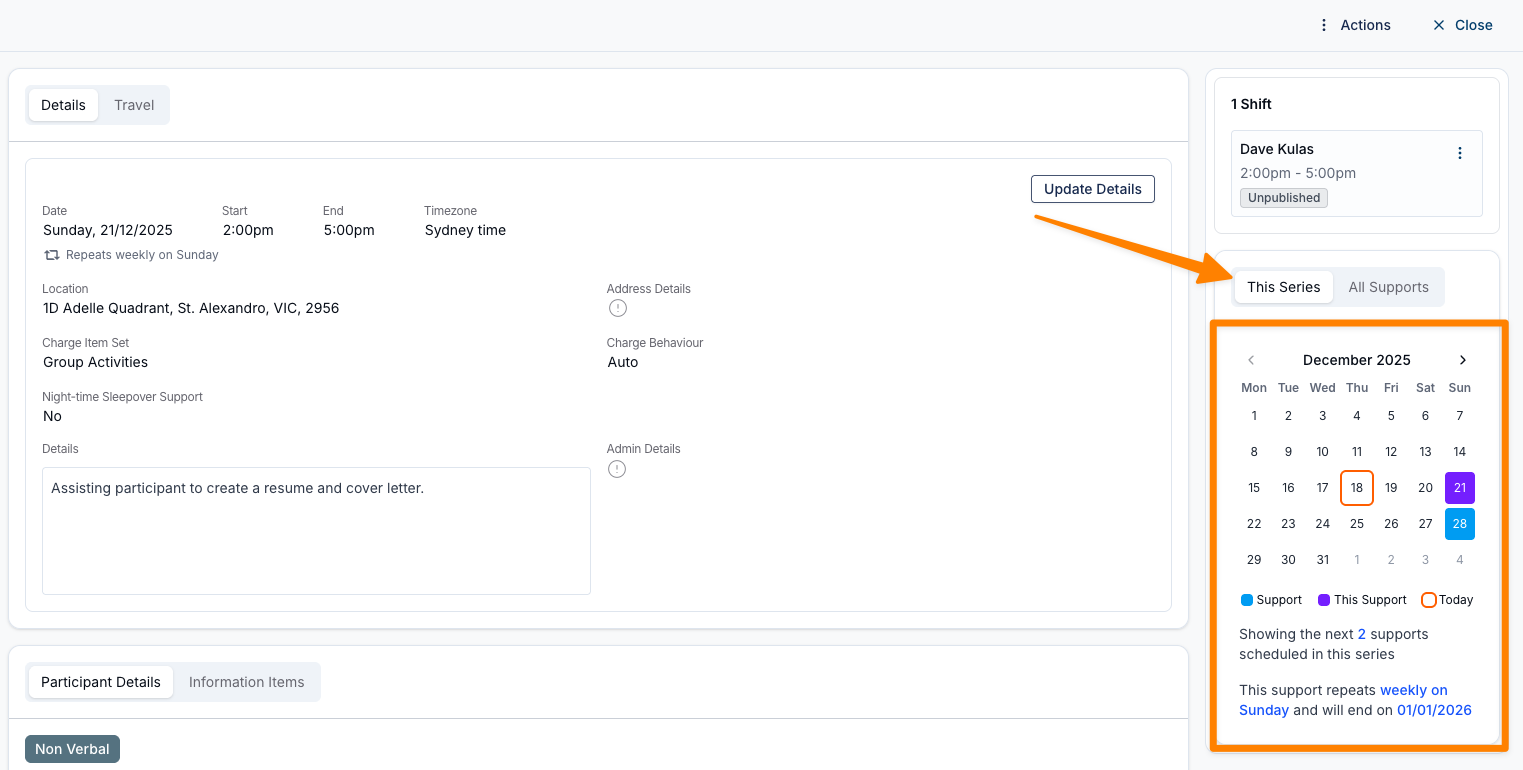
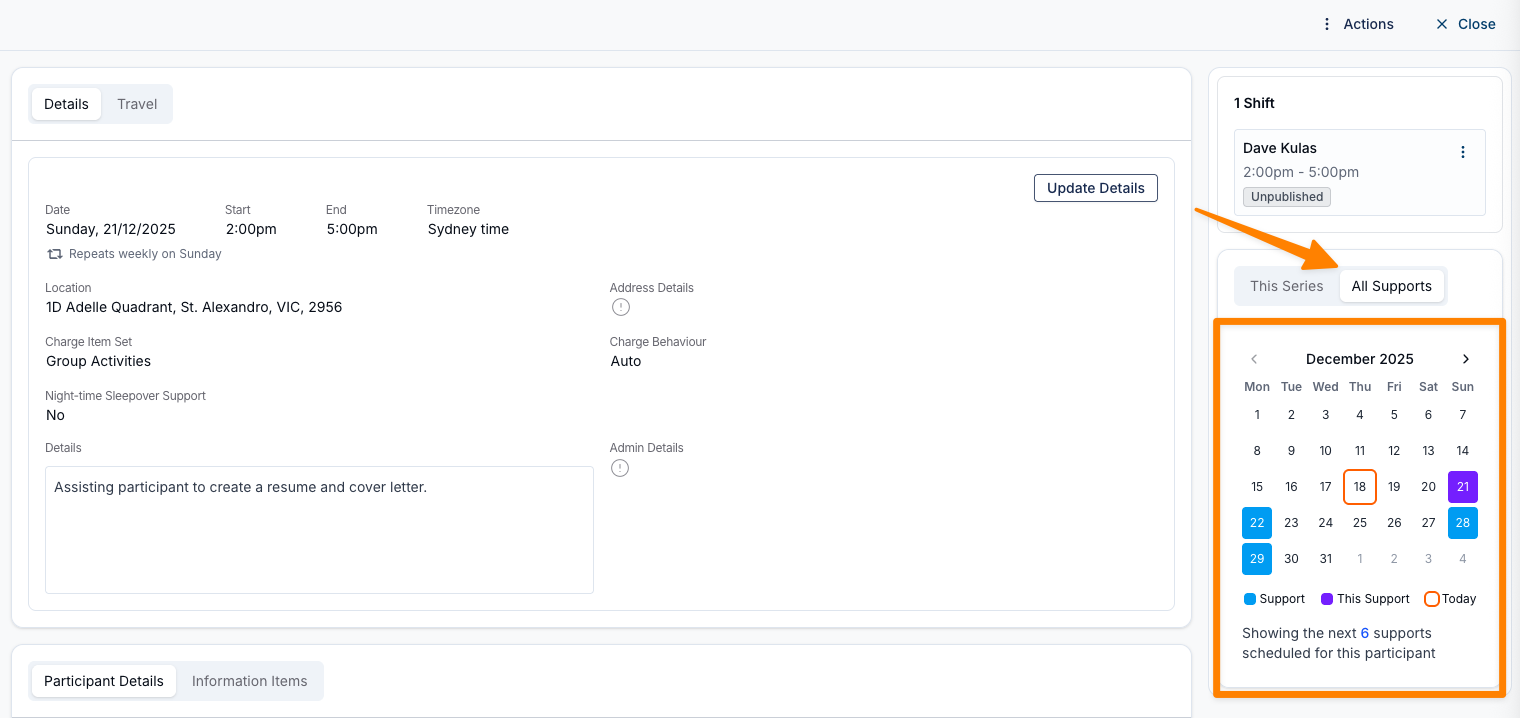
Within each Support, a mini schedule is displayed. For individual supports, the default view is set to This Series. The current date is outlined in orange, the selected support is highlighted in purple, and any upcoming supports for the Participant or Group appear in blue.
The mini schedule also includes a written summary indicating how many supports are shown for the displayed month, along with the support frequency and end date.
You can switch the view to All Supports to display all upcoming support sessions allocated to the Participant when a direct support is selected.
Viewing Unavailability in the Schedule View
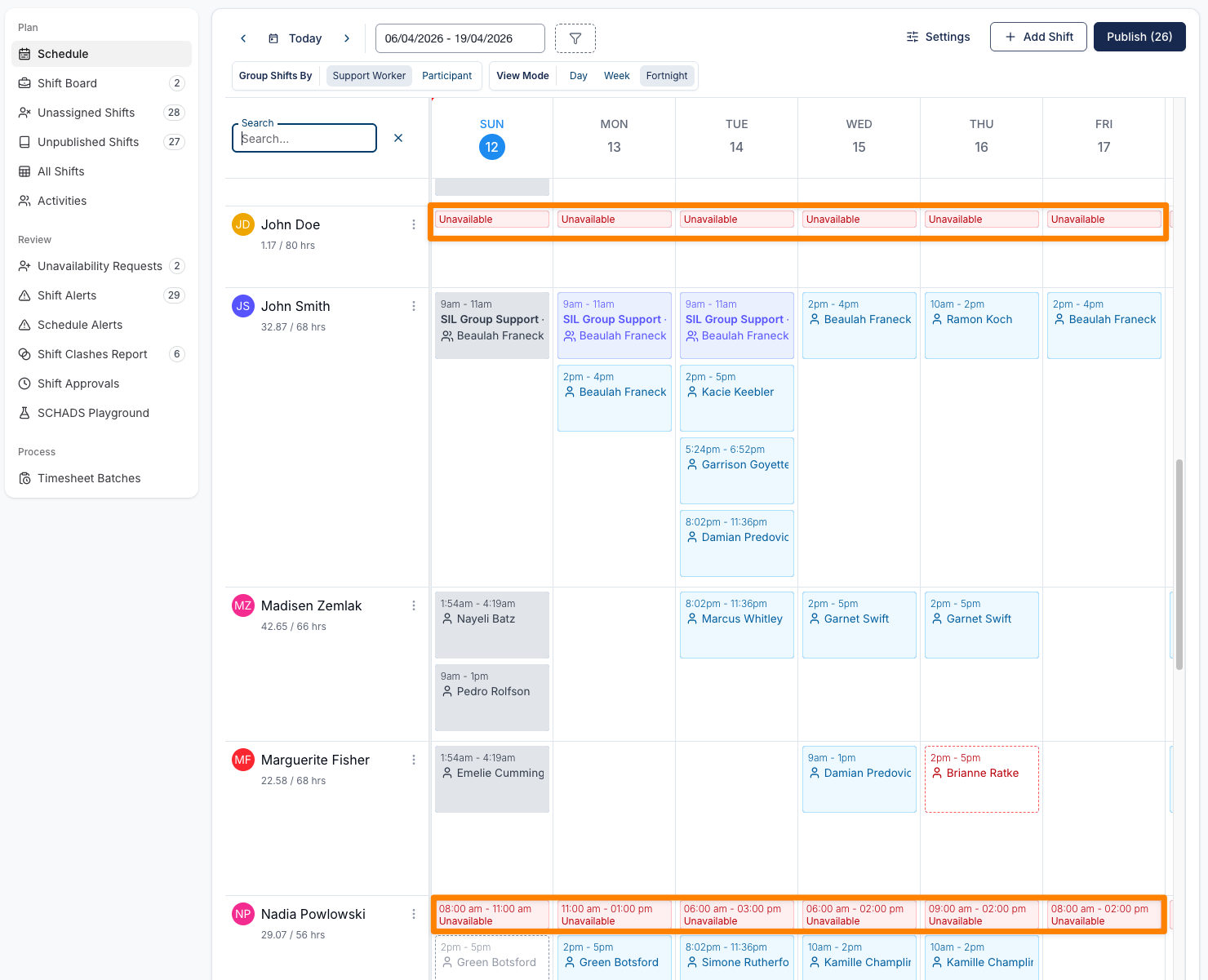
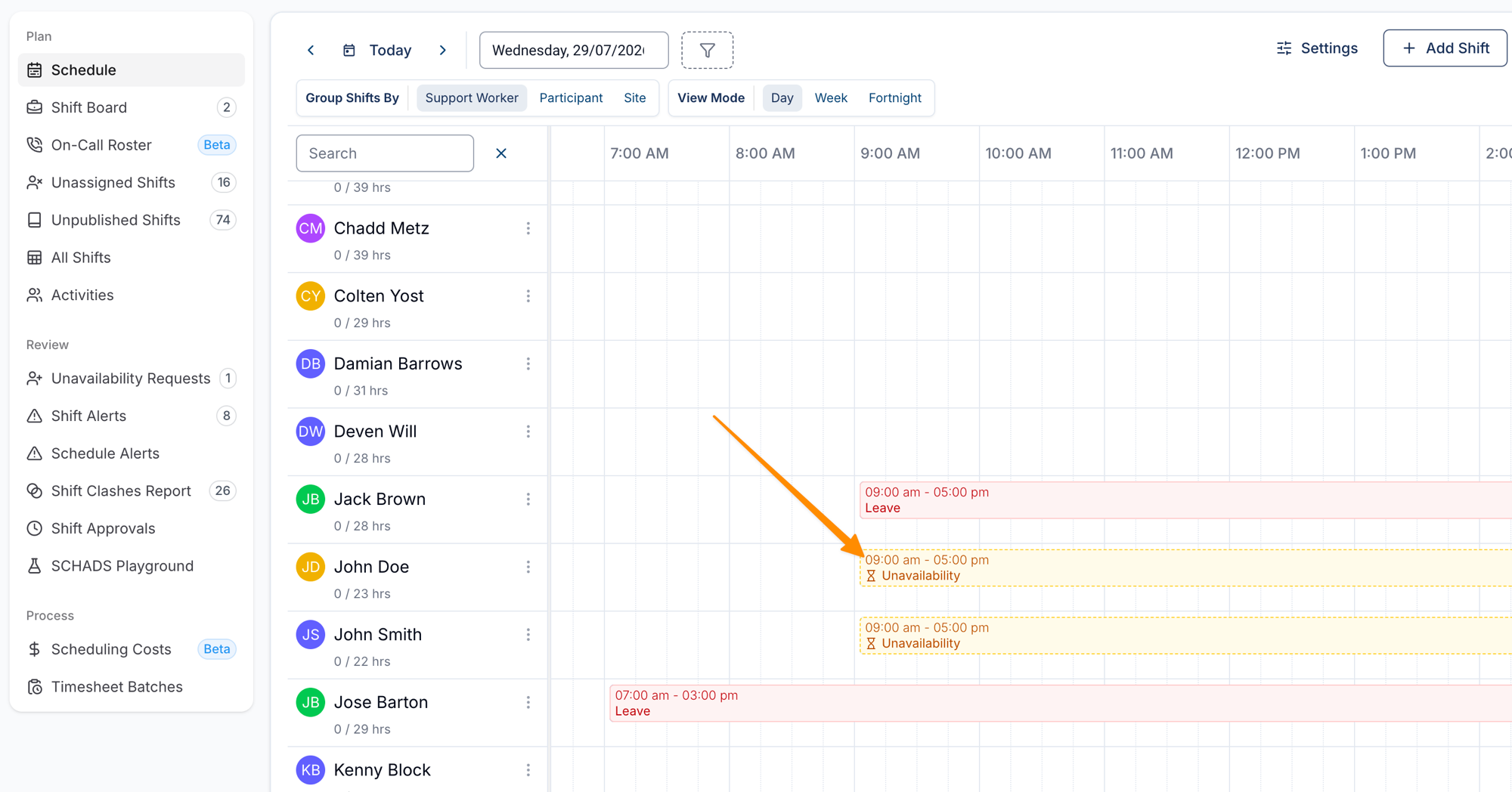
Users can view periods of unavailability directly within the Schedule view, providing greater visibility when planning and allocating supports.
Unavailability set as All day - including each day of a multi-day leave request - is displayed with an Unavailable chip with no time shown, indicating the staff member is unavailable for the entire day. Unavailability set for specific times (such as a few hours) is displayed as an individual tile with those times clearly shown.
Where Unavailability Sits in the Day
Unavailability is ordered by time alongside that day's shifts, so its position relative to rostered work is clear:
- Timed unavailability sits in time order between the shifts before and after it. For example, a 9:00 am to 5:00 pm unavailability follows a shift that ends at 8:24 am and precedes a shift that starts at 9:00 am.
- All-day unavailability stays at the top of the day, above every shift, because it covers the whole day.
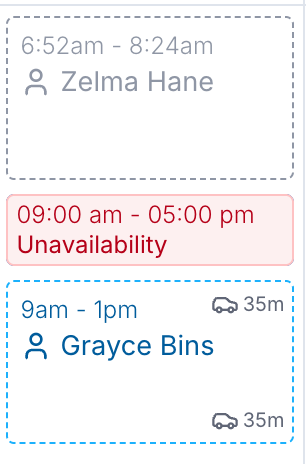
This ordering applies in the Day, Week and Fortnight views, and to both approved and pending requests - whether they are leave or unavailability.
For more information, visit the Managing Availability guide.
Pending Leave & Unavailability on the Schedule
Pending (unapproved) leave and unavailability requests appear directly on the Schedule, so you can see them while planning and allocating supports - without needing to switch across to the Unavailability Requests tab to check what's still awaiting a decision.
Pending requests are styled so they're easy to tell apart from approved leave:
- Approved leave and unavailability appears as a solid, filled block.
- Pending requests appear in a distinct colour with a dashed outline, and are marked with an hourglass icon. Hovering over the request shows a Pending label so the status is clear beyond colour alone.
Reviewing a pending request from the Schedule
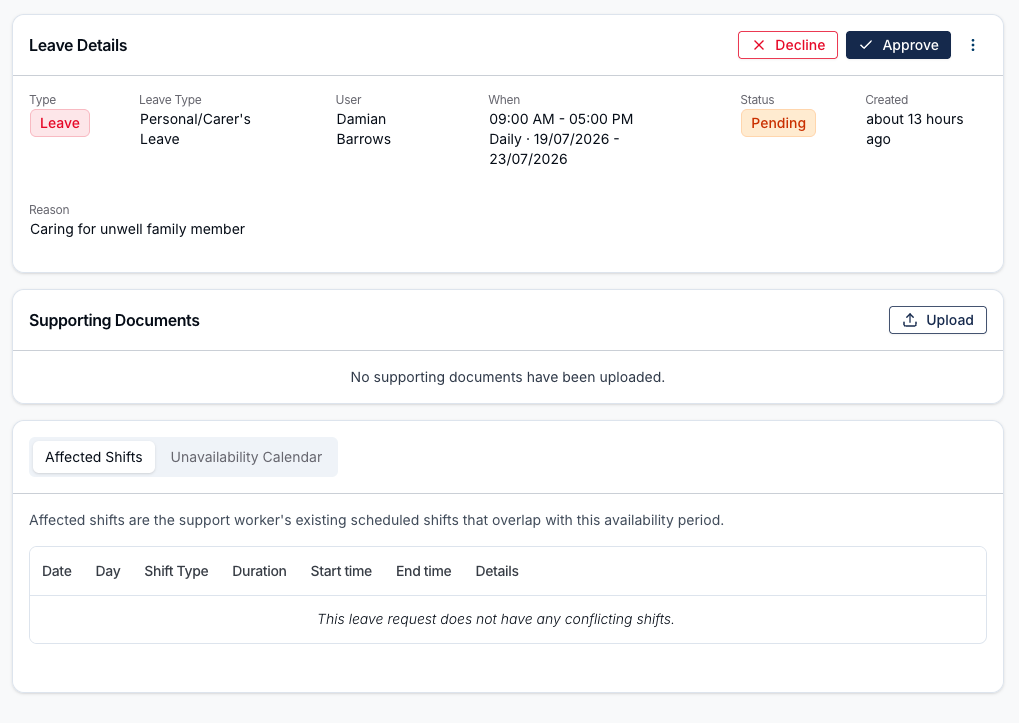
Clicking a pending request opens the full review panel right on the Schedule, so you can action it without leaving the view you're working in. From this panel you can see:
- The request details (type, dates, times, and the reason given).
- The affected shifts - any rosters or Participant supports that may be impacted if the request is approved. You can untick any shift the worker should keep when you approve - see Choosing Which Shifts to Keep.
- For Leave requests, the employee's live leave balances and suggested leave hours pulled from your payroll integration.
You can approve or decline the request on the spot (and edit or delete it where needed). Once actioned, the Schedule refreshes automatically to reflect your decision.
For more information on reviewing and approving requests, visit the Managing Availability guide.