- Administration
- Settings
- Template Settings
Template Settings
Overview
Custom Templates turn your organisation's standard paperwork into reusable Astalty documents. Placeholders fill business, Participant, service agreement or team member details when you generate a document.
By default, only Admins can view and manage templates. User Templates also need the User Document Templates feature and the Can manage HR details for users permission (see Updating Roles and Permissions).
Creation Process
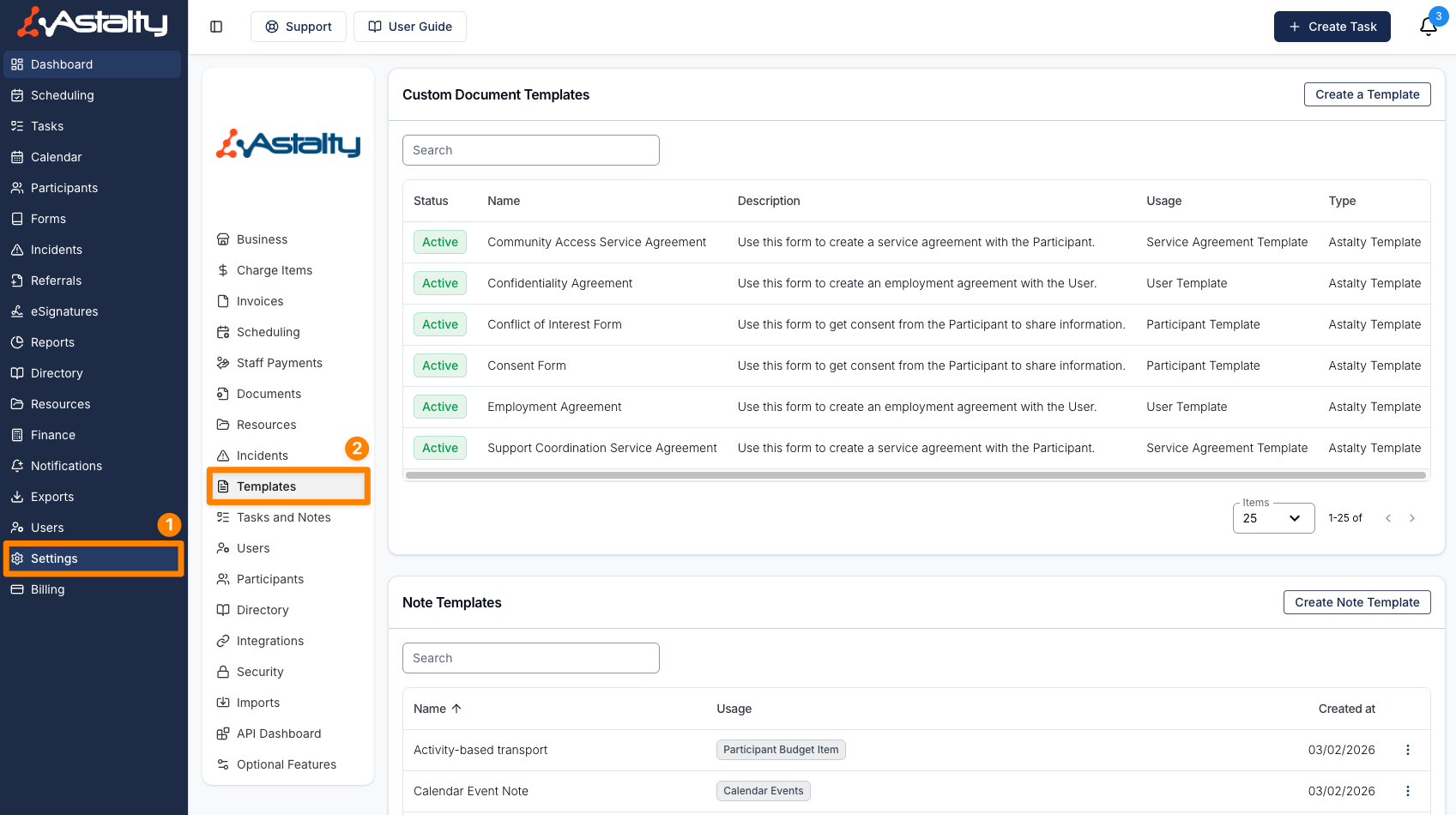
Open Settings > Templates, then select Create a Template.
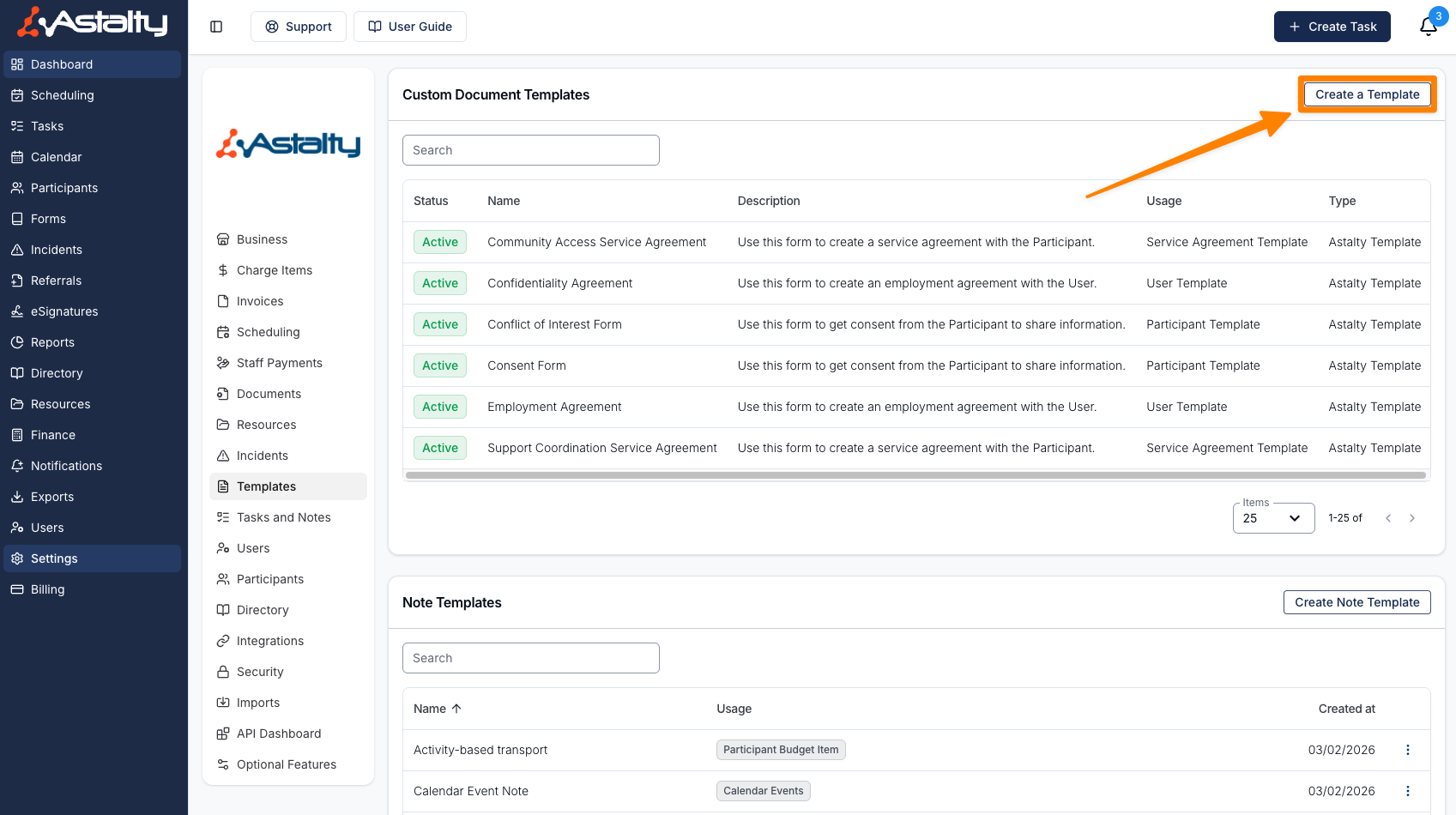
The form opens with a Want a head start? card offering to Browse the library - a set of pre-written templates you can import and then edit as your own, covered in the Document Template Library. Below it, a divider reading or start from scratch below leads into the form described here.
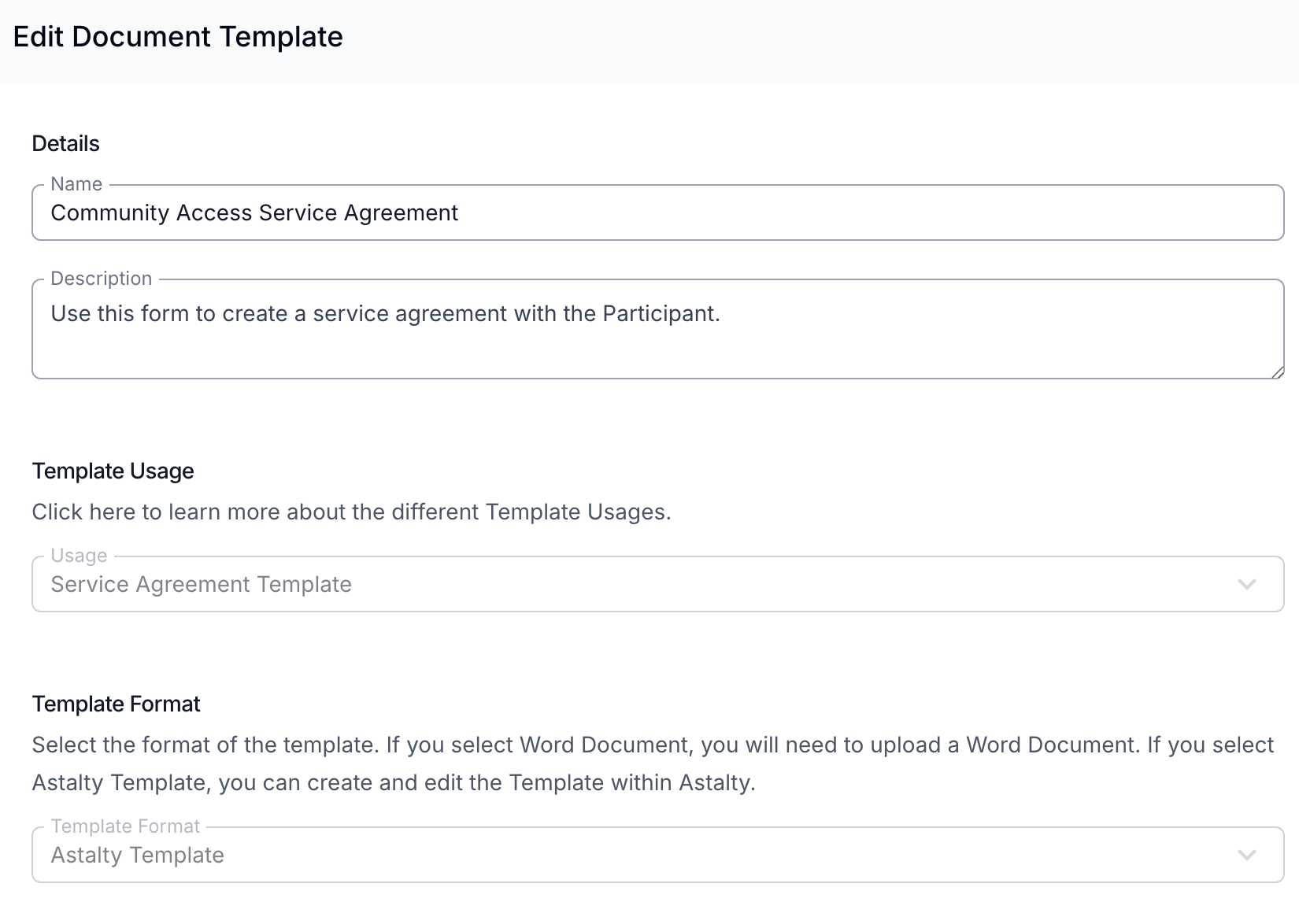
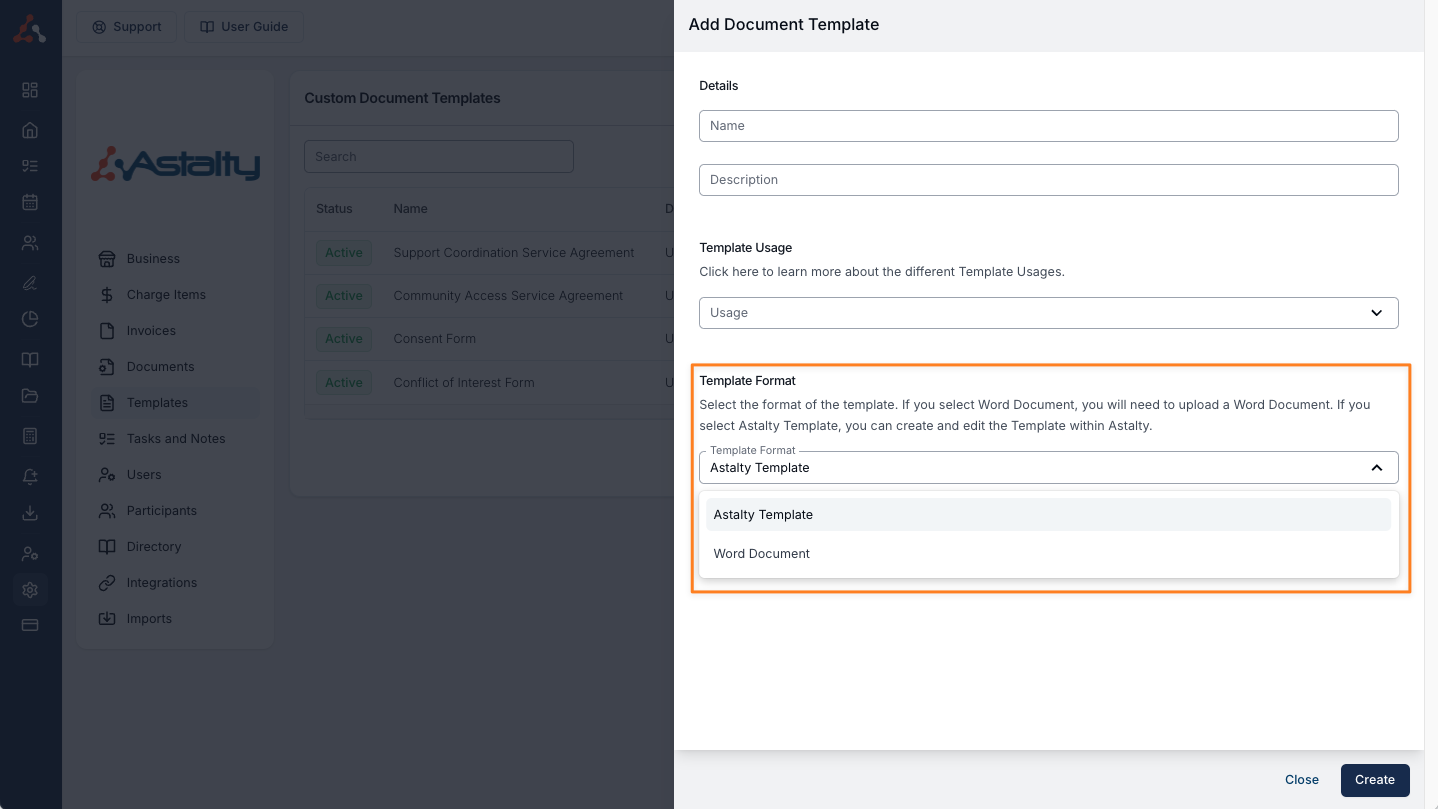
Enter a name and description, choose the usage type, then select an Astalty Template or Word Template.
The same sections appear when you come back to edit the Template later - Details, Template Usage, and Template Format - each covered below.
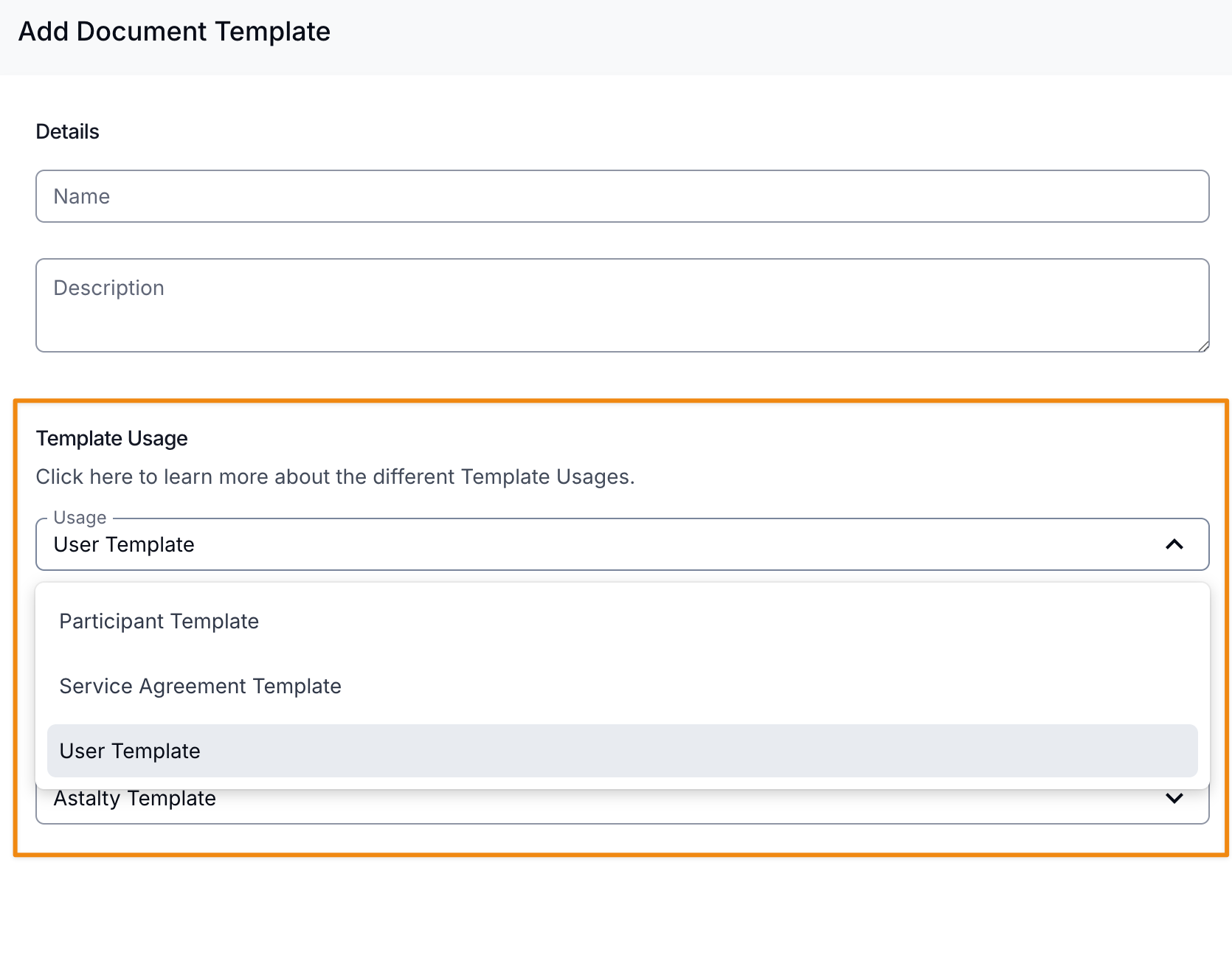
Template Usage Types
The usage type controls which placeholders are available:
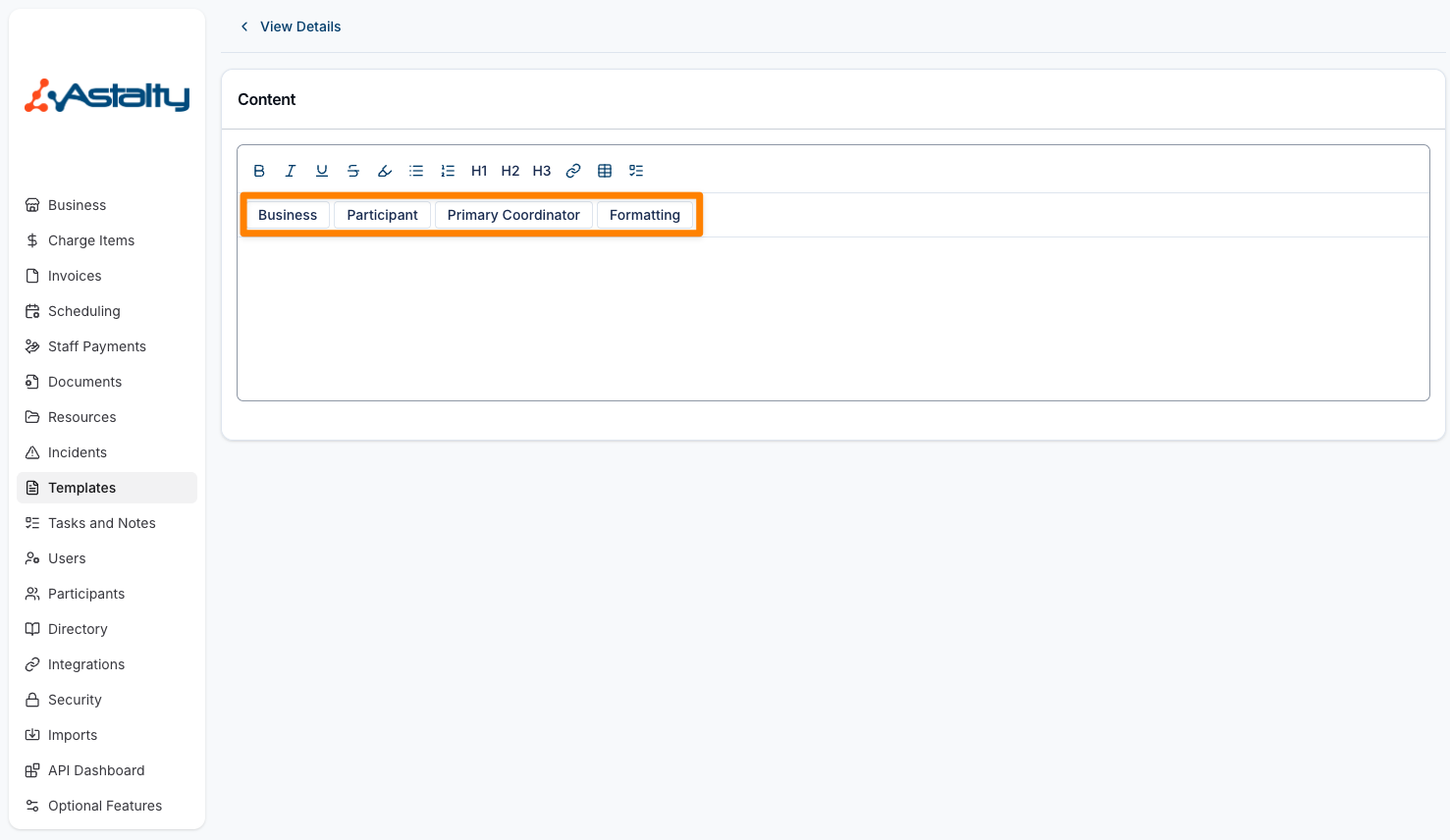
- Participant Template - This Template allows you to use the following placeholder groups;
- Business
- Participant
- Primary Coordinator
- Formatting
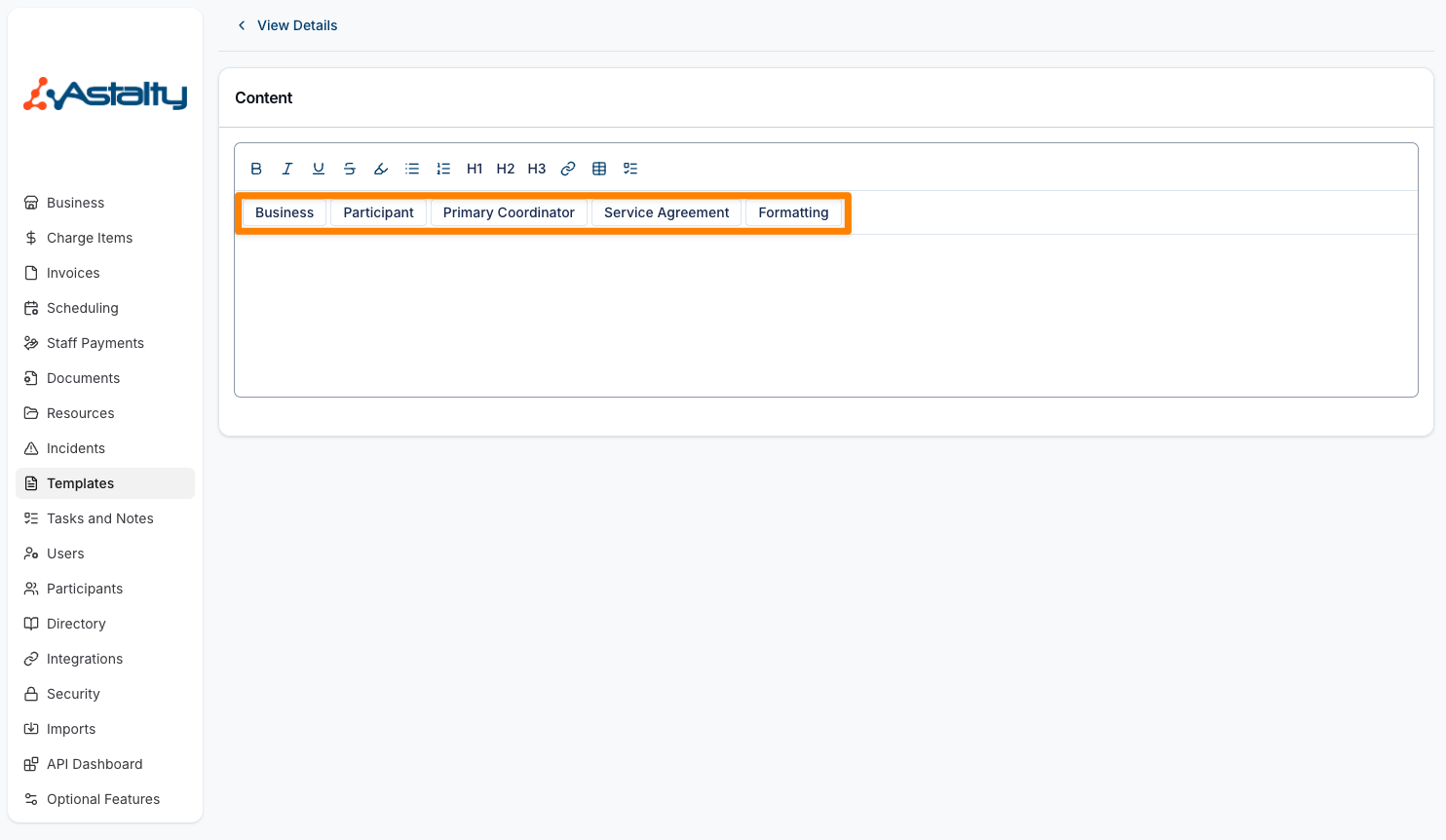
- Service Agreement Template - This Template allows you to use the following placeholder groups;
- Business
- Participant
- Primary Coordinator
- Service Agreement
- Formatting
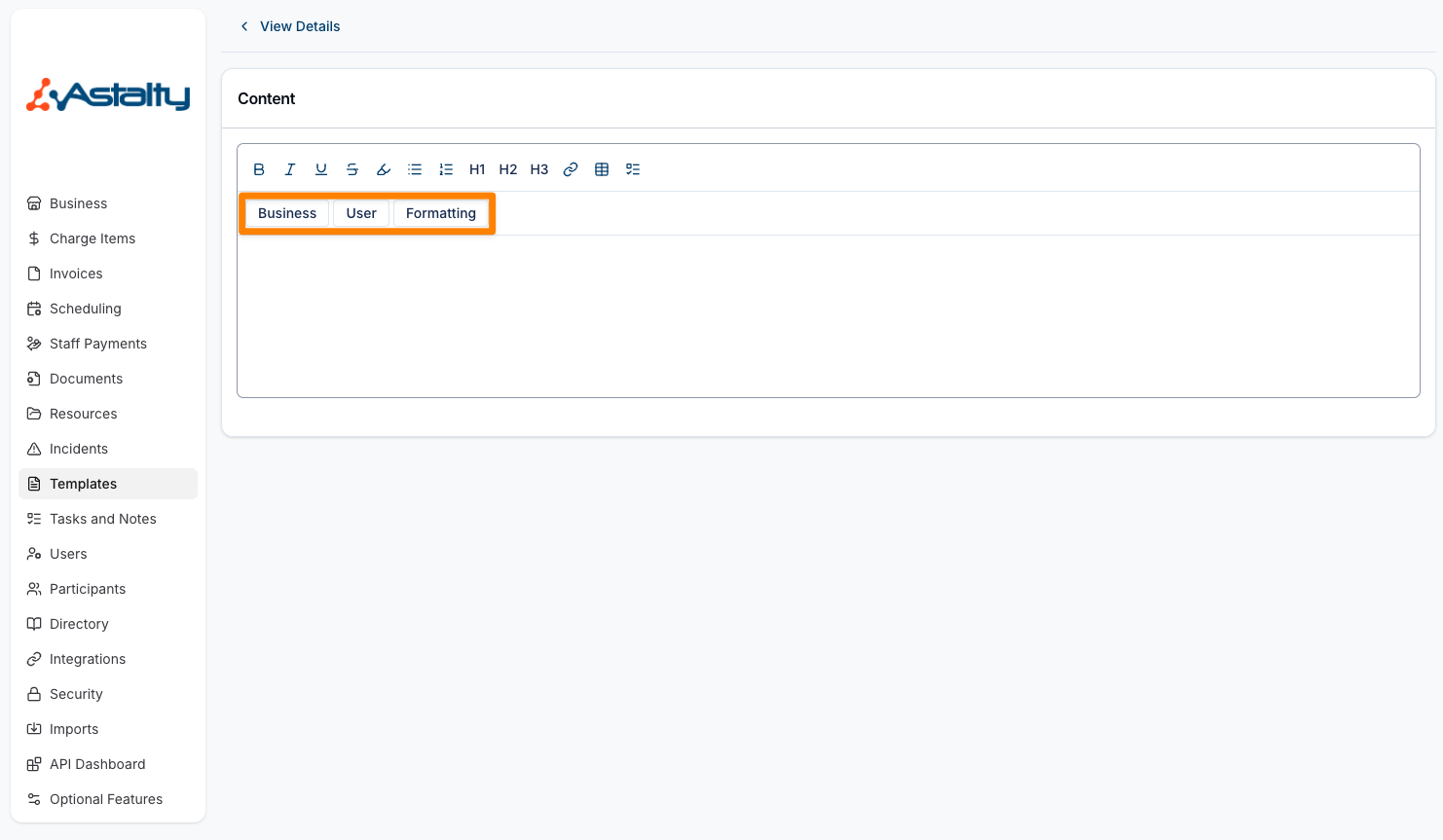
- User Template - This Template allows you to use the following placeholder groups;
- Business
- User
- Formatting
Template Format
Astalty Template Vs Word Template
Choose an Astalty Template to build and edit the content in Astalty with placeholders.
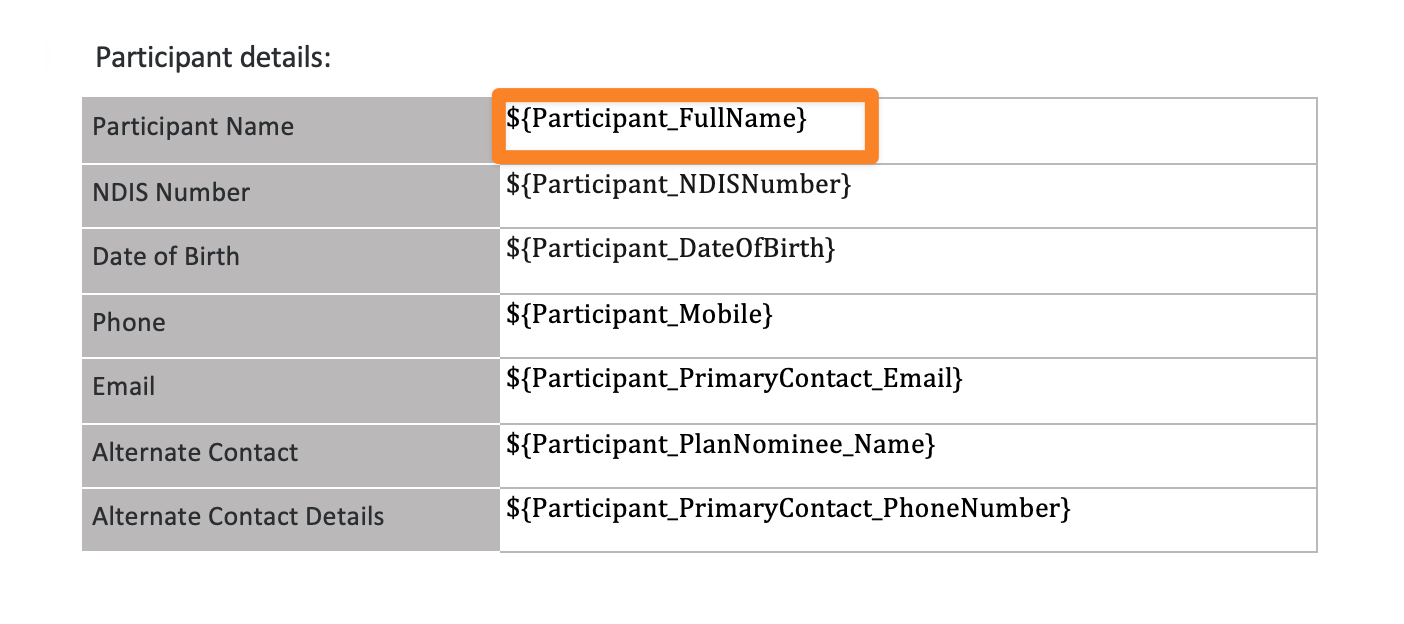
Using a Word Template lets you upload a .docx file whose placeholders are filled when a document is generated. Add the supported placeholders to the Word file before uploading it, because they cannot be inserted from Astalty's editor. Generated Word documents can then be downloaded and completed in Microsoft Word.
For a Word Template, insert the required placeholders in the Word document before uploading it. See Document Template Placeholders.
Content Screen
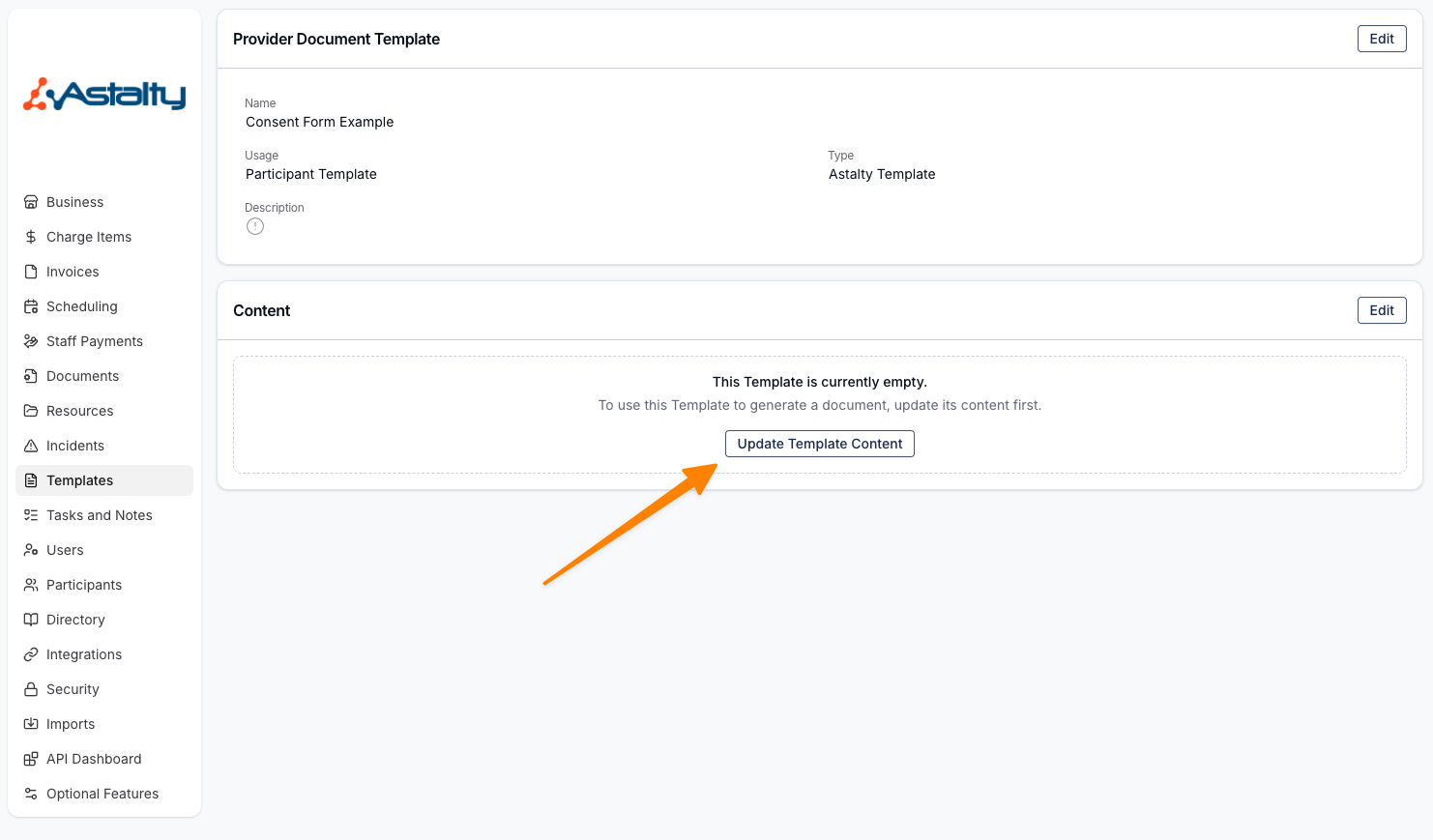
Select Create. For an Astalty Template, select Update Template Content to open the editor.
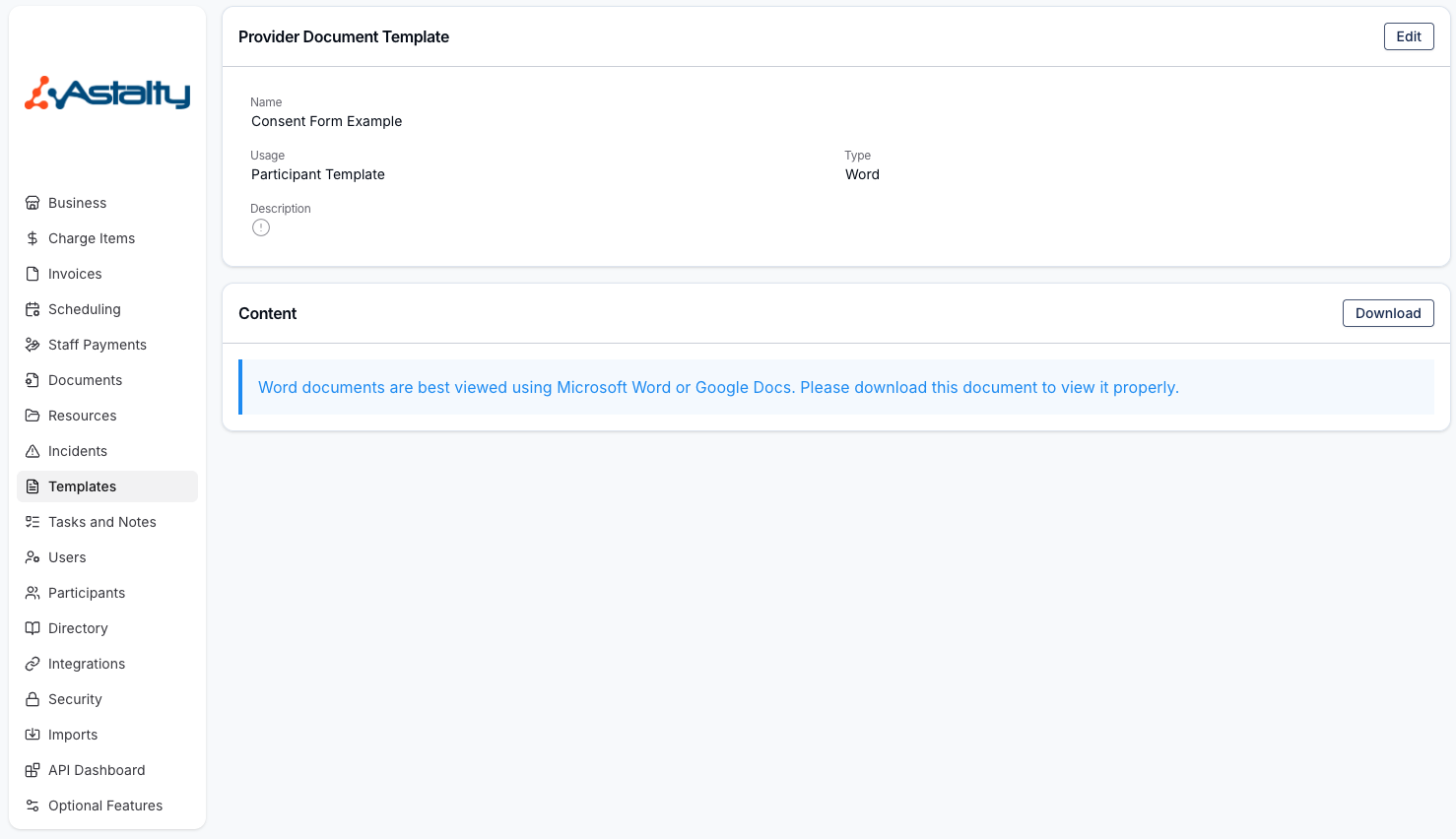
For a Word Template, the content screen lets you download the uploaded Word document.
Document Layout
Astalty Templates print with a front page carrying your logo and the document's title, and can also include a contents page, a repeating header and footer, and page numbers. These options sit in the Front Page, Body, and Header & Footer sections of the template's Edit screen.
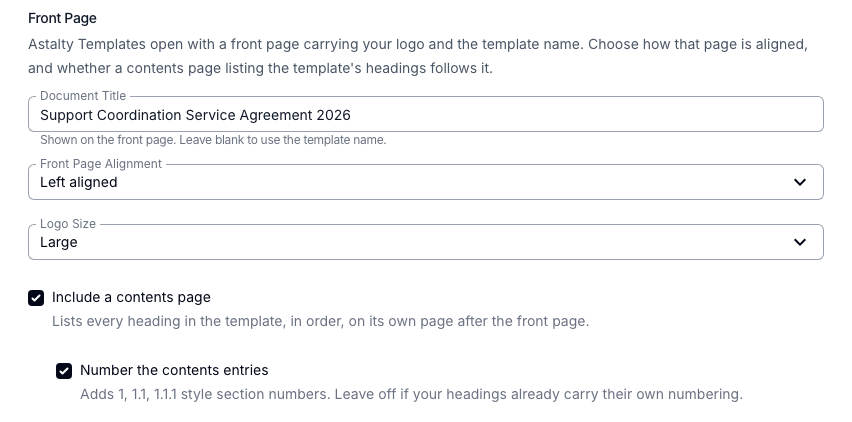
See Document Layout for what each option does, and for how the settings are captured at the moment a document is generated.
Template Content - Placeholders
The editor shows the sections available for the Template's usage type.
Astalty Placeholders and fields that you can enter into your Astalty Template will pull information from within your Astalty Account. Some examples of placeholders include NDIS Number, Participant Name, Primary Coordinator Name, and Schedule of Supports.
See Document Template Placeholders for the full list.
Participant Template
If you selected the Participant Template, this is what you would see.
Service Agreement Template
If you selected the Service Agreement Template, this is what you would see.
User Template
If you selected the User Template, this is what you would see.
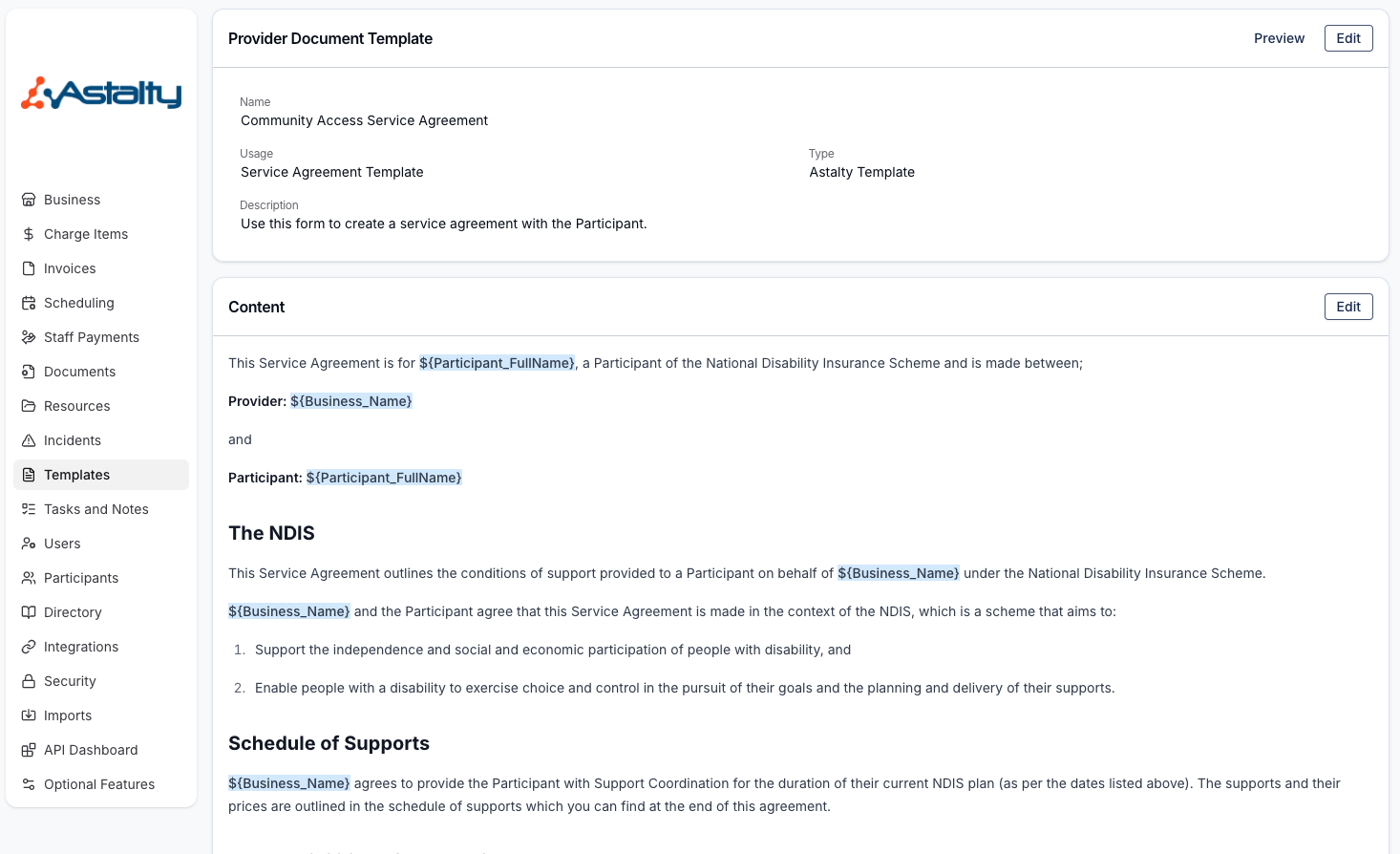
Completed Astalty Custom Template Example
Once you have added your information from any existing organisational documentation or if you created the information from scratch and added it into Astalty, the Template screen would look like this below.
How to edit a Custom Template
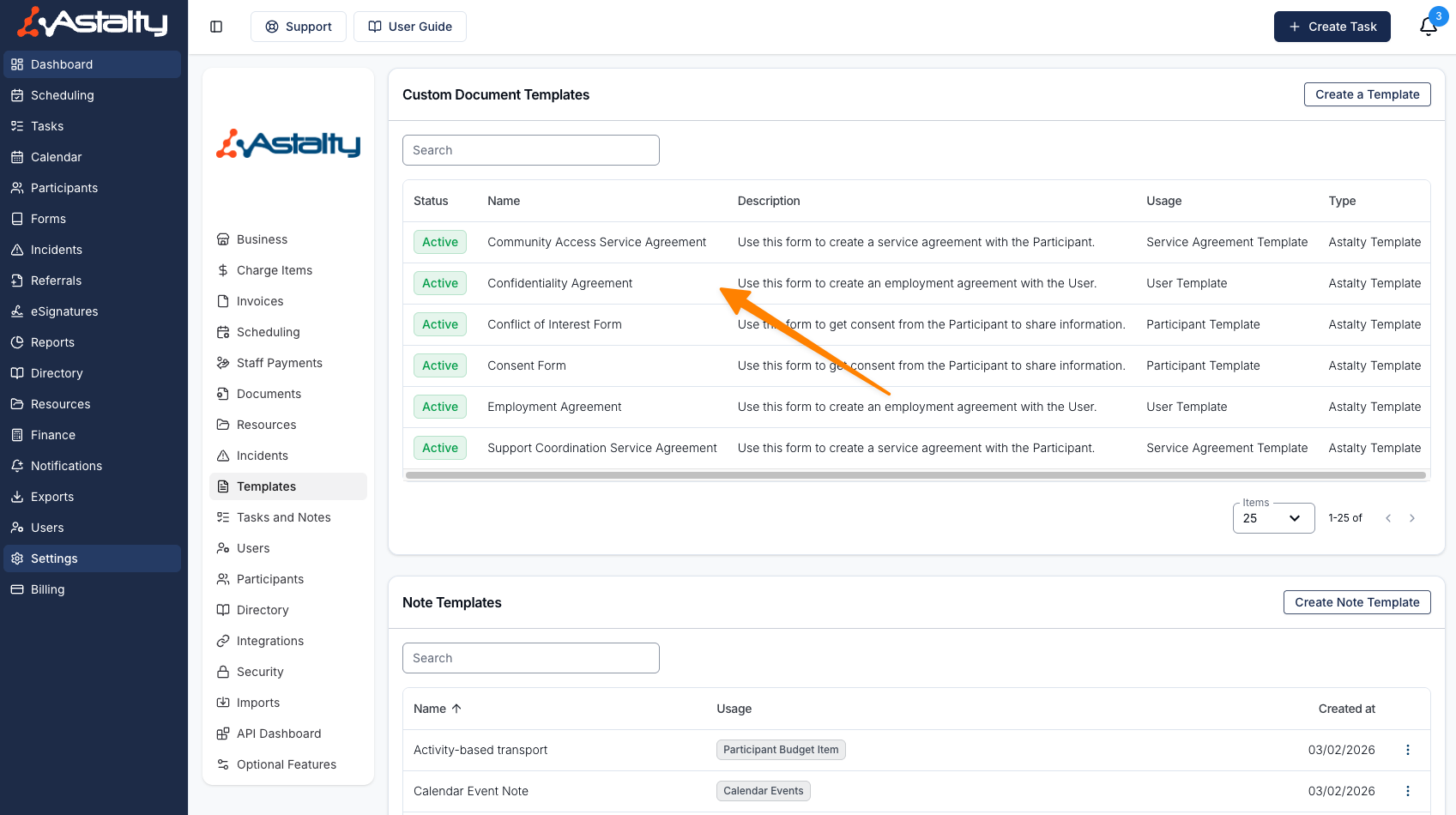
Select an Astalty Template under Settings > Templates to edit it.
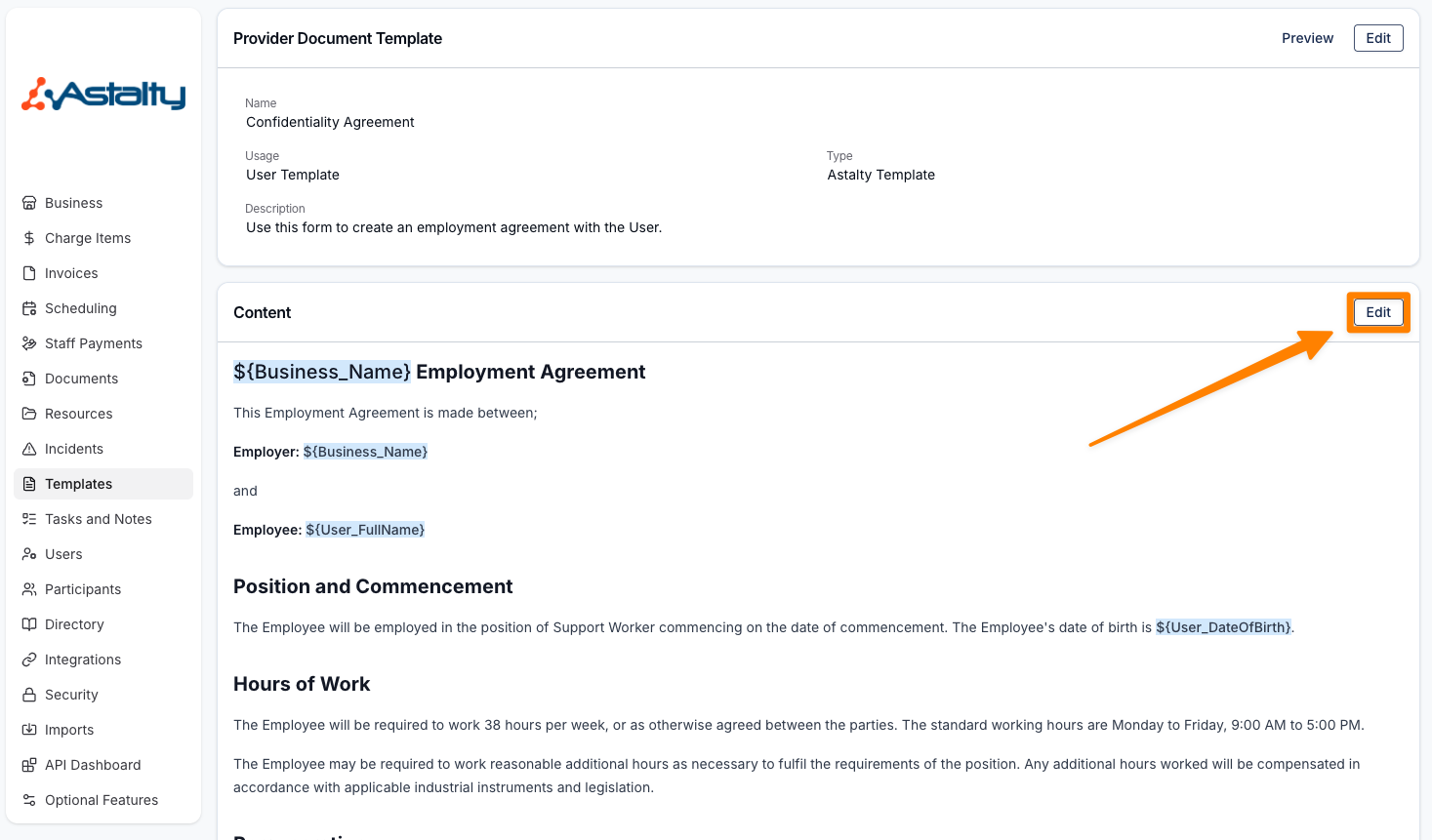
Once within the entry click the Edit option to access the text editor.
For Word Document template types you will need to download the template and edit the document in Word prior to re-uploading with the changes.
Front Page
An Astalty Template opens with a front page carrying your business logo and a title. The Front Page section of the Template form controls what that page says and how it looks, and whether a contents page follows it.
- Open the Template from Template Settings.
- On the Provider Document Template card, select Edit.
- Adjust the settings under Front Page.
- Save your changes.
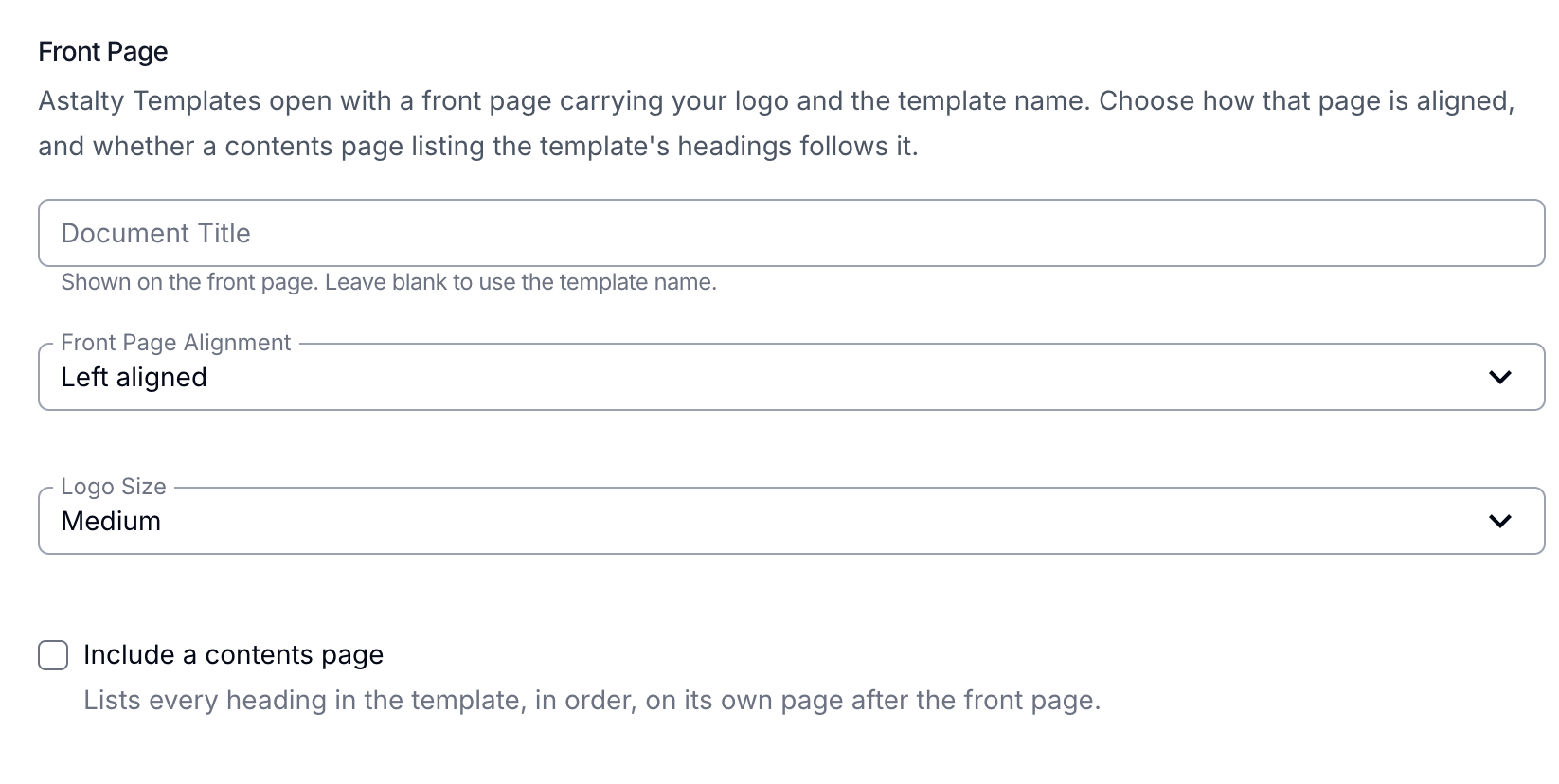
You can set all of these while creating a Template, rather than coming back to edit them afterwards.
Document Title
The title on the front page is the Template's name, unless you give the Template its own Document Title.
Leave Document Title blank to use the Template name on the front page. You can instead use a detailed Template name, such as Community Access Service Agreement 2026, while giving the generated document a shorter title, such as Service Agreement.
Front Page Alignment
Sets where the logo and title sit on the front page:
- Left aligned - the default. The logo and title sit against the left margin.
- Centred - the logo and title are centred across the page.
Logo Size
Controls how large your business logo is printed on the front page - Small, Medium (the default), or Large. If your logo is detailed or includes text alongside the icon, a larger size keeps it legible; a simple mark usually looks better small.
Include a contents page
Tick Include a contents page to add a page listing every heading in the Template, in order, on its own page straight after the front page. It's off by default, and is worth turning on for longer documents such as a full Service Agreement.
The list is built from the headings in your Template content, down to three levels deep, and each entry links to its section in the PDF. A Template with no headings won't produce a contents page even with the setting turned on - so if your contents page comes out missing, check that your content uses headings rather than bold text.
Ticking the box reveals a second option, Number the contents entries, which adds 1, 1.1, 1.1.1 style section numbers to the list. Leave it off if your headings already carry their own numbering, or you'll end up with numbers twice.
Your Front Page settings carry through to every document generated from the Template, the blank PDF you download from the Actions menu, and the on-screen Preview.
Body
Body Text Size sets how large the Template's own content is printed in the generated document - Small (the default), Medium, or Large. Bumping it up is an easy way to make a document easier to read for a Participant who prefers larger print, without editing the Template content itself.
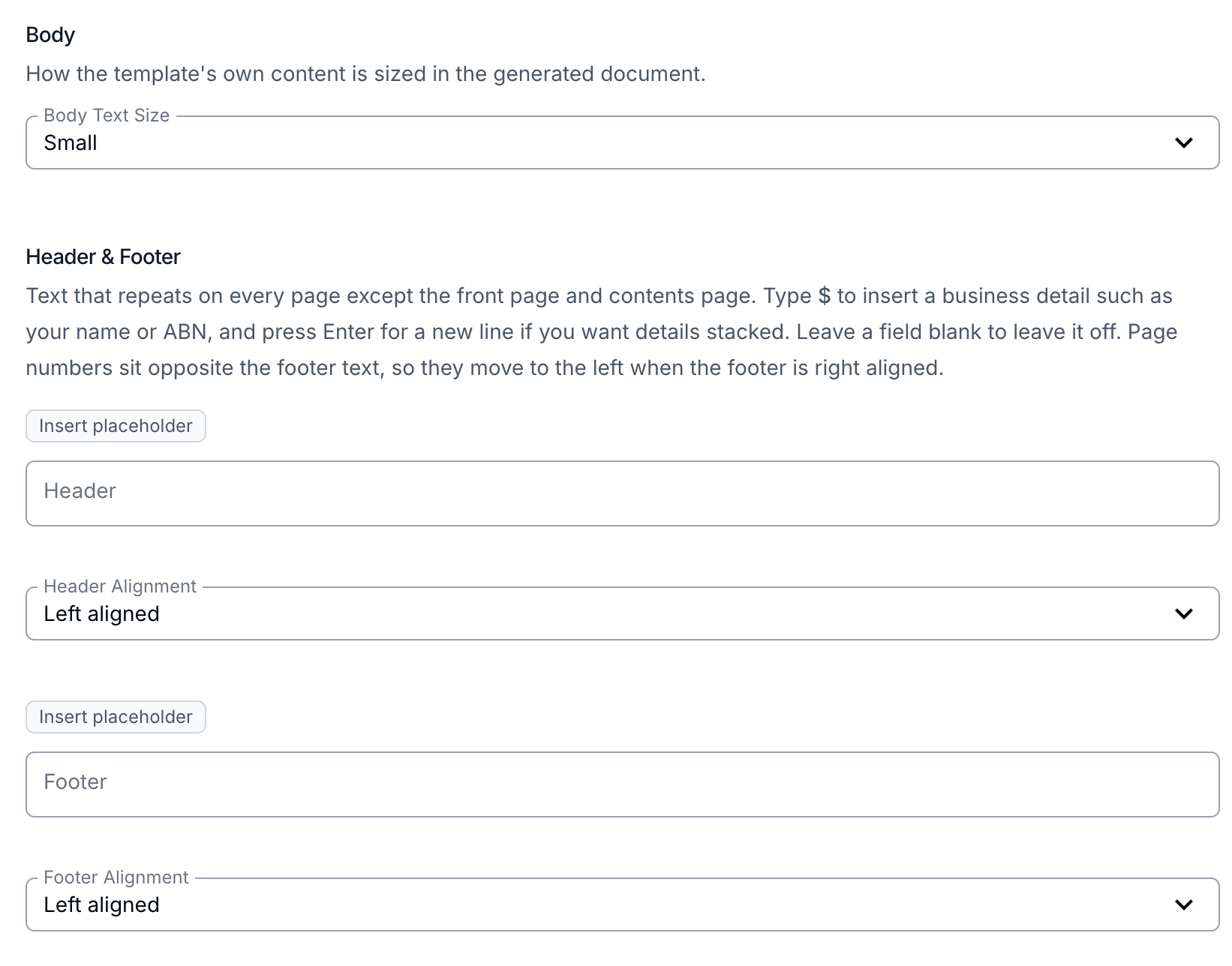
Header and Footer
The Header & Footer section adds text that repeats on every page of the generated document. Type into Header, Footer, or both, and leave a field blank to leave it off entirely.
- Header Alignment and Footer Alignment each offer Left aligned, Centred, or Right aligned.
- Press Enter for a new line if you want details stacked over several lines.
To include a business detail such as your business name or ABN, either select Insert placeholder above the field and pick from the list, or type $ in the field itself to bring up the same list. Either way the detail fills in automatically when the document is generated, so it stays right if your business details change later.
Page numbers are always printed in the footer as Page 1 of 4, and they sit opposite your footer text - so they move to the left when the footer is right aligned. With no footer text, the page number sits on the right on its own.
Preview or Download a Blank Template
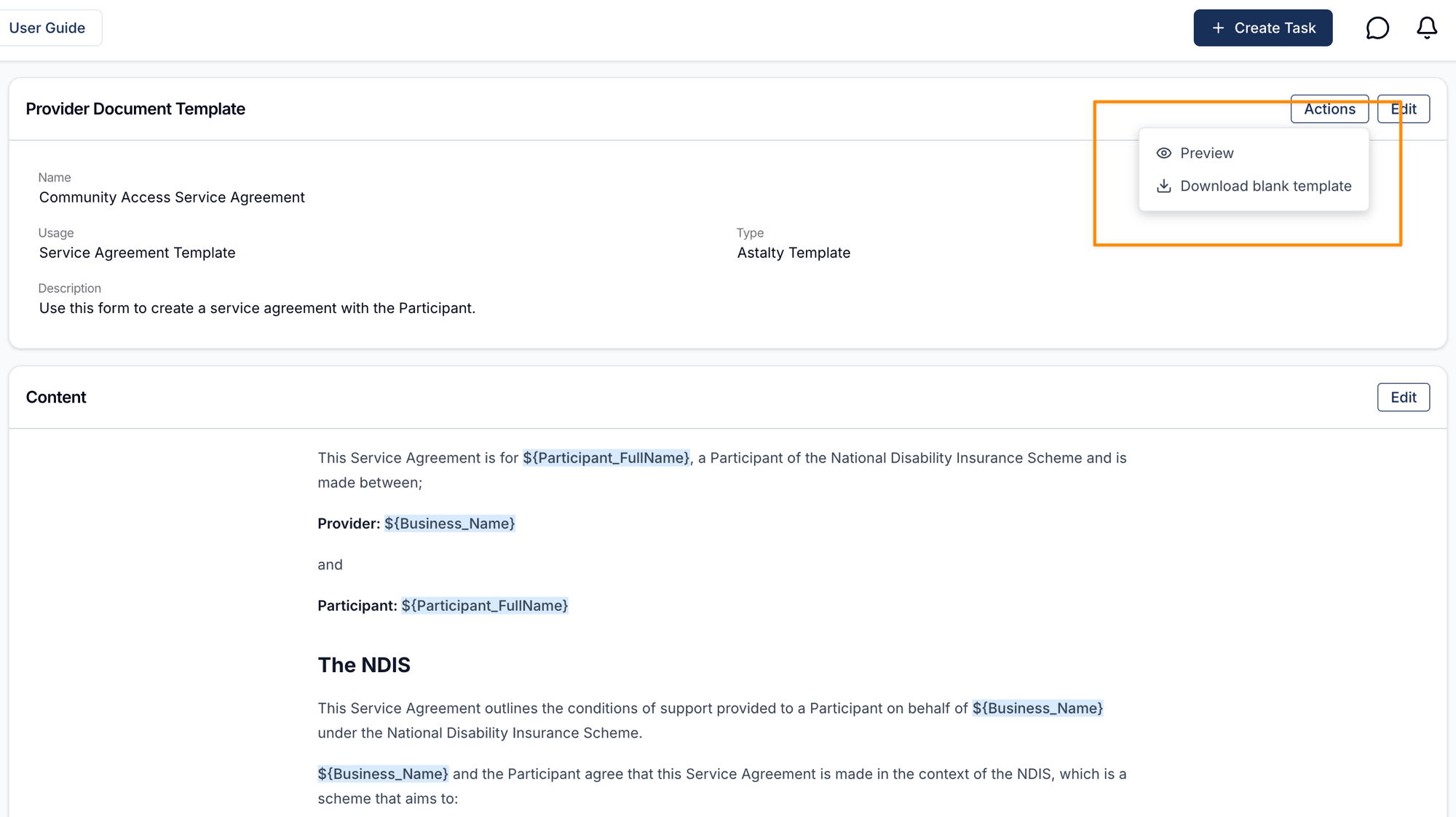
When viewing an Astalty Template, the Actions menu in the top right gives you two ways to check a template before you generate it for anyone:
- Preview - opens a quick on-screen preview of the template's layout.
- Download blank template - downloads an empty PDF of the template without selecting a Participant.
The blank PDF keeps the template's wording, headings, and page breaks, but leaves every Placeholder unfilled - each one is shown as a plain label in square brackets (for example [Participant Full Name] or [Business Name]) instead of being replaced with a Participant's details.
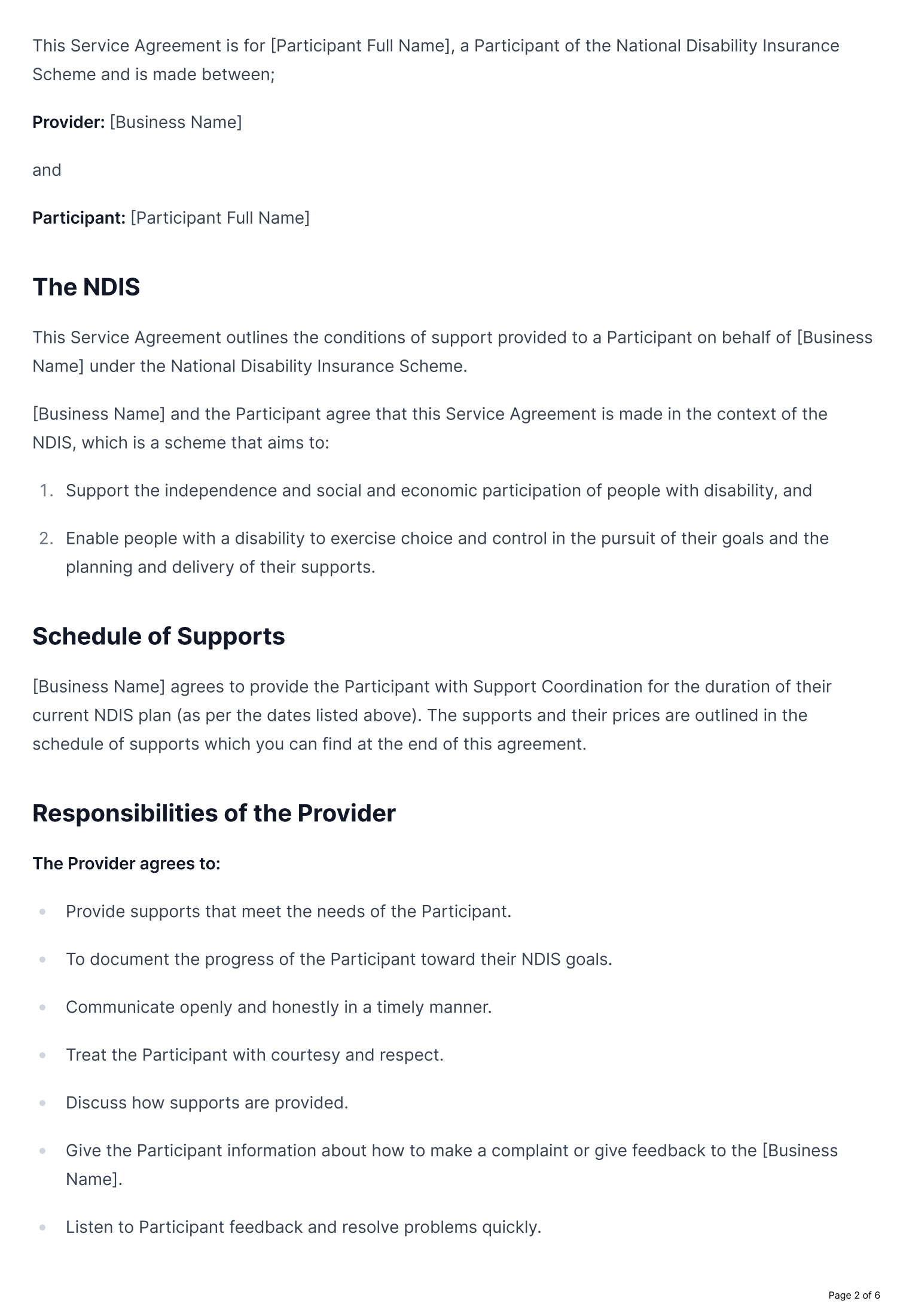
This is handy for previewing a template's structure, or for producing a paper copy to print and fill in by hand - no Participant required.
How to Generate a Custom Template
To generate a Custom Template:
- Participants - open the Participant profile and select Templates. See Participant Templates.
- Users - open the user profile and select Templates. See User Templates.
Once in these menus you will see the Custom Templates uploaded to your Astalty account where you will be able to Generate and complete the documents.