Form Settings
Overview
Use Settings to update the form's appearance, status, notifications, confirmation behavior, and access.

Form Details
Edit the form's name, status, description, background colour, and submit button text and colour.

Changing a published form to Unpublished puts its outstanding submission requests On Hold. Recipients cannot open or submit those requests and reminders stop. The requests are not cancelled, so publishing the form again makes them fillable.
Archive the form from this section when it is no longer needed. Archiving cancels outstanding submission requests. A register form is also moved to the Archived tab in Registers, while its entries are kept.

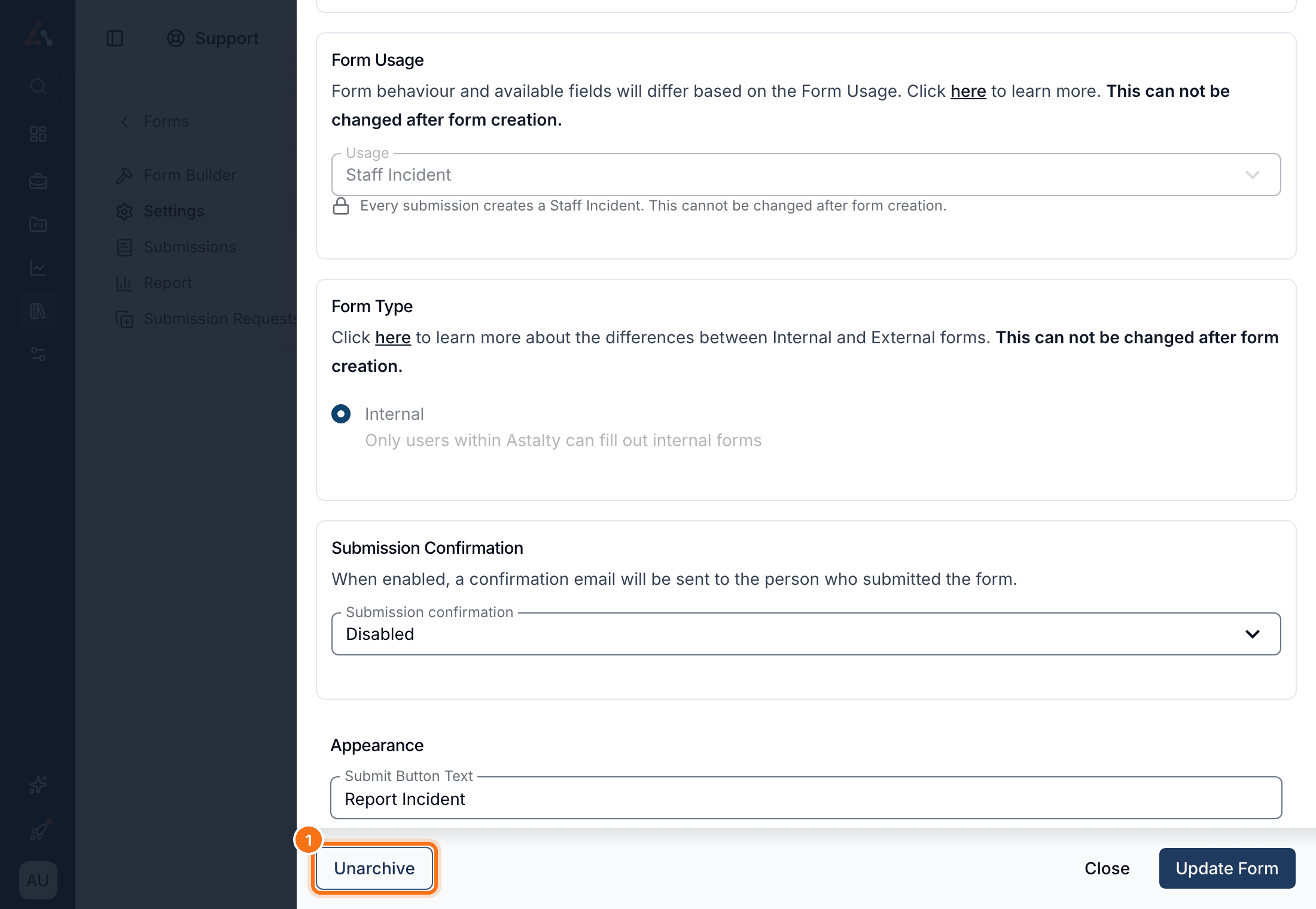
You can unarchive a form from the same section. An unarchived form remains unpublished until you publish it.
Embedded Form
If you embed an External form on your own website, you can choose whether the form's name appears above it. This is handy when your web page already has its own heading and you don't want the form's title to show twice.
In the Embedded Form section, choose one of the following options:
- Show form name (default) - the form's name is displayed above the embedded form.
- Hide form name - the form's name is hidden so your own page heading can show instead.

Notifications
General and Register forms can have per-form notifications with their own message, delivery method, and recipients.

Participant Incident and Staff Incident forms use the shared Incident Notifications settings. Referral and Feedback forms use their corresponding shared notification settings. Astalty shows a link to the relevant Notifications page when you have access to it.
If you duplicate a form, its per-form notifications are copied to the new form with their messages, recipients, and delivery methods.
Submission Message
This option allows you to customise the submission message displayed when a form is submitted.

Submission Confirmation
The submission message only appears on screen at the moment the form is submitted. If you'd also like the person who filled out the form to receive something in writing, use Submission Confirmation to email them a confirmation that their submission was received.
In the Submission Confirmation section, choose one of the following options:
- Disabled (default) - no confirmation email is sent.
- Email - a confirmation email is sent to the person who submitted the form.
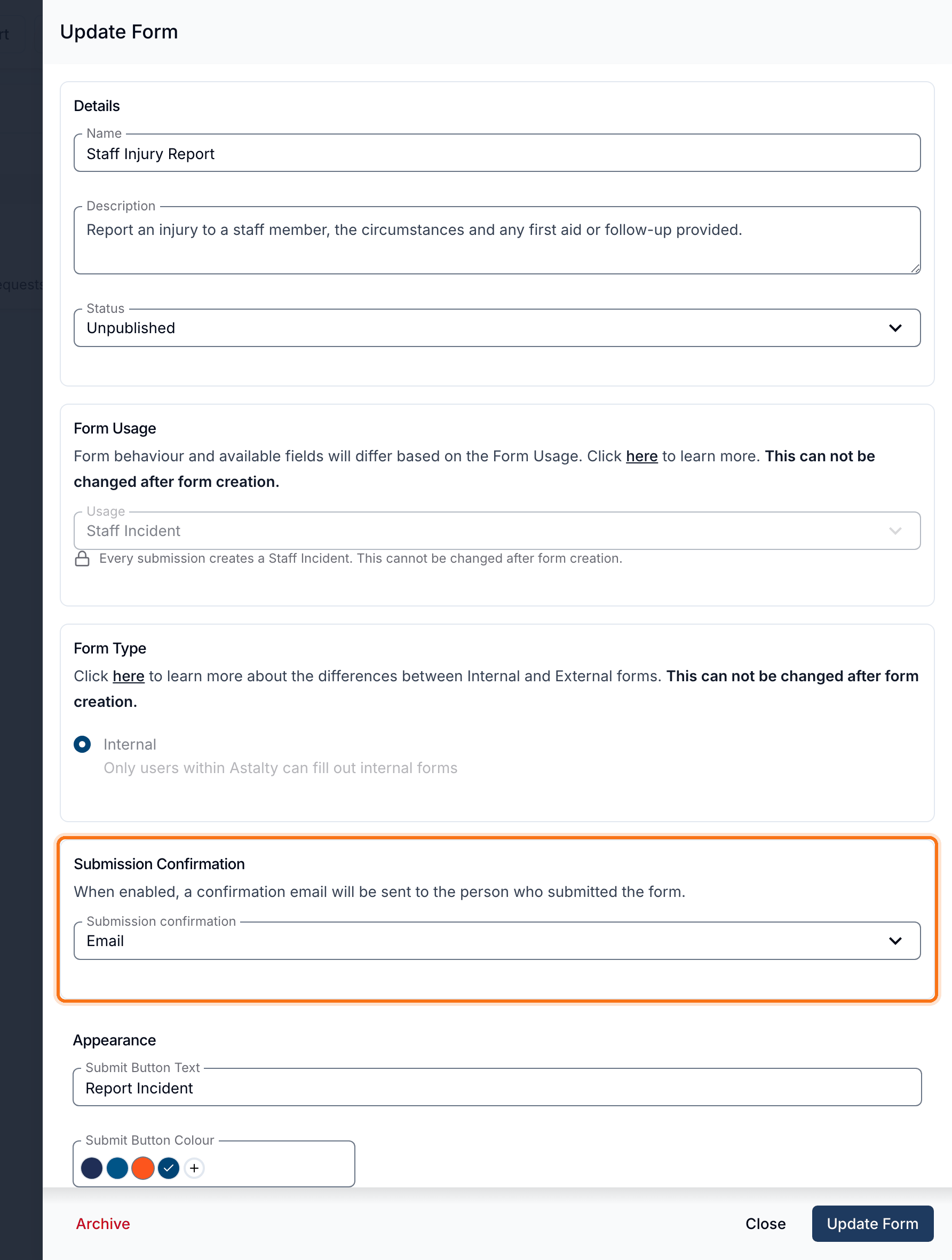
The email goes to the email address on the submitting user's Astalty profile. It is sent to that person only - it doesn't replace form Notifications, which are how you alert managers or other staff that a submission has come in.
What the Confirmation Email Contains
What the email says depends on the form's usage:
| Form usage | Subject | Includes |
|---|---|---|
| General | Form Submission Confirmation | The name of the form that was submitted |
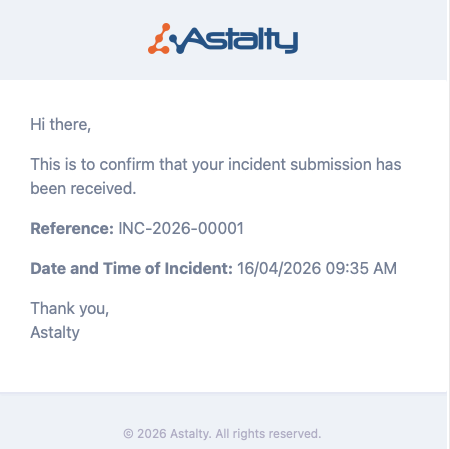
| Participant Incident and Staff Incident | Incident Submission Confirmation | The incident Reference number and the Date and Time of Incident |
Below is an example of the confirmation email for an incident form:
If you duplicate a form, the Submission Confirmation setting is copied to the new form.
Who Can Fill Out This Form
Choose who can complete a Form. By default, all new Forms are given Admin, Manager and Team Member access, allowing your Admins, Managers and Team Members (but not Support Workers) to view and submit the Form. You can choose to restrict access to specific users or make the Form available to everyone by clicking on Edit in the Who Can Fill Out This Form section and following the prompts.

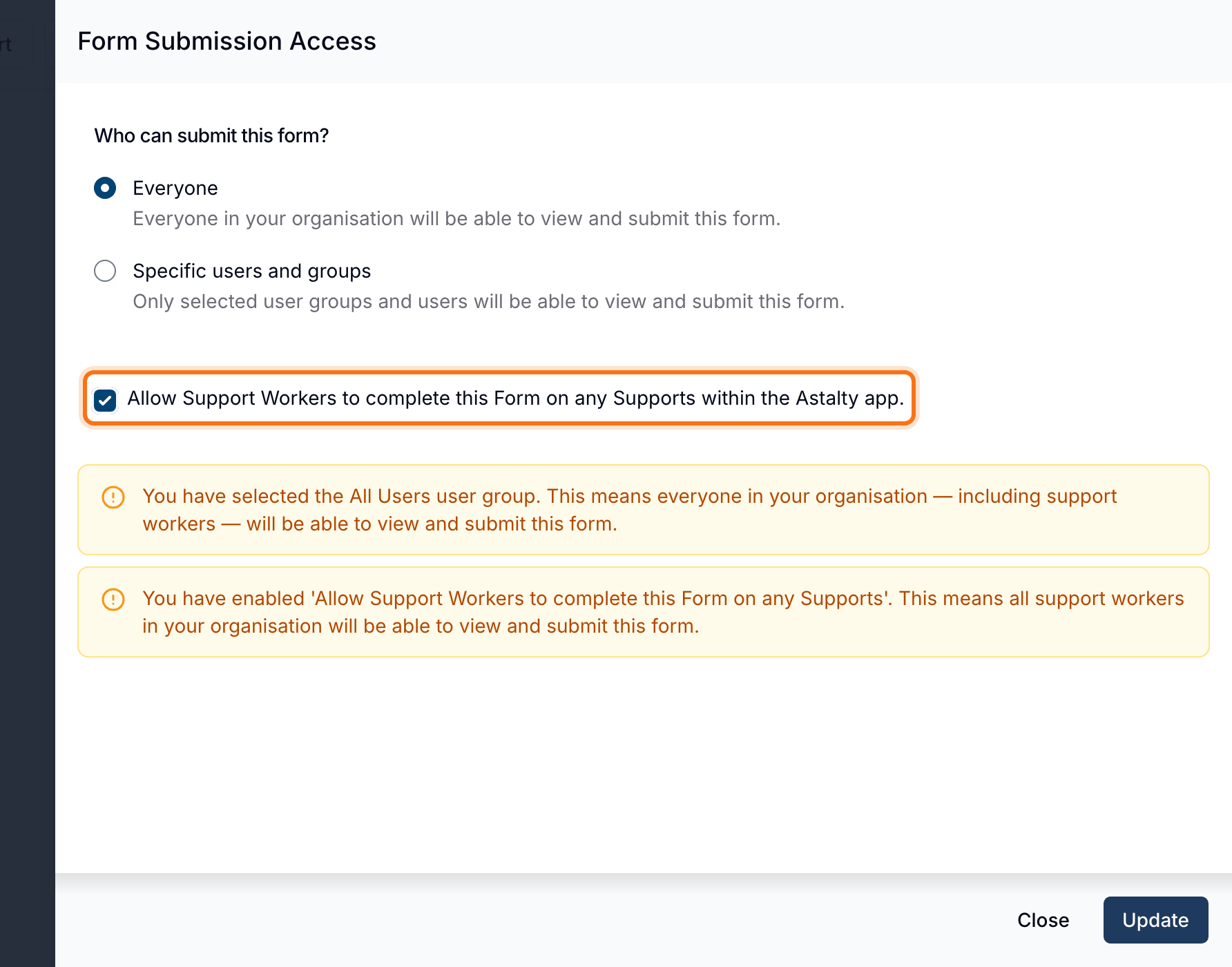
Choosing Everyone selects the All Users group, which gives every user in your organisation - including Support Workers - access to the Form. Support Workers only see it against Participants they are associated with, unless you also enable Allow Support Workers to complete this Form on any Supports within the Astalty app (covered below). If you want to isolate who can access the Form, choose specific Users or User Groups instead of Everyone.

Select Allow Support Workers to complete this Form on any Supports within the Astalty app to make the Form available on every support for every Participant. See Participant Details in the Support Worker App for where Support Workers find it.
To make a Form available for one Participant only, create it and assign it from that Participant's profile. See Creating a Participant-Specific Form.
If you duplicate a form, these access settings are copied to the new Form, including the Allow Support Workers to complete this Form on any Supports within the Astalty app option. Note that Forms assigned to an individual Participant via their profile are not carried over - you'll need to assign the copy to that Participant separately.
Who Can View Form Submissions
Use Who can view form submissions? to choose the users and User Groups that can read submissions for this Form. This is useful for confidential Forms such as staff supervision or complaint Forms.

This access list is also copied when you duplicate a form, so a copy of a confidential Form stays restricted to the same people.
For a Register Form, this is the same list as Can View in the Register's access settings. Listed users and groups can read every entry and its submission.
Recent Submissions in the Astalty App
On a General Form, use Recent Submissions in the Astalty App to let Support Workers look back at the Form's recent submissions in the Astalty app, for Participants on their shifts - for example, checking when medication was last given.
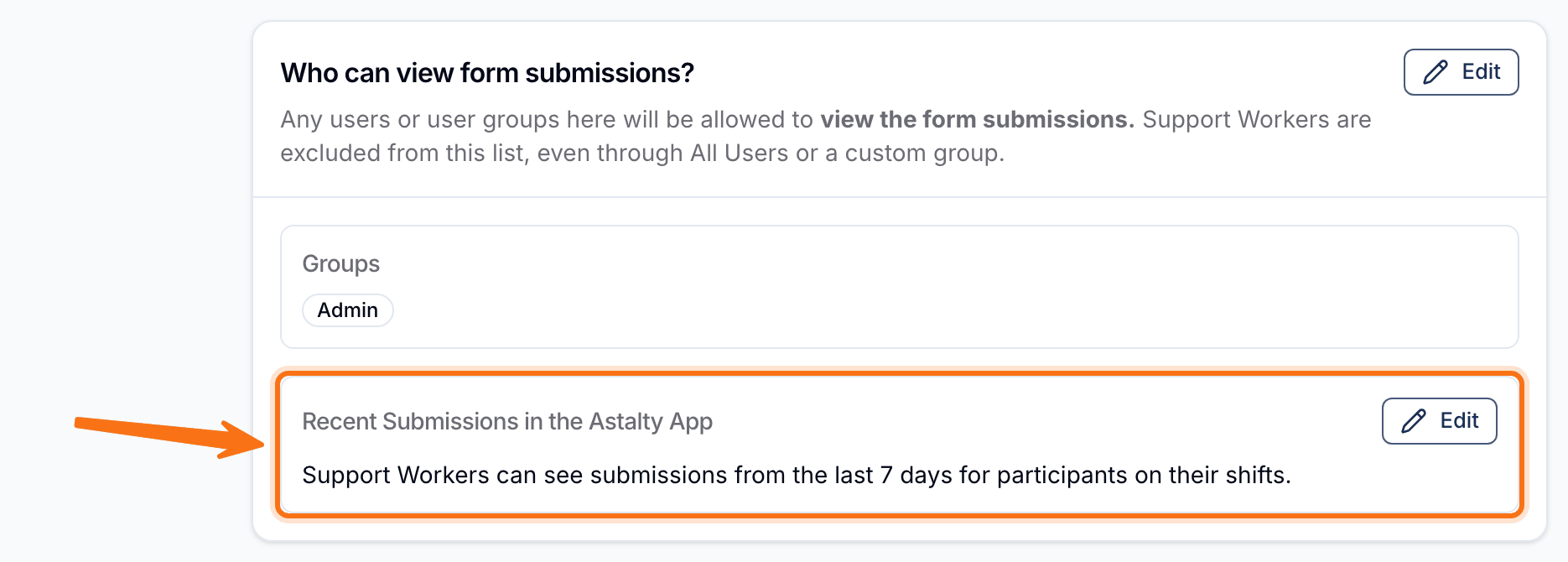
Select Edit, then turn on Show recent submissions to Support Workers and set Number of days to how far back they can look. Support Workers then see submissions from that many days, for Participants on their shifts, including submissions made by other staff - not only their own.
This is off by default. While it's off, Support Workers can only see their own submissions of the Form. See Previous Submissions for where Support Workers find this in the app.