- Participants
- NDIS Plan
- Services
Services
To manage Services for a Participant, open their profile and select NDIS Plan. Charge Items explains how Services connect to the supports your organisation delivers and bills.

Creating a Service
Once you have navigated to the Plan you want to add the Service to, click Add Service.

Service Type
When Scheduling is enabled, choose how this Service is delivered:
- Unscheduled service is billed through Tasks, such as Support Coordination, recovery coaching, or allied health. It requires at least one Charge Item and includes Calculate remaining units using.
- Scheduled service is for rostered Supports, such as community access, group activities, or supported independent living. It can use Charge Items and Charge Item Sets. Astalty asks you to confirm if you continue without a Charge Item Set, but the Service must still have at least one Charge Item or Charge Item Set.
Service Name
The Service name should describe the service you are delivering. For example;
- Level 2 Support Coordination
- Level 3 Support Coordination
- Psychosocial Recovery Coaching
- Occupational Therapy
Service Budget Amount
The total budget amount for this service.
If some funding has already been used, this amount should still be the total amount for the service - typically the total amount listed on their plan. You can then reconcile the budget.
Reconcile
To reconcile a Service budget amount, click the Reconcile button next to the Service Budget Amount field.

Remaining Amount
How much funding is remaining for this service as at the Reconciled Date.
Reconciled Date
The date that the remaining amount was valid - this will default to today's date.
Management Type
Define how the funds for this service are managed. This will dictate how Charge Items are invoiced when you process your invoice batches.
Service Category
The NDIS Support Category that this Service falls under. This is important as it will dictate which Charge Items can be used for this Service.
If you want to use Charge Items starting with 07, then you will need to select the 07 - Support Coordination service category.
Service Coordinator
The Team Member who is in charge of coordinator or delivering this Service. This is helpful if you are delivering several services to the same Participant.
For example you may have a Participant receiving Level 2 and Level 3 Support Coordination. You may have the Level 2 Support Coordinator as the Primary Coordinator but you can also assign another team member as the Service Coordinator for the Level 3 Support Coordination Service.
Charge Items
Assign every Charge Item you plan to use for this Participant to a Service. Astalty uses that assignment for invoicing and Service utilisation.
A Charge Item can only belong to one Service at a time.
An archived Charge Item Set stays on the Service and its past charges keep counting towards Utilisation, but it can't be selected for new supports - see Archiving & Restoring Charge Item Sets.
To stop a Charge Item or Charge Item Set being used by this one Participant, without affecting anyone else, mark it inactive on the Service instead of removing or archiving it - see Marking a Charge Item or Charge Item Set Inactive below.
Calculate Remaining Units Using
Select the Charge Item you want Astalty to use to calculate the remaining units using. Typically, this would be the standard hourly Charge Item for your service - such as Level 2 Support Coordination.
Updating a Service
The steps to update a Service are the same as those outlined above for Creating a Service however instead of clicking *Create Service *you navigate to the Service you'd like to update by clicking on the Service and then clicking Edit.


Marking a Charge Item or Charge Item Set Inactive
Mark a Charge Item or Charge Item Set inactive on a Service to stop it being used for that one Participant, while it stays available to every other Participant and its past charges keep counting towards this Service's Utilisation.
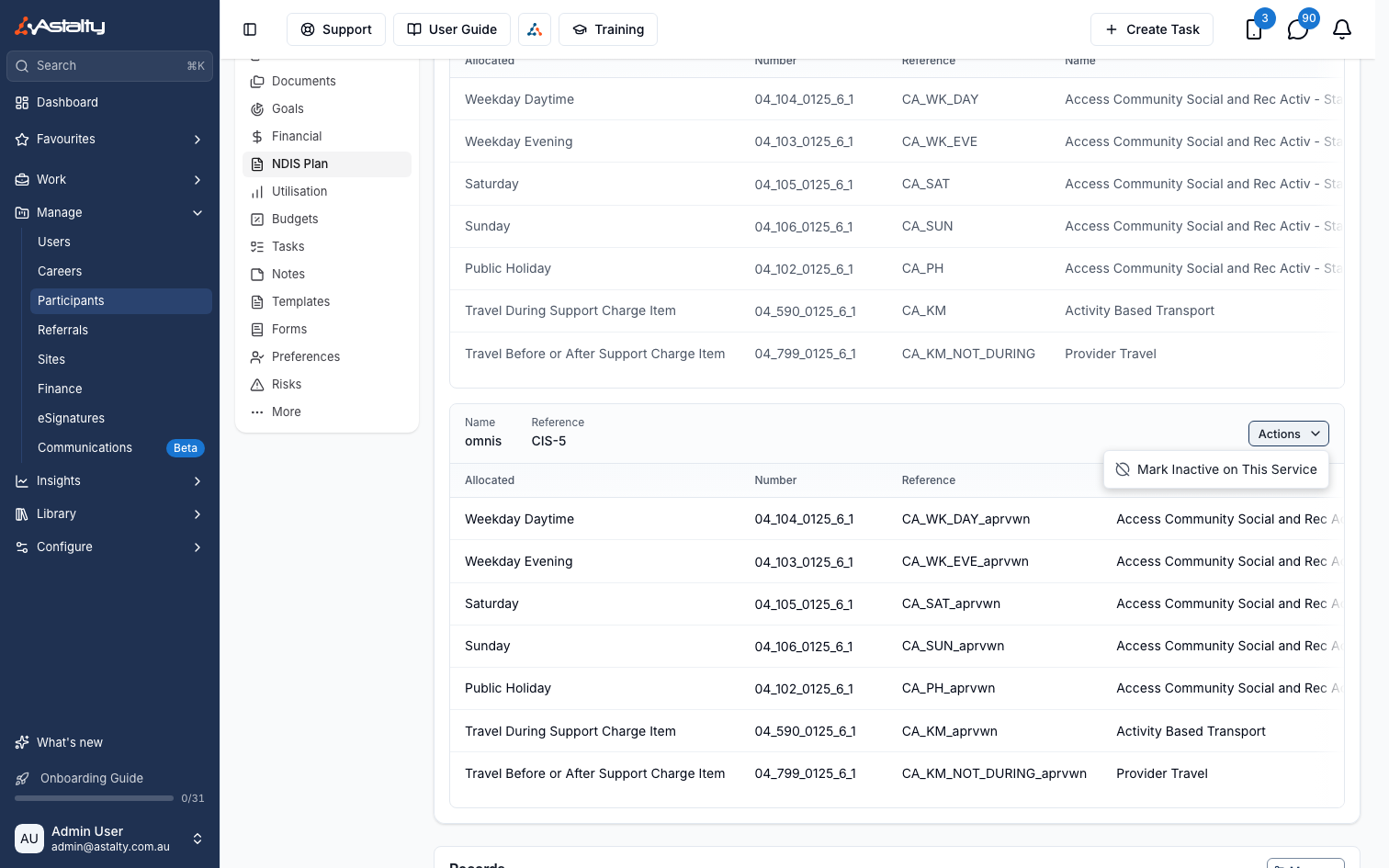
On the Service, open the three dots next to a Charge Item, or click Actions on a Charge Item Set, then Mark Inactive on This Service. Confirm in the dialog that appears.
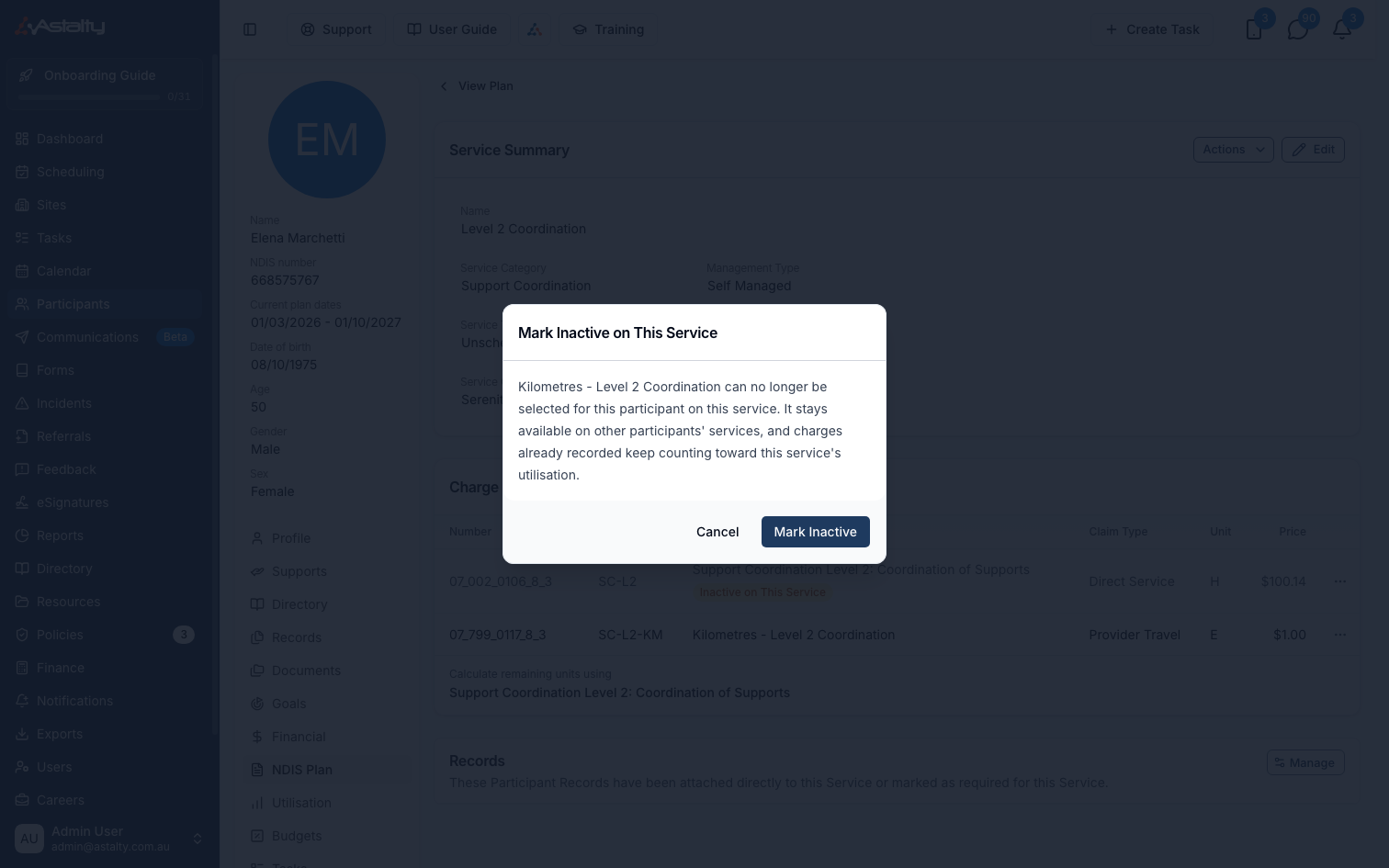
The row then shows an Inactive badge, and:
- It can no longer be selected for this Participant's new supports or charges on this Service.
- Charges already recorded keep counting towards this Service's Utilisation.
- It stays unaffected on every other Participant's Service.
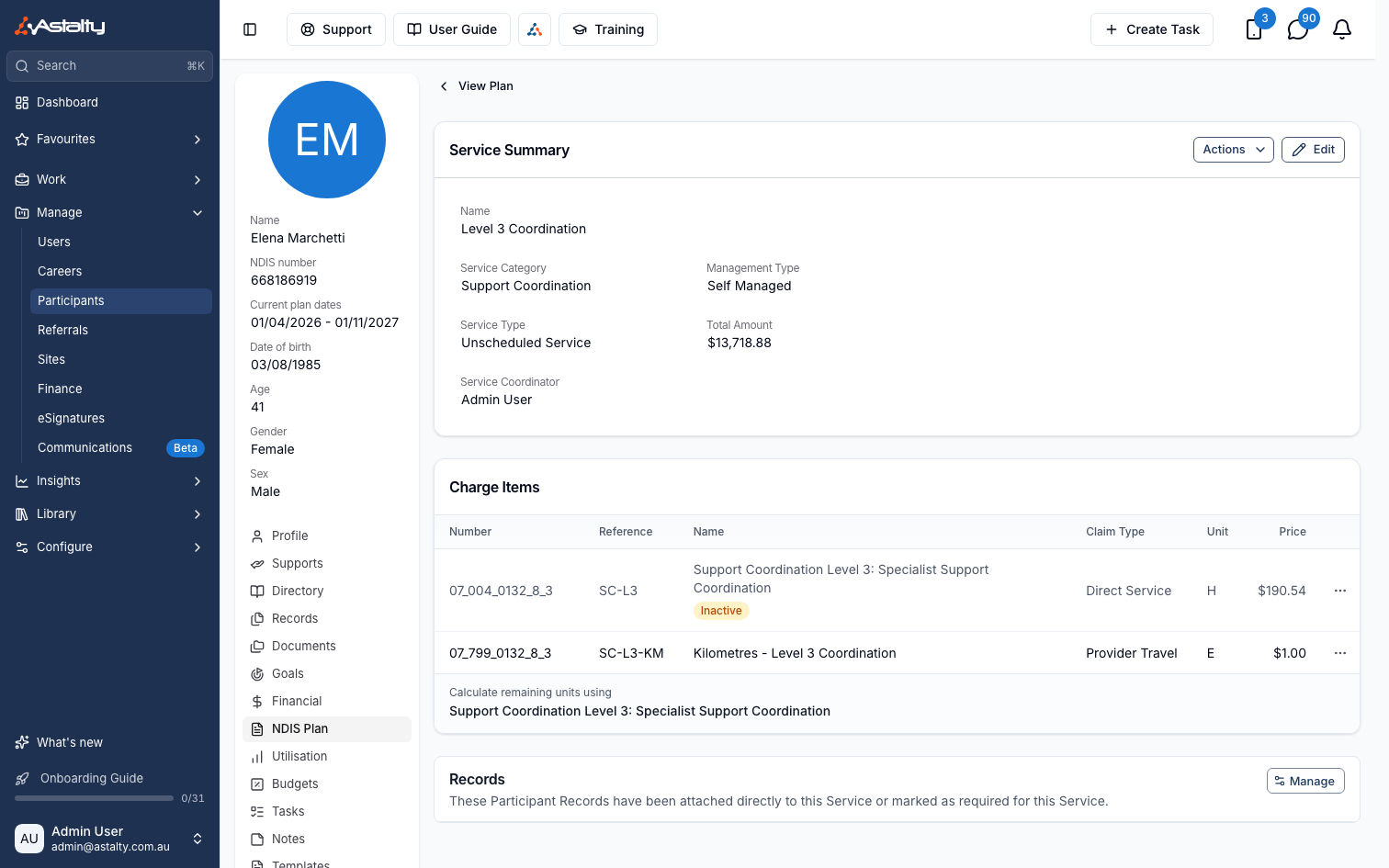
The Edit Service page shows the same badge. The item or set stays ticked there, so saving keeps it on the Service, and unticking it still raises the usual Utilisation warnings.
To undo it, open the same menu and click Mark Active on This Service - no confirmation needed.
As with an archived Charge Item Set, a support still billed through an inactive Charge Item Set needs a different set chosen before it can be edited, extended, reinstated, or have its cancellation switched to charged. Manual Charge supports aren't affected.
Creating and Updating Services
Watch the following video to see a visual guide on how to create and update Services.
Deleting a Service
Deleting a Service cannot be undone.
To delete a Service:
- Open the Service from the Participant's NDIS Plan.
- Select Edit.
- Select Delete, then confirm the deletion.
The following video demonstrates the deletion workflow.
Records on a Service
If Participant Records are enabled for your account, each Service has its own Records card, listing the Participant Records attached directly to that Service or marked as required for it.
Click Manage on that card to choose which Record Types this Service requires. Any that don't have a Record yet show as Missing on the Service and on the Participant's Records page - this is for tracking only, and doesn't block shifts, notes or invoicing.
For the full steps, and for how Service requirements interact with Record Types you've already made required across your account or by Participant Tag, see Setting Required Records on a Plan Service.