- Administration
- Settings
- Users Settings
- User Records
User Records
User Records track staff documents, expiry dates, verification and rostering requirements. A User Record Type defines the rules that apply to one kind of record.
How to Set Up and Manage User Records
Your organisation remains responsible for deciding which records and checks meet its obligations.
Setting Up User Record Types
- Open Settings > Users.
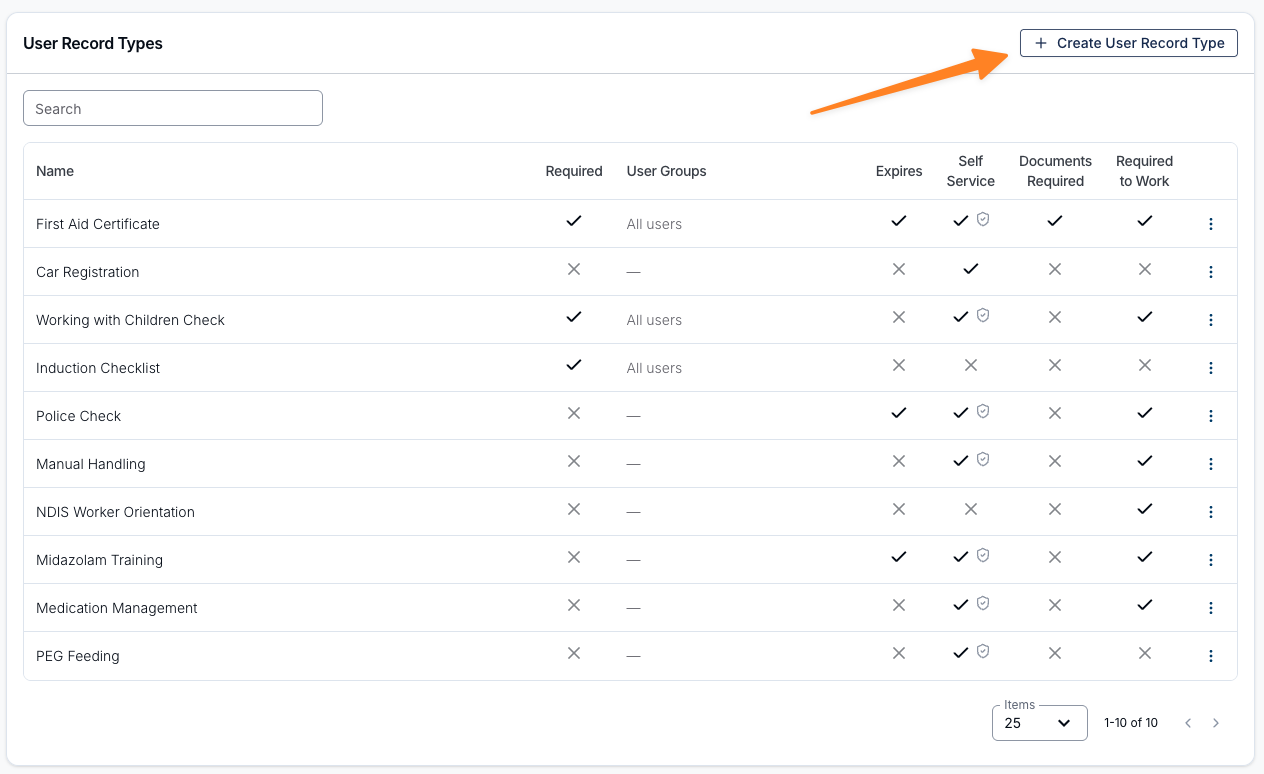
- Select Create User Record Type. If you are setting up records for the first time, you can start from the suggested Record Types.
- Enter a name, such as First Aid Certificate.
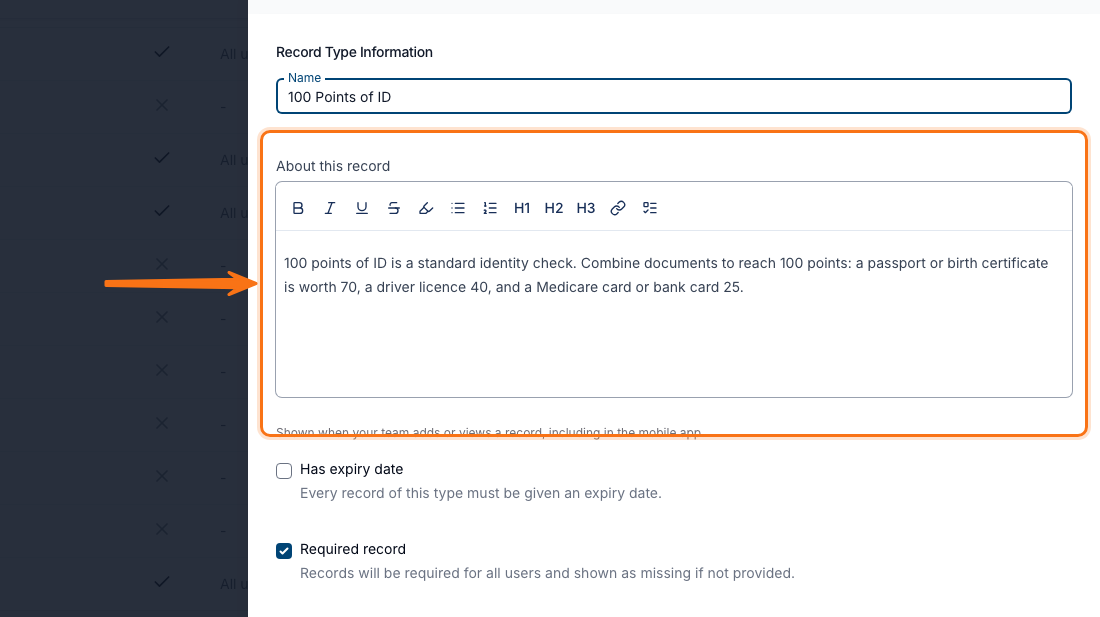
- In About this record, explain what the Record is and where staff can obtain it. This optional content appears when staff add, edit or view the Record on web and mobile.
-
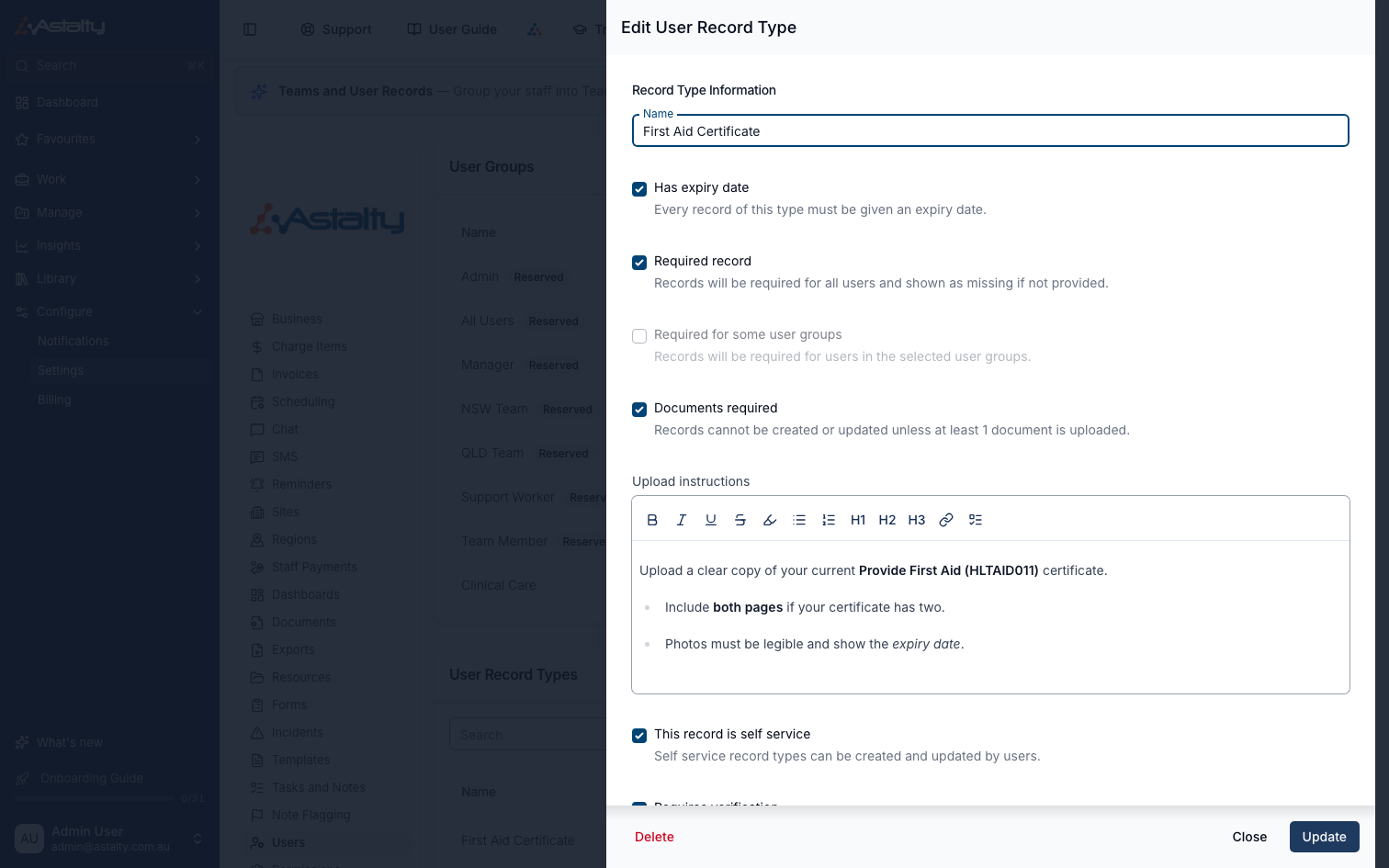
Choose the options that apply:
- Document Expiry Date records an expiry date.
- Record Requirement makes the Record required for everyone.
- Document Upload Requirement requires at least one document when the Record is created or updated.
- Upload Instructions explains what to upload. It appears in the upload area while Document Upload Requirement is selected.
- Self-Service Uploads lets Users upload their own documents. A visible but non-required Record Type appears as Optional in the app. See Uploading User Records.
- Verification Requirement requires another team member to verify a self-service upload.
- Select Create.
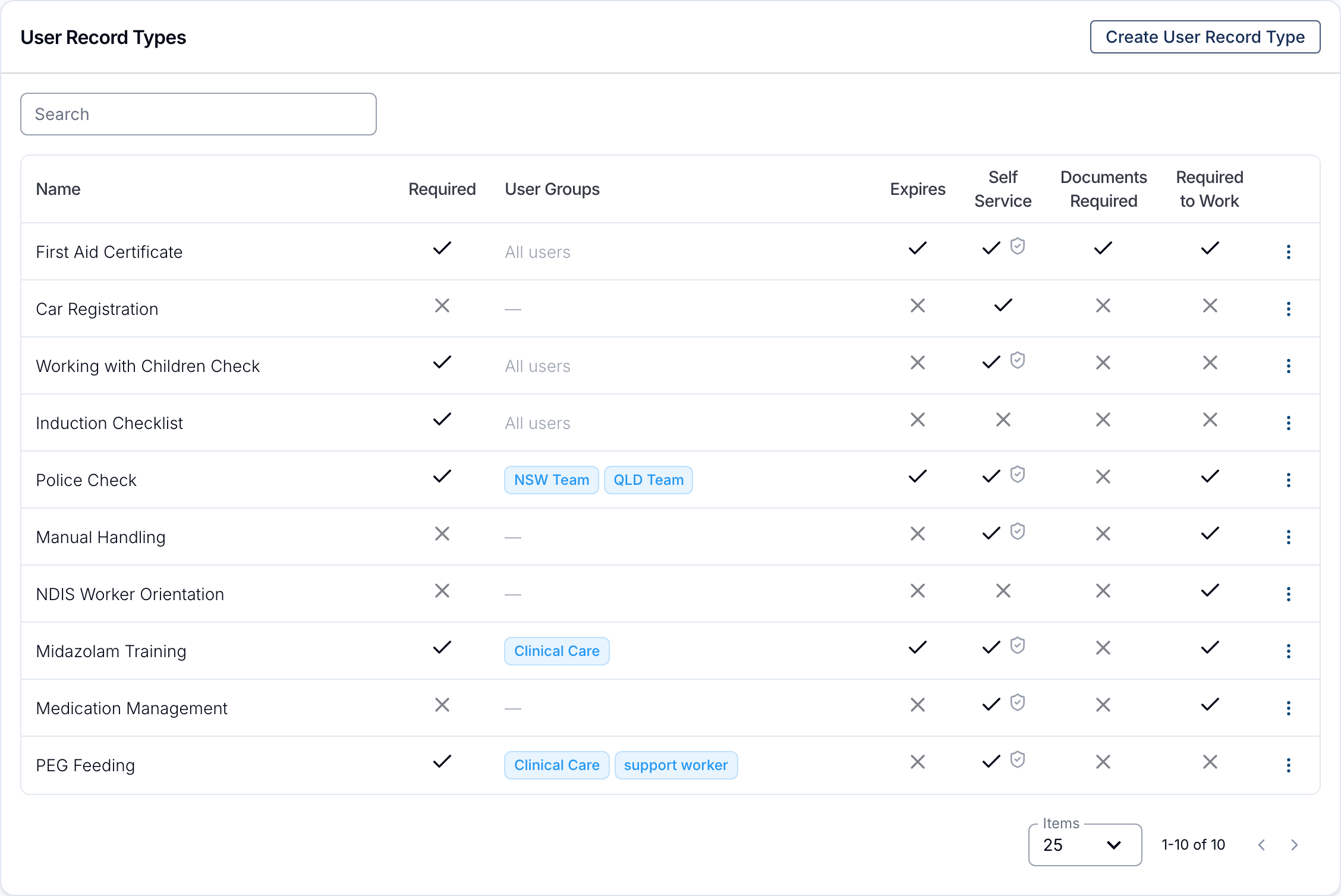
The User Record Types table shows whether each type is required, which User Groups need it, whether it expires, and whether it supports self-service or requires a document.
Starting From the Suggested Record Types
Rather than typing out every Record Type by hand, you can add the ones most NDIS providers keep for their staff in a single step.
- Go to User settings.
- Select Create User Record Type.
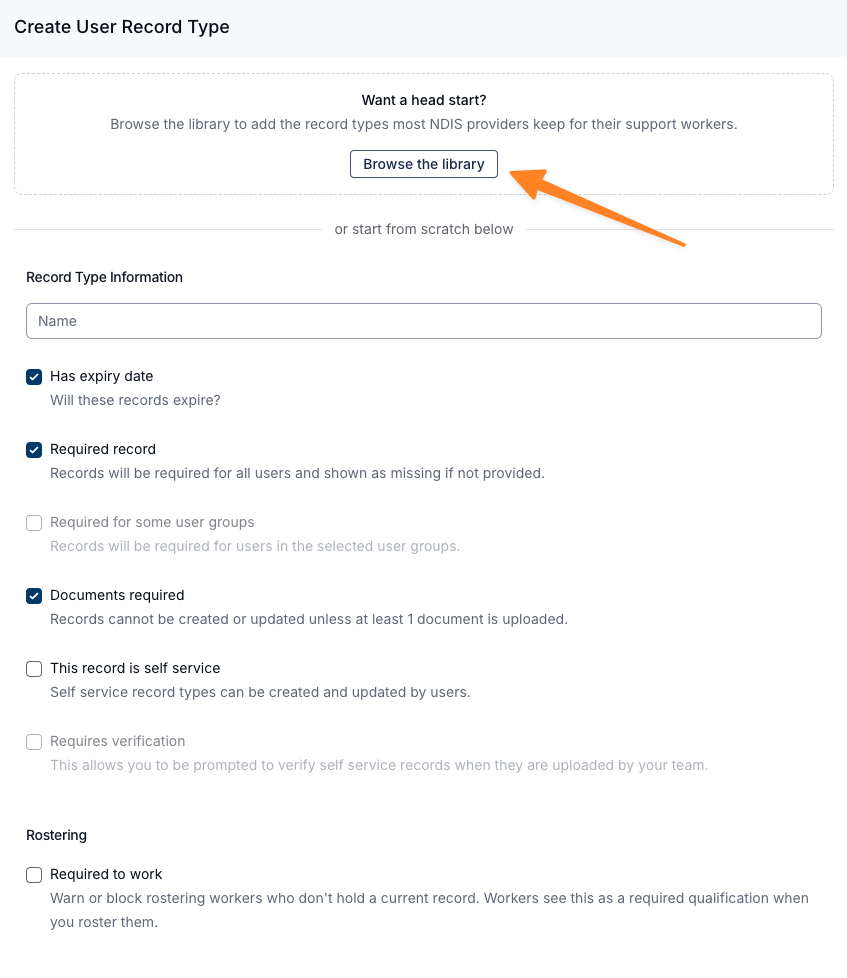
- On the Want a head start? card, select Browse the library.
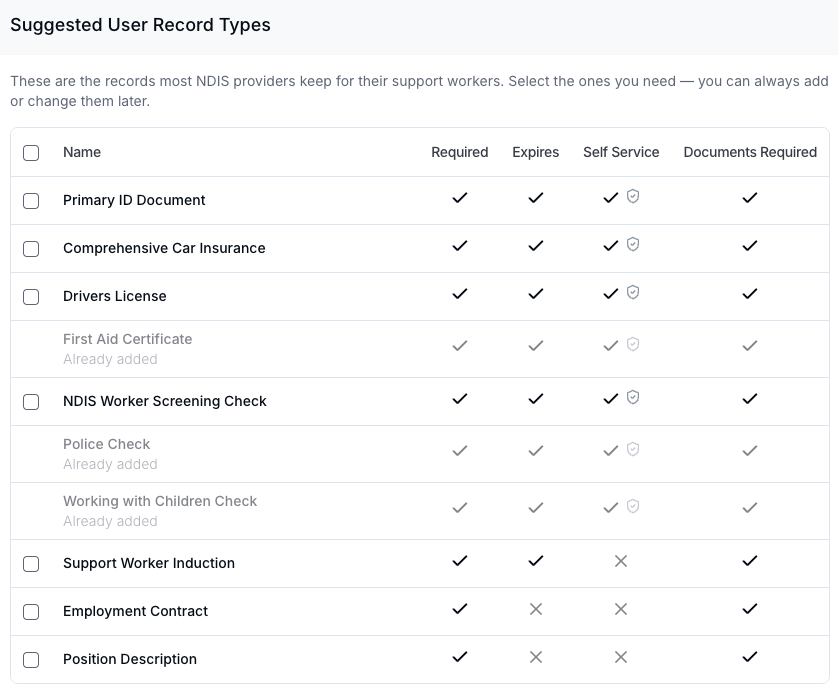
- In the Suggested User Record Types drawer, tick the Record Types you want, or use the checkbox in the header row to select them all.
- Select the add button, which counts what you have ticked, for example Add 6 Record Types.
The card sits at the top of the create form, above a divider reading or start from scratch below, so building a Record Type by hand is still one screen away.
What You Can Add
The drawer lists ten Record Types, showing how each one will be configured before you add it:
| Record Type | Expires | Self Service | Verification |
|---|---|---|---|
| Primary ID Document | Yes | Yes | Yes |
| Comprehensive Car Insurance | Yes | Yes | Yes |
| Drivers License | Yes | Yes | Yes |
| First Aid Certificate | Yes | Yes | Yes |
| NDIS Worker Screening Check | Yes | Yes | Yes |
| Police Check | Yes | Yes | Yes |
| Working with Children Check | Yes | Yes | Yes |
| Support Worker Induction | Yes | No | No |
| Employment Contract | No | No | No |
| Position Description | No | No | No |
All ten are added as required Records, and all ten require at least one document to be uploaded. In the drawer, verification is shown as a shield icon beside the Self Service tick, with the tooltip Verification required.
Added Record Types are ordinary Record Types from that point on. They are not linked to the library, so you can edit, rename, or delete them exactly like the ones you create by hand.
There is a matching library for document templates. See the Document Template Library.
Archiving a User Record Type
Archive a Record Type your organisation no longer uses instead of deleting it. An archived type stops being offered when staff create a new User Record and stops counting as a required Record, but Users who already have one keep it, and any configured User Record Notifications stop sending for it. You can unarchive it at any time, which restores both.
- Open Settings > Users.
- Open the actions menu for the Record Type and select Archive, then confirm.
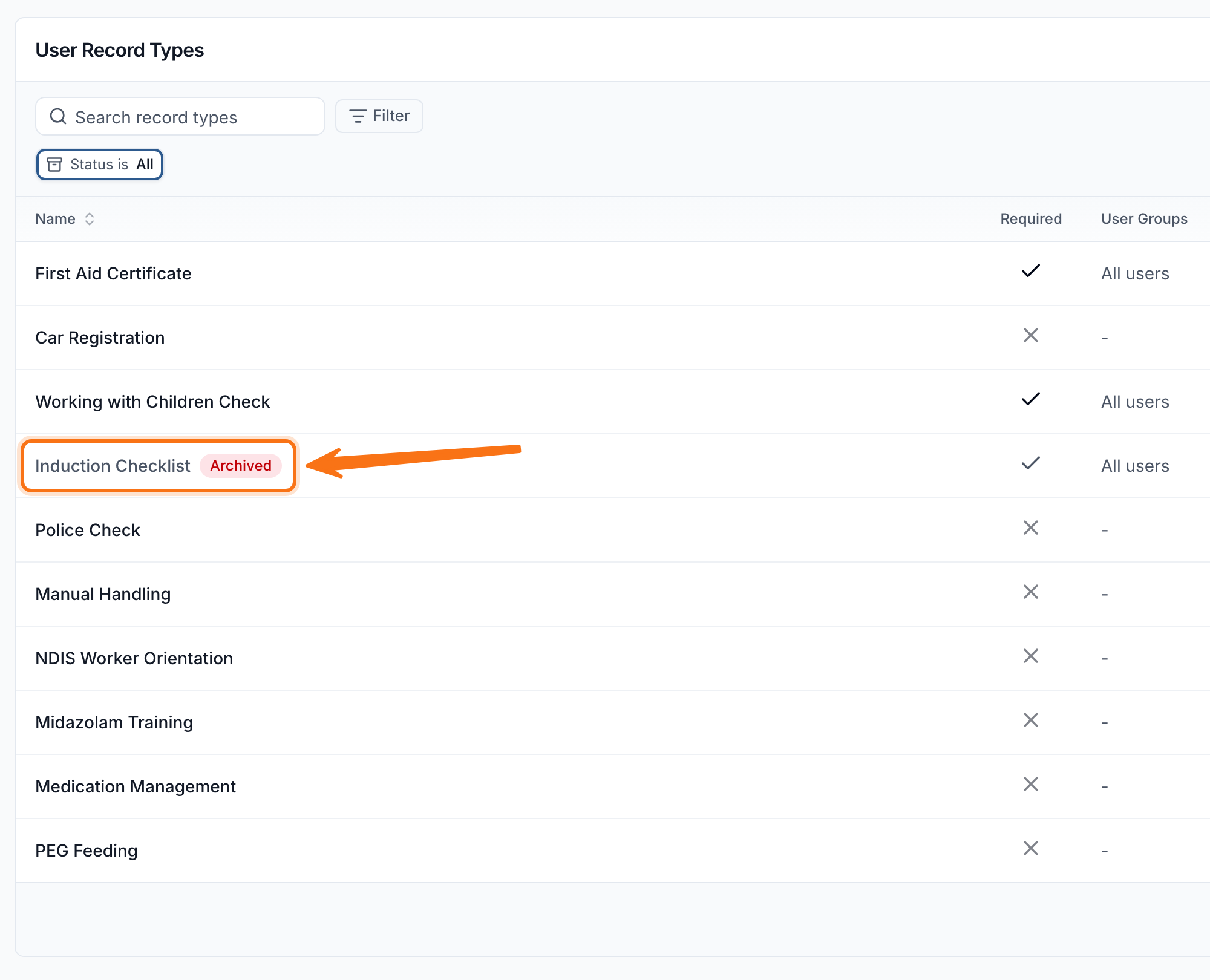
Use the Status filter above the User Record Types table to show Active, Archived, or All types; it defaults to Active. An archived type shows a red Archived chip beside its name, and its actions menu offers Unarchive in place of Archive.
Archiving a Record Type That's Already in Use
A Record Type already used by a User Record cannot be deleted. Select Delete to see what's blocking it, then select Archive instead to archive the type without removing those Records.
Using User Records
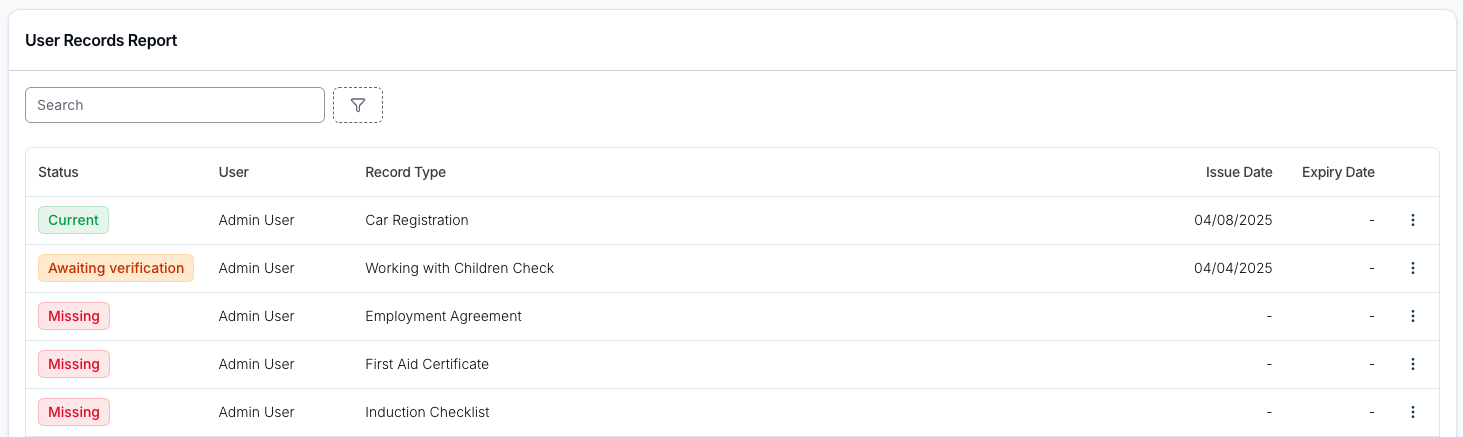
- Use the User Records Report to find missing, expired and awaiting-verification Records.
-
Configure User Record Notifications to alert selected recipients when Records need attention.
-
Make a Record Type mandatory for rostering to warn or block the scheduler when a worker's Record is missing or expired. See Required Qualifications.
-
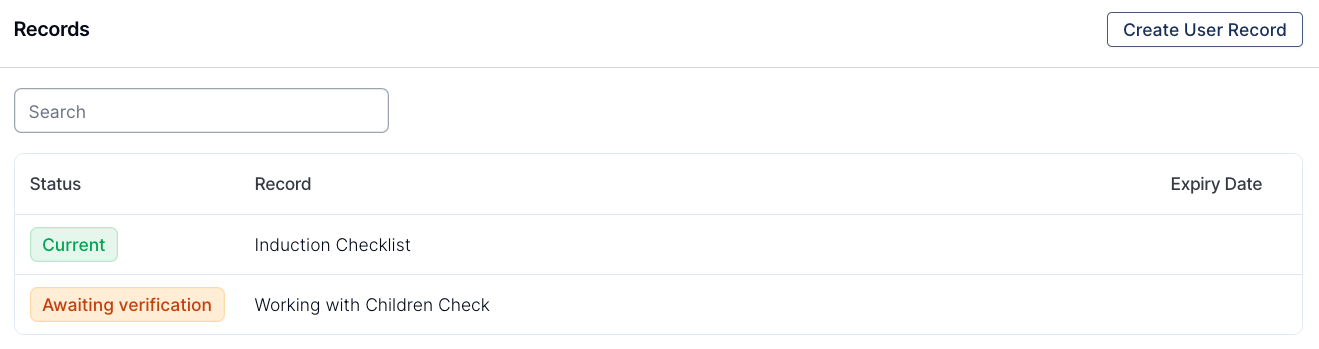
To manage a User's Records, open Users, select the User, then open Records.
Send User Records for Signing
Create or open the User Record before sending its document for signature.
Uploading a Record
- Open Users and select the User.
- Open Records and select Create User Record.
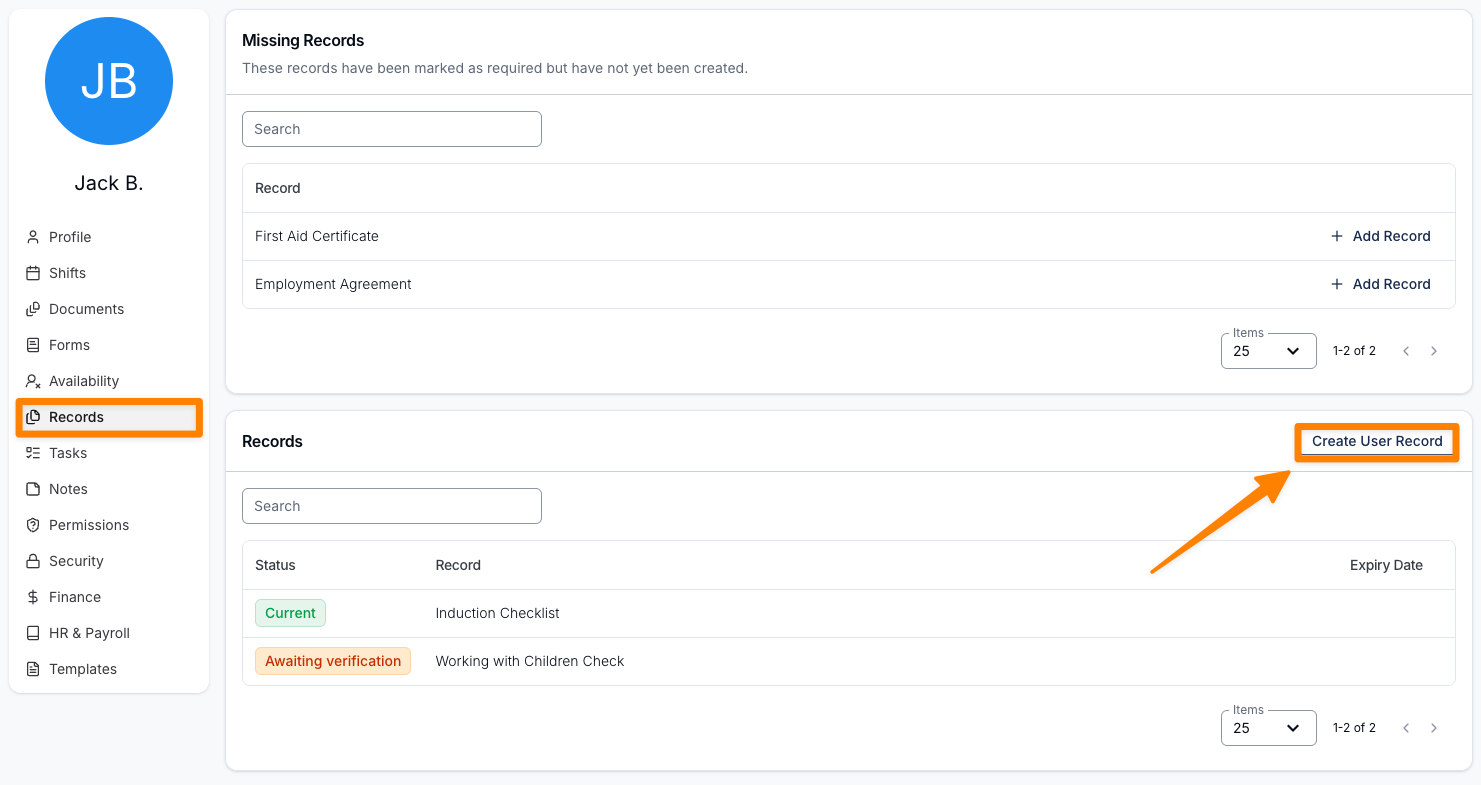
- Select the Record Type and complete its required fields.
- Upload files or choose existing documents from the User's profile.
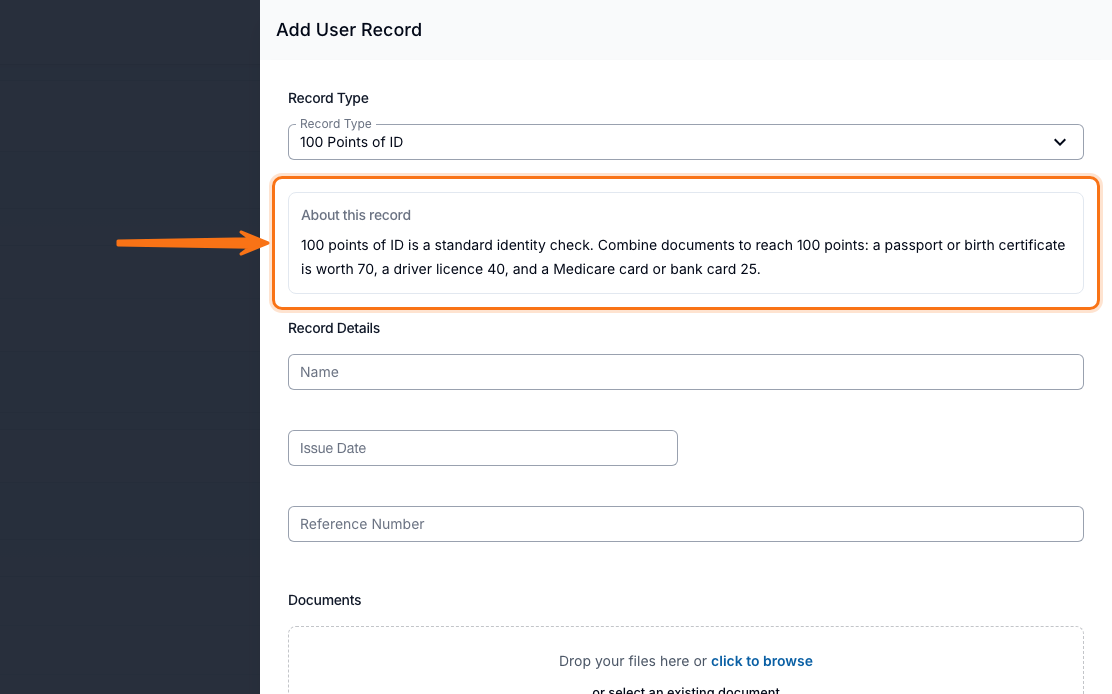
If the Record Type has About this record set, it appears under the Record Type dropdown. The same box shows when editing or viewing an existing Record of that type.
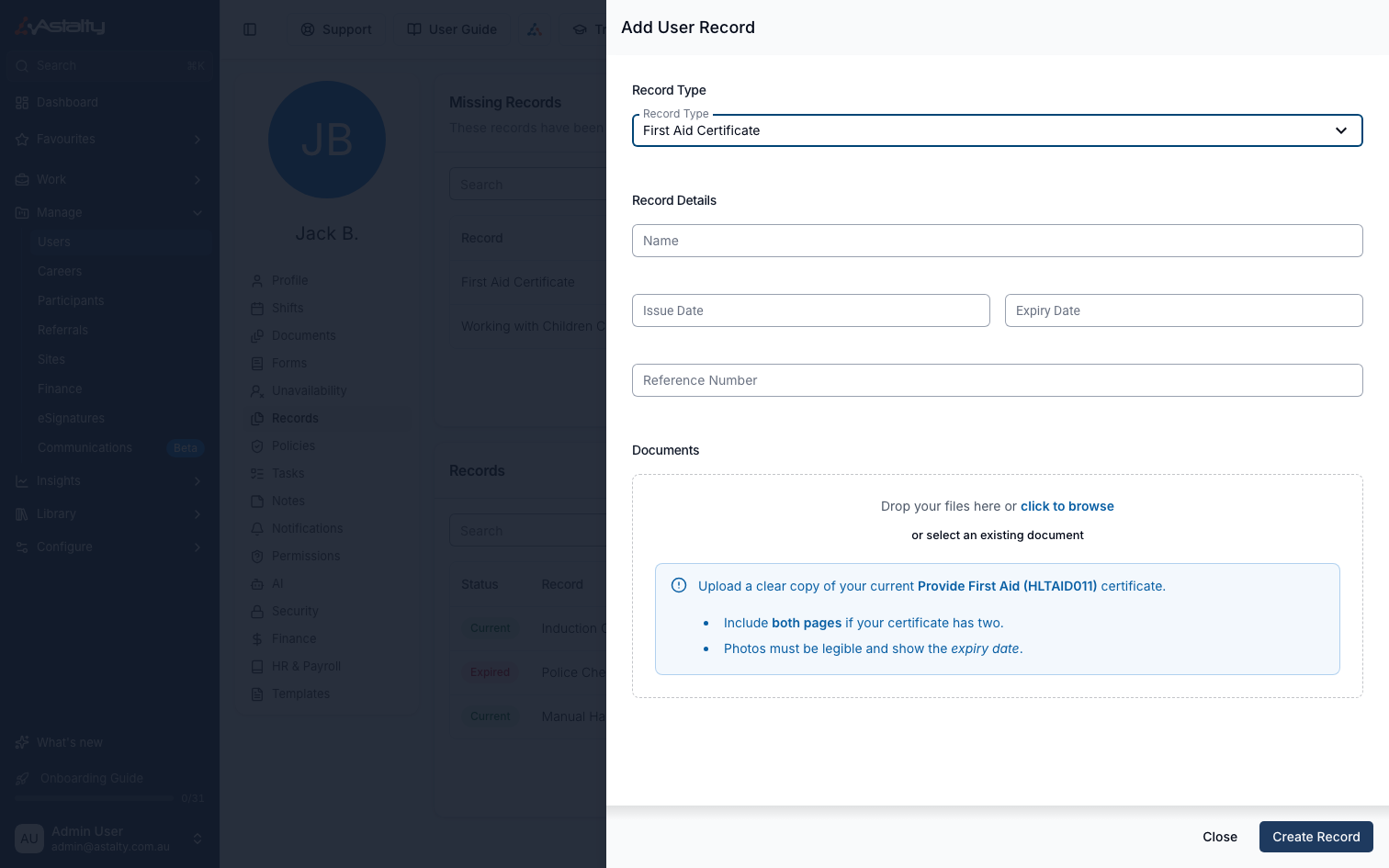
If the Record Type has Upload Instructions set, they appear as a note inside the upload box. The same note shows when editing an existing Record of that type.
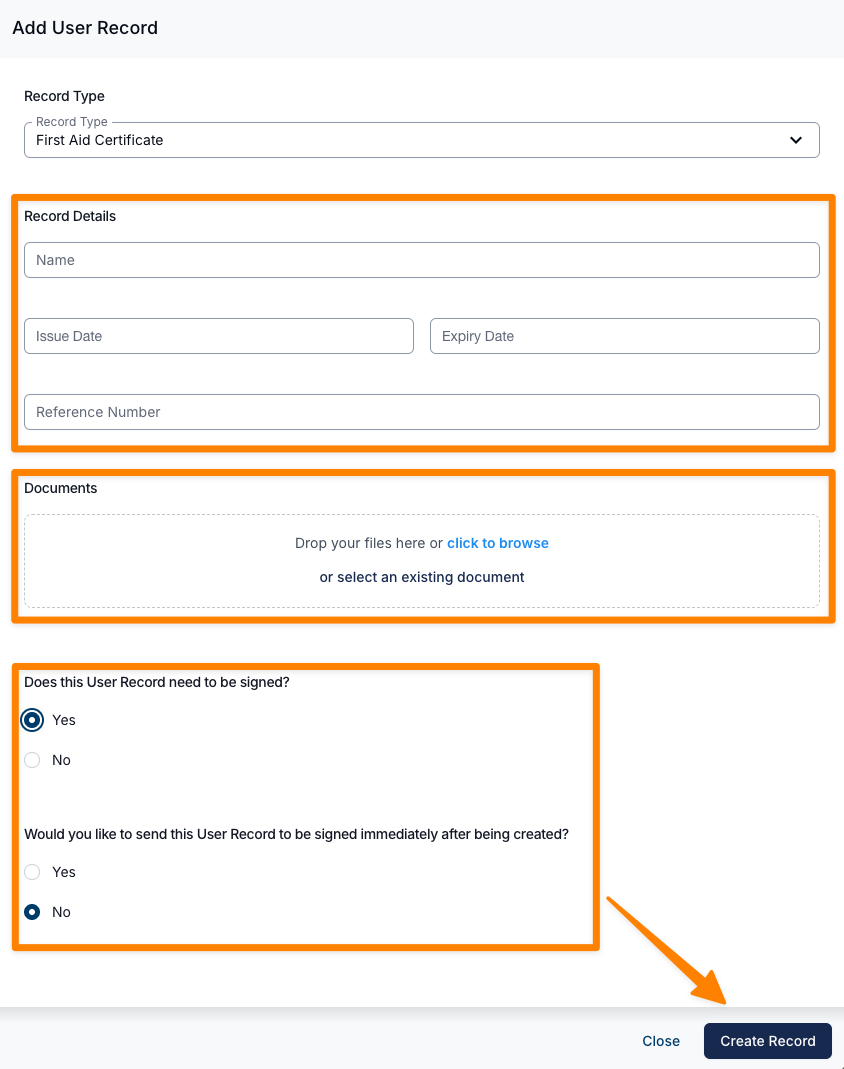
If the Record requires a signature, you can choose to send it for eSigning immediately after creation, or select No to send it at a later time.
- If the Record can be signed, choose whether to send it now.
- Select Create Record.
File Types and Size Limits
As well as documents, you can attach video to a User Record. Astalty accepts MP4, WebM and MOV video files, alongside the usual PDF, Word, spreadsheet and image formats.
Every file on a Record, whether video or document, can be up to 500 MB. A larger file is rejected with File exceeds the 500MB size limit and a format Astalty does not accept is rejected with Invalid file type, both before the Record is saved.
This is what makes a Record like Support Worker Induction practical to hold as a recording rather than a document. Once the Record is saved, select the video to play it in Astalty, the same way you'd open an attached PDF.
Only PDF and Word (DOCX) files can be signed, so a video never goes out in an eSignature request. If the only files you attach are videos, the Does this User Record need to be signed? question doesn't appear at all, and videos aren't offered when you send a Record for signing.
Changing a Fully Signed Record's Status
A Record's Signature Status is read-only while a signature request is in progress, and Astalty moves it to Awaiting Signatures when the request is finalised and to Signed once every signer has signed.
If only some signers sign through eSignatures and someone else signs on paper, a Record can show Signed while a signature is still outstanding. Once every eSignature signer has signed and no request on the Record is still in progress, Signature Status unlocks and offers Awaiting Signatures alongside Signed, so you can flag that a paper signature hasn't come in yet.
Choosing Awaiting Signatures shows a warning in place of the usual hint:

Set the status back to Signed once the paper signature is in. While the override stands, a repeated completion on the same request, or a change to another request on the Record, no longer flips the status back on its own - only setting it to Signed by hand clears it. The Record's details show a muted Set manually note under Signature Status as a reminder.
When a Record Type Can't Be Sent for Signing
Not every Record Type can go out for signature. A Record Type can only be sent for signing when both of these are true on the Record Type in Settings > Users:
- Documents required is ticked, and
- This record is self service is not ticked.
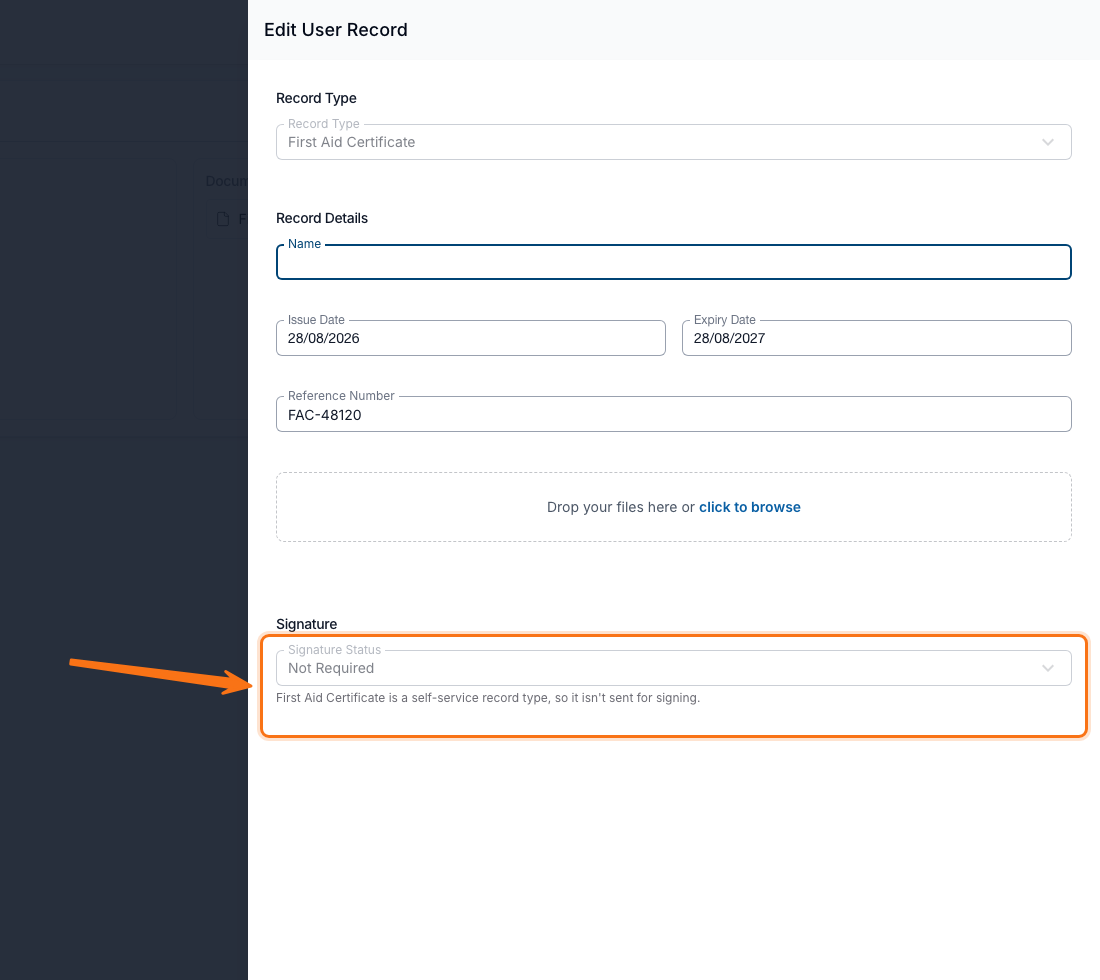
Self-service Record Types are the ones your staff upload themselves, such as a First Aid Certificate, so there is nothing for your organisation to send out for signature. Record Types that do not require documents have no document to sign.
When a Record Type doesn't meet both conditions, Astalty leaves the signing question out and tells you why, rather than offering a signing option that could never be completed.
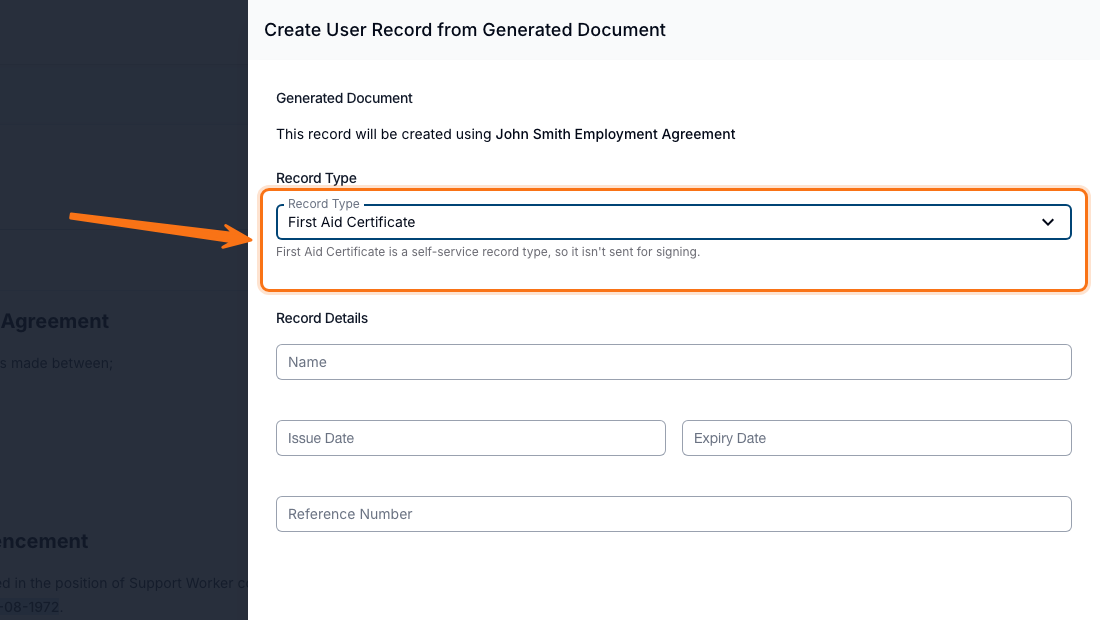
Creating a Record: the Does this User Record need to be signed? question only appears for Record Types that can be signed. When you create a Record from a generated document, a short note under Record Type explains why the question is missing:
Editing a Record: Signature Status stays on Not Required and cannot be changed, with the same explanation beneath it:
The Send for Signing button doesn't appear on these Records either, and they aren't offered when you send multiple Records in one eSignature request.
Sending Multiple User Records for Signing
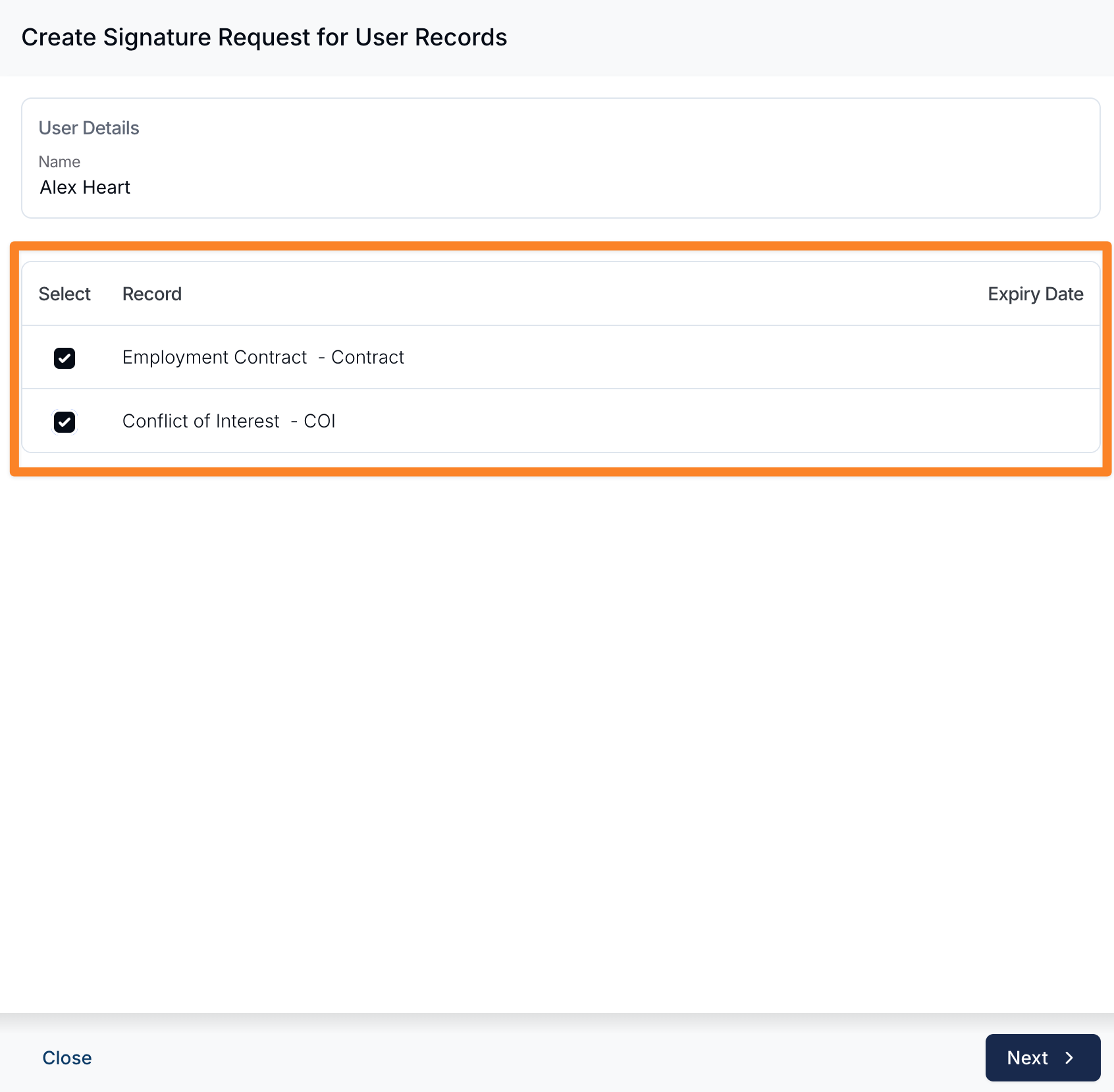
Send multiple User Records in one eSignature request when the same recipient needs to review and sign them together.
Uploading in the Support Worker App
Support Workers can upload their own Records in the mobile app. See Uploading User Records.
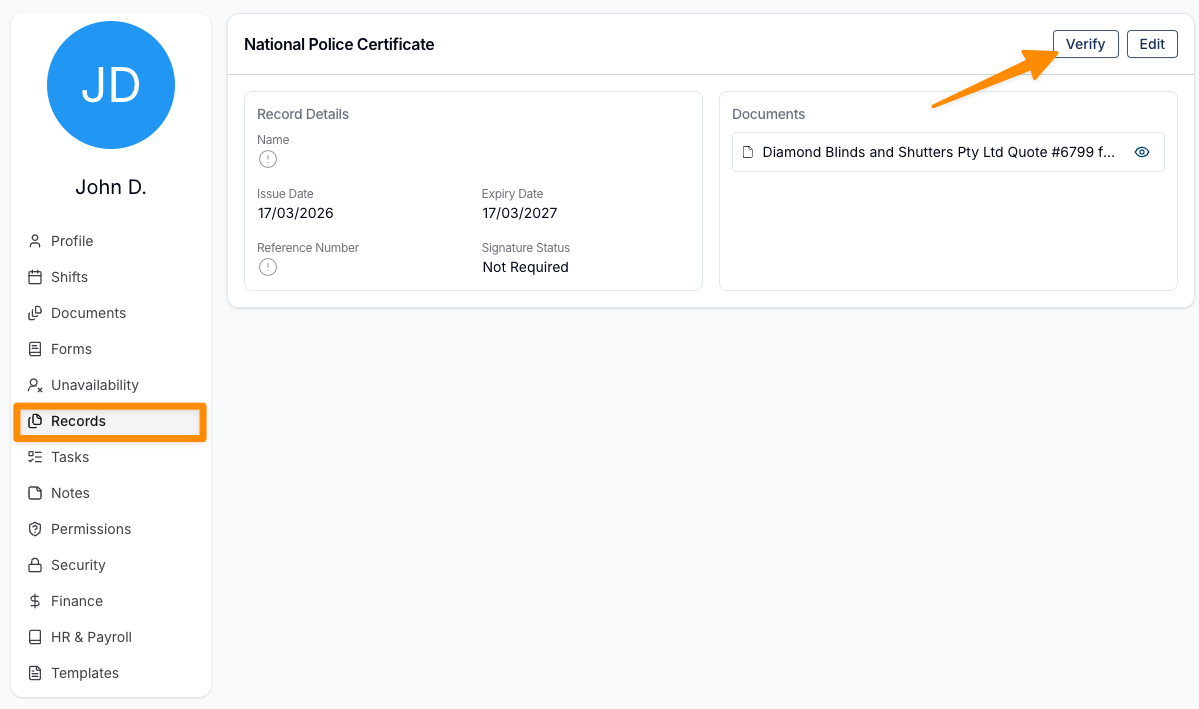
Verifying User Records
When a User submits a Record that requires verification:
- Open the User's profile and select Records.
- Open the submitted Record and review its documents.
- Select Verify if the documents meet your requirements.
Astalty updates the Record's verification status.
Notifications for User Records
User Record notifications can alert the Record Owner when a Record requires attention, such as when it is due to expire or needs an update.
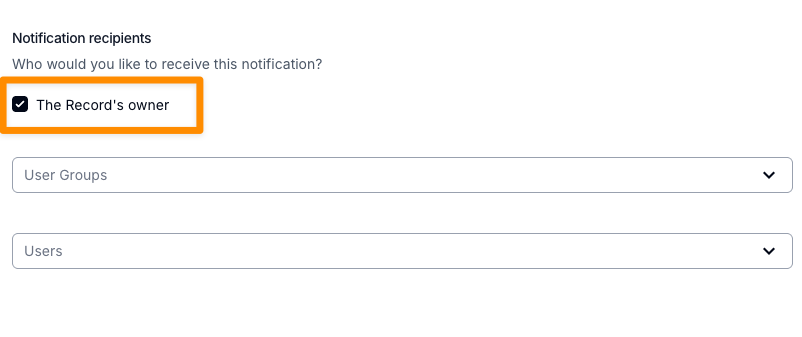
Managers, Team Members and Admins can also receive configured notifications and upload Records through the browser version of Astalty.
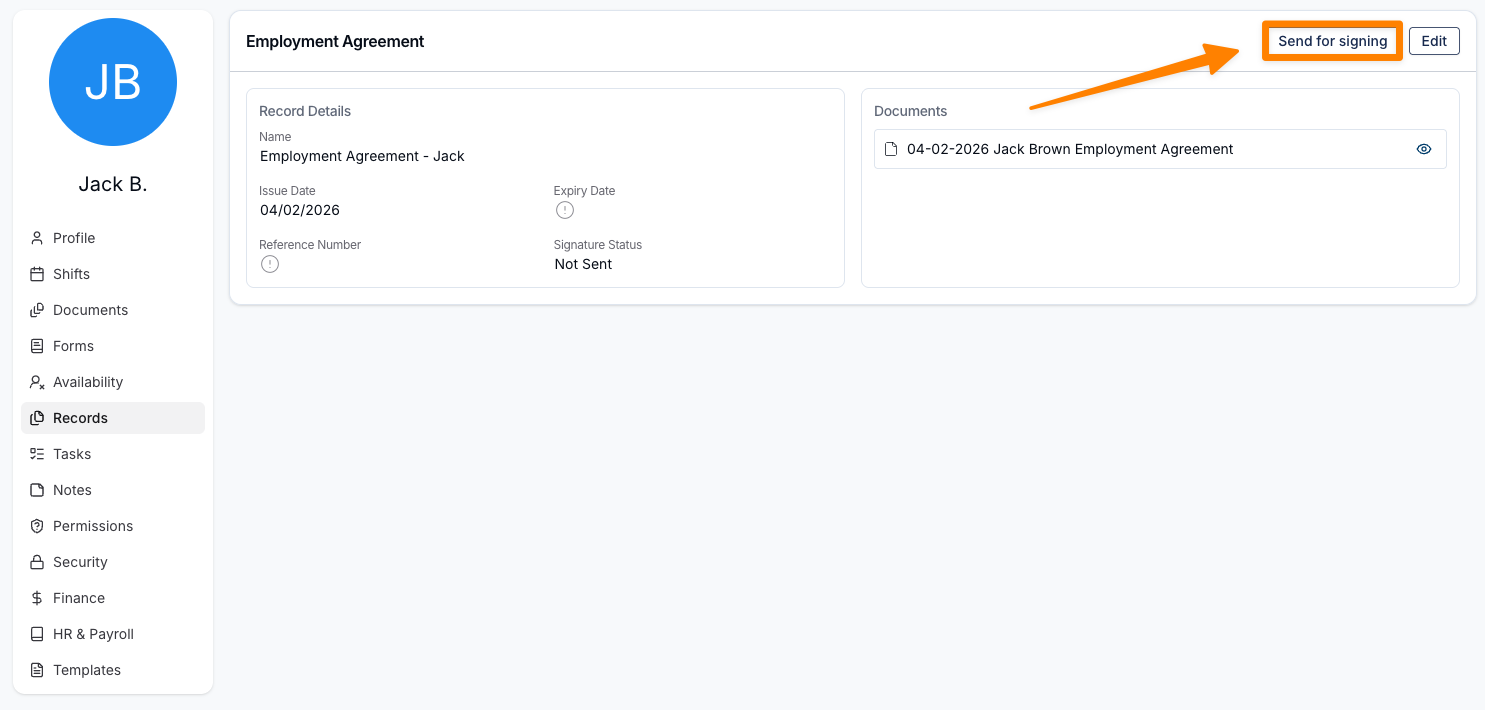
Sending for Signature
- Open the Record and select Send for Signing.
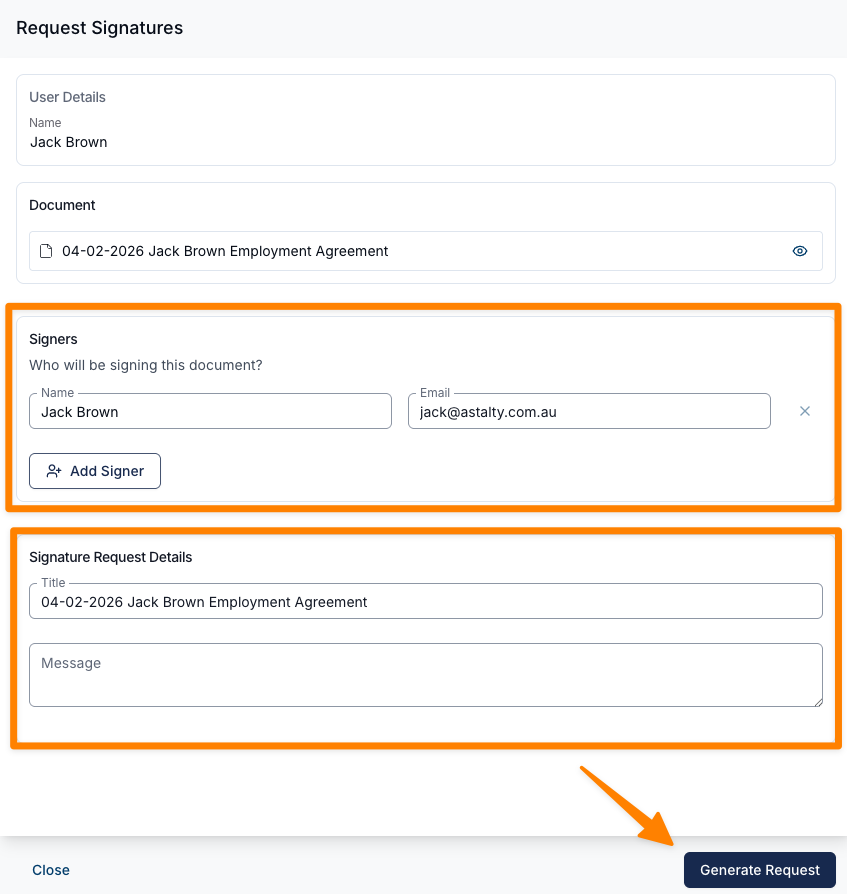
- Complete the recipient fields and add a message when needed.
- Select Generate Request to prepare the request in the connected eSignature service. See Requesting Signatures.
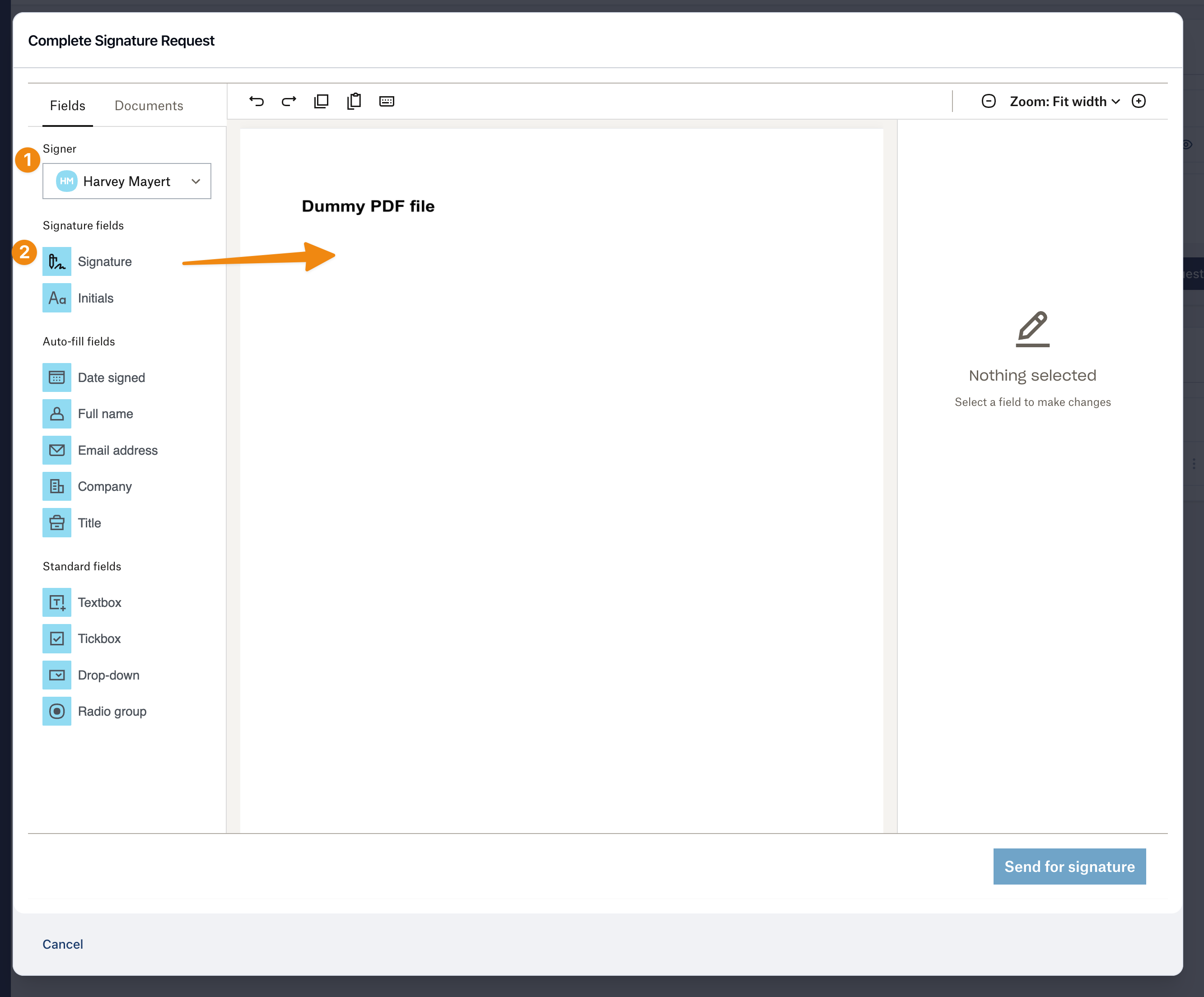
Video Walkthrough
User Record User Groups
Rather than requiring a Record from everyone, you can require it only from the users in one or more User Groups. A Car Insurance Record, for example, only applies to the staff who drive.
When you create or edit a User Record Type you choose one of these, not both:
- Required record: everyone in your organisation needs the Record.
- Required for some user groups: only the users in the User Groups you select need it. Tick this option, then choose the groups under Required for user groups.
Ticking either option disables the other, so a Record Type is required for everyone or for specific User Groups, never a mix of the two.
The video walkthrough uses a Car Insurance Record Type to demonstrate a User Group requirement.
Seeing Which User Groups Need Each Record
The User Record Types list has a User Groups column, so you can check who each Record is required for across the whole list instead of opening every Record Type one by one. The column shows one of three things:
- The names of the linked User Groups: only the users in those groups need the Record.
- All users: the Record Type has Required record ticked, so everyone needs it.
- -: the Record Type is not required, so it is never reported as missing.
The Required column is ticked in both of the first two cases, so a Record required for a single User Group still counts as a required Record. The User Groups column shows how far that requirement reaches.