Utilisation Report
Open Reports > Participants > Utilisation.
Report Overview
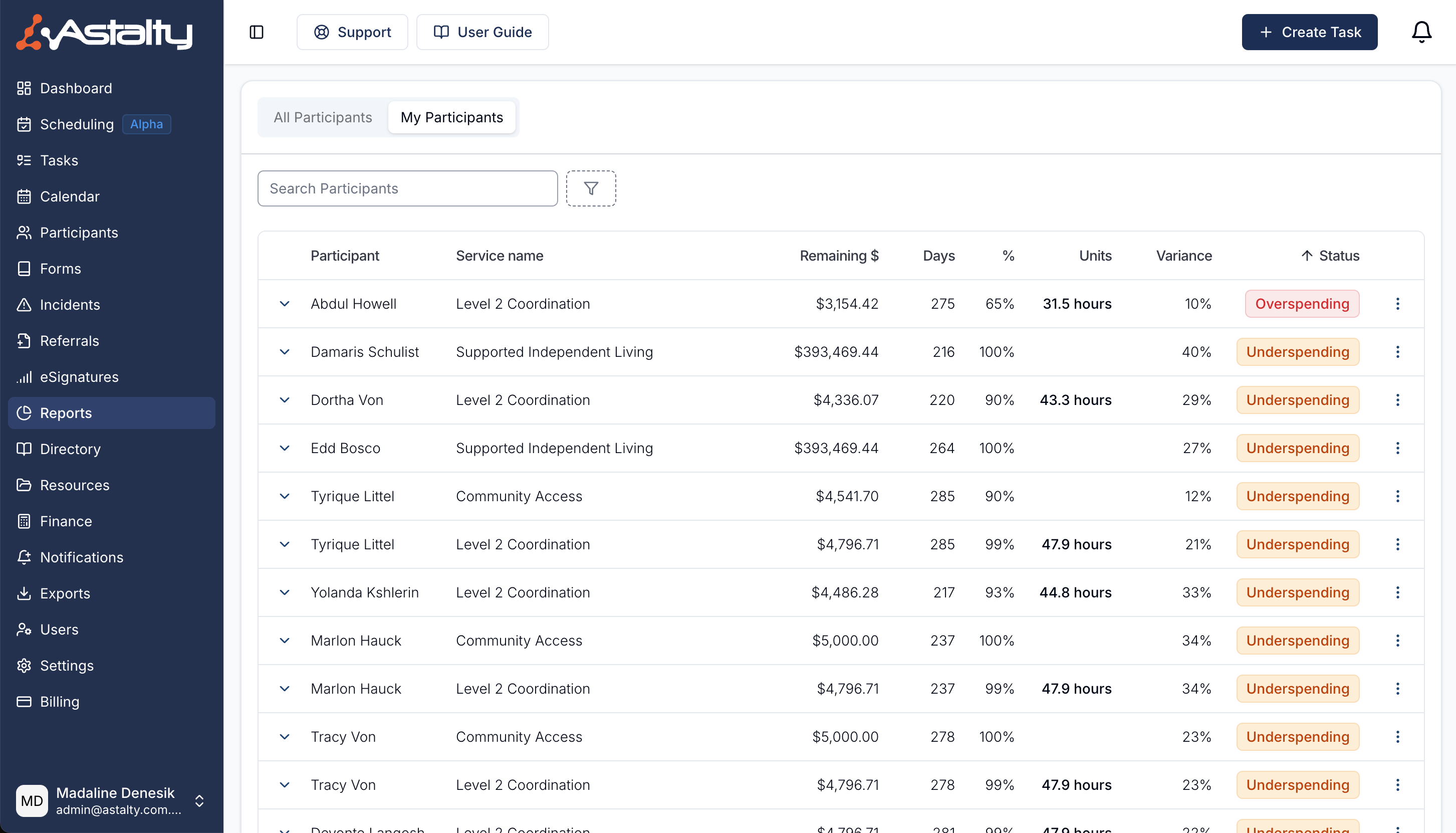
The report shows one row per current Service, with how much of its funding is left and whether it is being spent faster or slower than time is passing. To see one Participant's Services, including a previous plan, use the Utilisation page on their profile instead.
A Service is listed when its own start and end dates cover today. Services that have ended or not yet started are left out, as are Services belonging to archived Participants.
Who Can See It
The Utilisation report is included on the Professional plan and above.
| Role | All Participants | My Participants | Coordinator and Team filters |
|---|---|---|---|
| Admin | Yes | Yes | Yes |
| Manager | Yes | Yes | Yes |
| Team Member | Yes, unless Can access all Participants is turned off for them | Yes | No |
| Support Worker | No | No | No |
Use the Participants filter to switch between All Participants and My Participants. It appears only when you can see all Participants. The report opens on My Participants the first time, then remembers the view you last chose on that browser.
In this report, My Participants works per Service. It shows every current Service for the Participants you are the Primary Coordinator for, plus any other Service where you are the Service Coordinator. Where you are only the Service Coordinator, the Participant's other Services don't appear.
How Spend Is Calculated
Spend is the total of the Participant's charges that use one of the Service's Charge Items. A charge counts when:
- it is billable
- it is not a draft
- it is dated from the Service's start date up to and including today
A charge counts whether or not it has been invoiced. Voiding an invoice returns its charges to uninvoiced, so they still count. Charges dated after today are not counted until that date arrives.
The report measures remaining funding, percentages, units and variance against the funding released so far. The released amount depends on how the Service is set up:
- Without funding periods: the Service's full amount.
- With funding periods: the total of the funding periods that have started so far. A future period is added once it starts.
When a funding period has been reconciled, the remaining amount starts again from the latest reconciled amount, plus any funding released since, less charges dated from the reconciliation date.
Filters
Search matches a Participant's name, preferred name, NDIS number, email or mobile, or the Service name.
Management Type
Filter the report to show only Services with one plan management type: NDIA, Plan or Self Managed.
The filter works at the Service level, so Participants whose plans mix management types are shown accurately: only the Services that match your selection appear. This filter is available on both the All Participants and My Participants views.
Service Category
Show only Services in the chosen NDIS Support Category.
The Service Name filter works the same way, showing only Services with the chosen name.
Team Member, Primary Coordinator & Service Coordinator
Three separate filters let you focus the report on the Participants a particular team member looks after. Each one uses the coordinator roles explained in Primary vs Service Coordinators:
- Team Member - every Service for the Participants the team member is Primary Coordinator for, plus any other Service they are the Service Coordinator of. Use this for a complete view of everything they touch.
- Primary Coordinator - every Service for the Participants the team member is Primary Coordinator for. Use this to review a team member's own caseload without Services they only cover as a Service Coordinator.
- Service Coordinator - only the Services the team member is the Service Coordinator of.
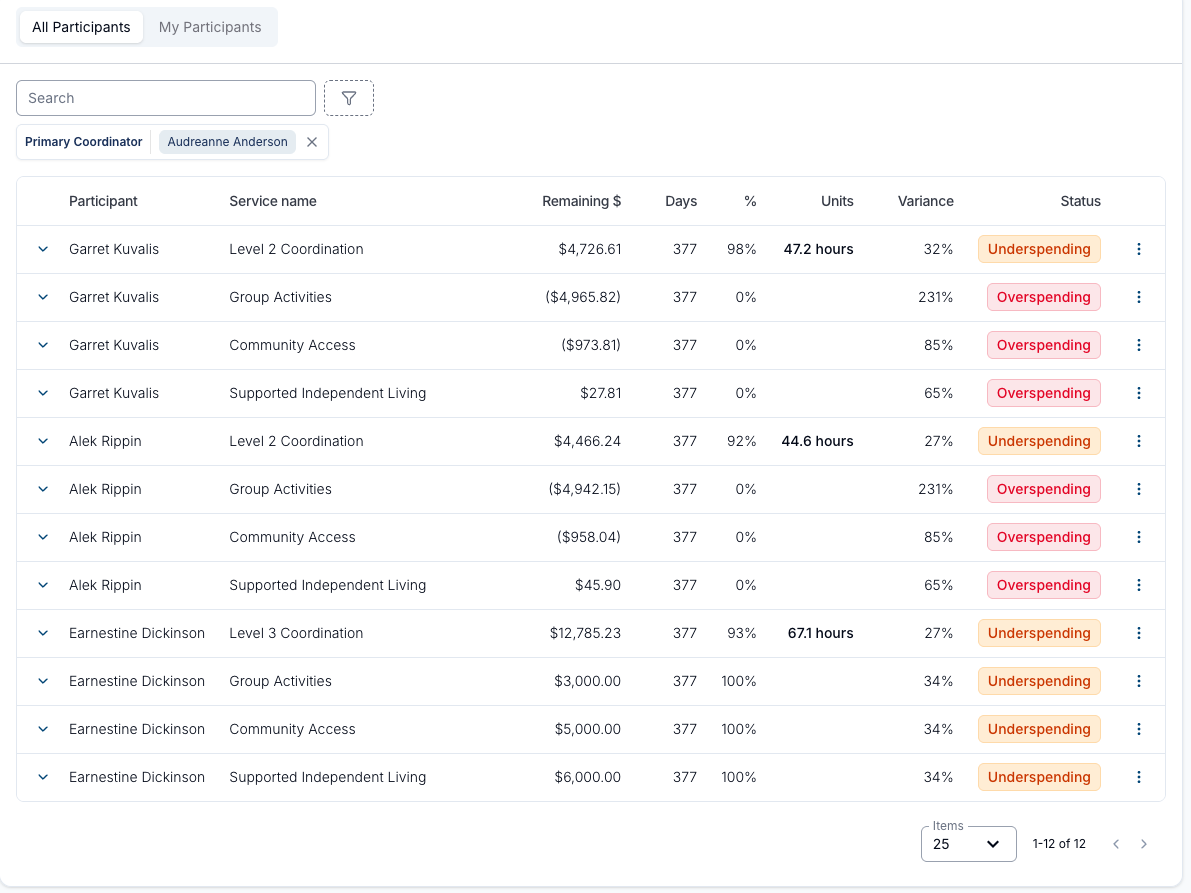
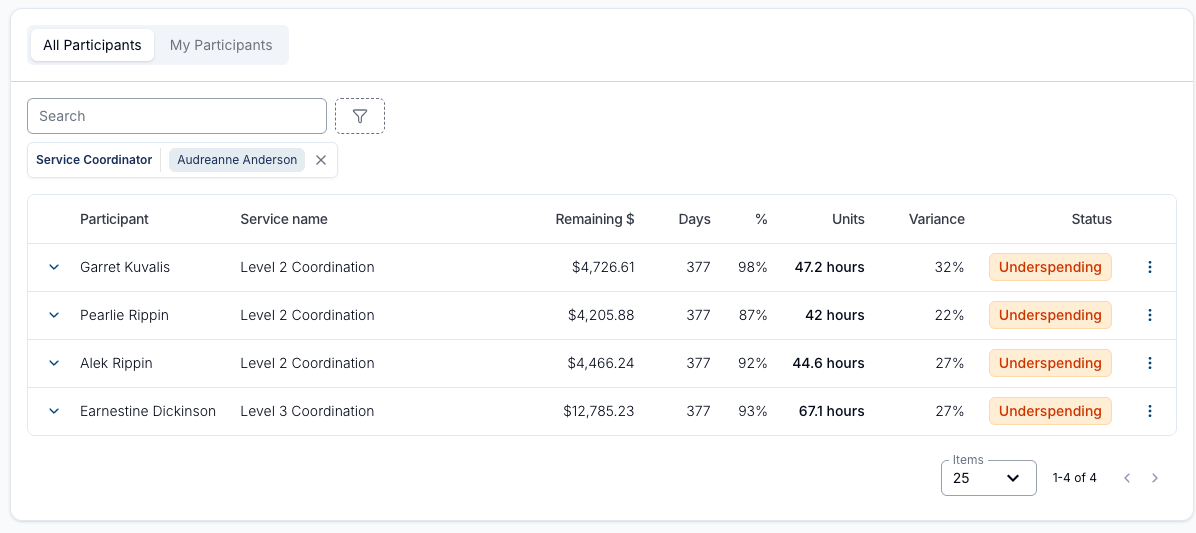
These filters are offered to Admins and Managers.
The Team Member filter is available in All Participants. It is hidden and cleared in My Participants, where the report already limits results to your own Participants and Services. The Primary Coordinator and Service Coordinator filters remain available in both views.
Team
Show every current Service for Participants whose Primary Coordinator, or a Service Coordinator on their current plan, belongs to one or more chosen teams. The filter appears for Admins and Managers when Teams are enabled. Your Team choice is remembered on that browser and applied the next time you open the report.
Tags
Narrow the report to Participants carrying selected Participant Tags, so you can review utilisation for a cohort rather than the whole caseload.
Select one or more tags, then choose how they combine:
- Match any - Participants carrying at least one of the selected tags. This is the default.
- Match all - only Participants carrying every selected tag.
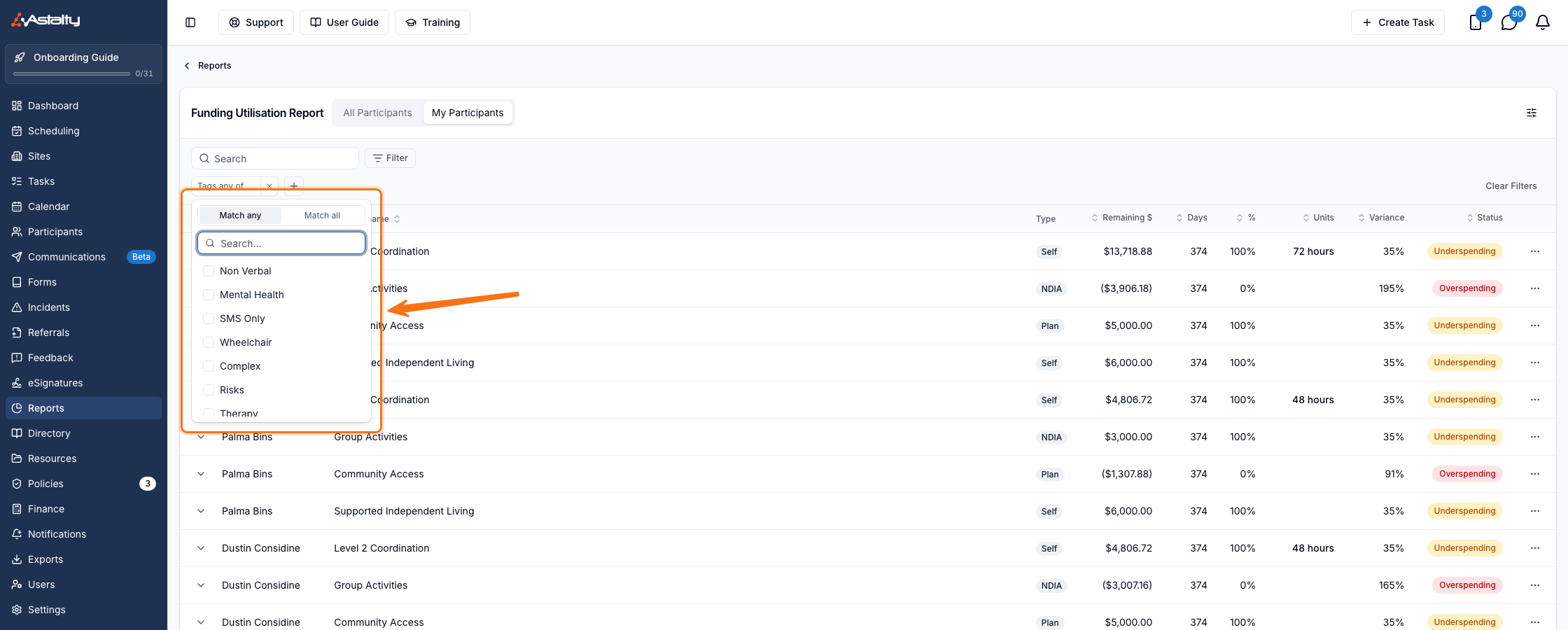
This filter is available on both the All Participants and My Participants views. It appears only when Participant Tags are enabled for your account and your role can view all tags.
Other Filters
| Filter | What it does |
|---|---|
| Support Purpose | Shows Services in Core, Capacity Building, Capital or Recurring support categories. |
| Region | Shows Services for Participants in the chosen regions, or Unassigned. Appears when Regions are enabled and you can view all Regions. |
| Site | Shows Services for Participants linked to the chosen sites. Appears when Scheduling is enabled and you can view sites. |
| Funding Periods | Yes shows only Services set up with funding periods. No shows only Services without them. |
| Over-committed | Yes shows only Services whose spent and scheduled charges exceed what is released for a funding period. No hides those Services. |
Report Columns
The report opens sorted by Participant name, A to Z. You can also sort by Service Name, Remaining $, Days, %, Units, Variance and Status.
Participant
This is the name of the Participant for this Service.
Service Name
The name of the Service. A calendar icon beside the name means the Service has funding periods.
Type
The plan management type for the Service: NDIA, Plan or Self. Because this is shown per Service, a Participant with a mix of management types has the correct type against each Service.
Support Purpose
The support purpose for the Service: Core, Capacity Building, Capital or Recurring. A dash means the Service's category has no support purpose.
Remaining $
The released funding left in the Service: funding released so far, less spend. See How Spend Is Calculated.
The Days column beside it shows how many days are left until the Service ends, or until the current funding period ends when the Service has funding periods.
%
The funding left in the Service, as a percentage of the funding released so far.
Units
The remaining amount converted into units, using the price of the Charge Item chosen in Calculate remaining units using when the Service is set up. It is shown in that Charge Item's unit, most often hours. The column is blank when no Charge Item is chosen.
Utilisation Variance
The Variance column is the difference between how much of the Service's time has elapsed and how much of its funding has been used.
For example, if a Service runs for two years and one year has passed, 50% of its time has elapsed. If 80% of the funding has been used, the variance is 30%.
The variance shows as a percentage by default. To show it as a dollar amount instead, open the report options and set Variance display to $. Astalty remembers that choice on your browser.
When a Service has funding periods but none has started yet, the variance is 0.
Status
The status shows whether the Participant's funding for that Service is being overspent or underspent.
- Overspending - the share of funding used is greater than the share of time elapsed, so the funds will run out before the Service ends at the current rate.
- Underspending - the share of funding used is the same as or less than the share of time elapsed.
An Over-committed badge appears when spent and scheduled charges exceed what is released for a current or upcoming funding period. Because it counts bookings, a Service can be Underspending so far and still be over-committed. Hover over the badge to see the first period that is over and, if you can view support charges, the amount over. The badge updates when charges change and overnight.
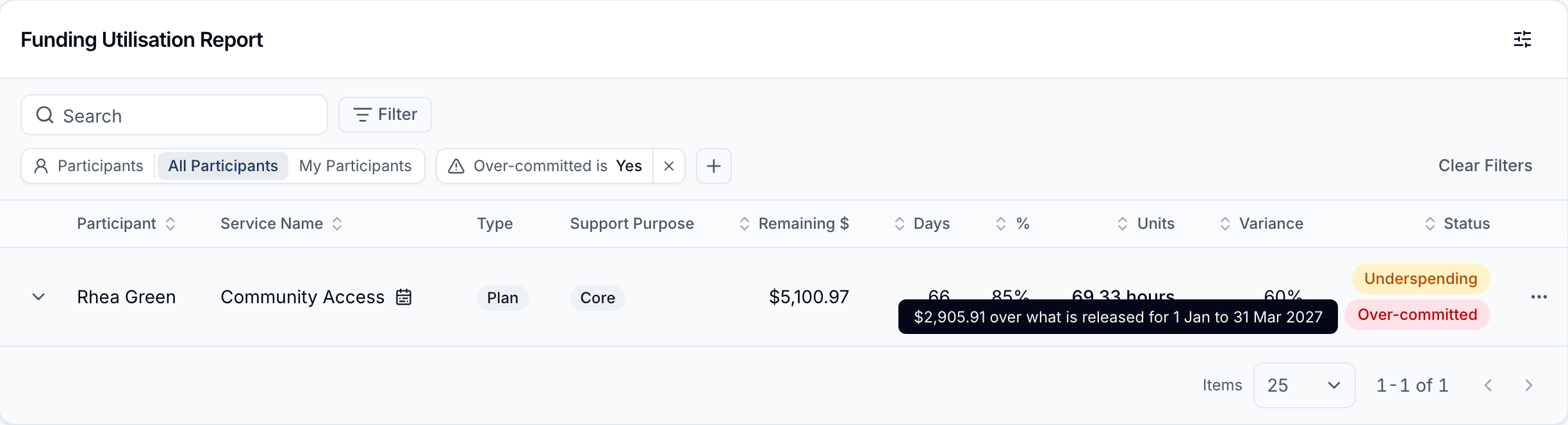
Funding Utilisation explains how spent and scheduled charges are measured against each funding period.
Detailed View
Click the down arrow at the start of a row to see the Service's detail: how much it is over or underspending by, how much of its time has elapsed, and how much of its funding has been spent. For a Service with funding periods, it also shows the released funds spent and any reconciliation date and amount.
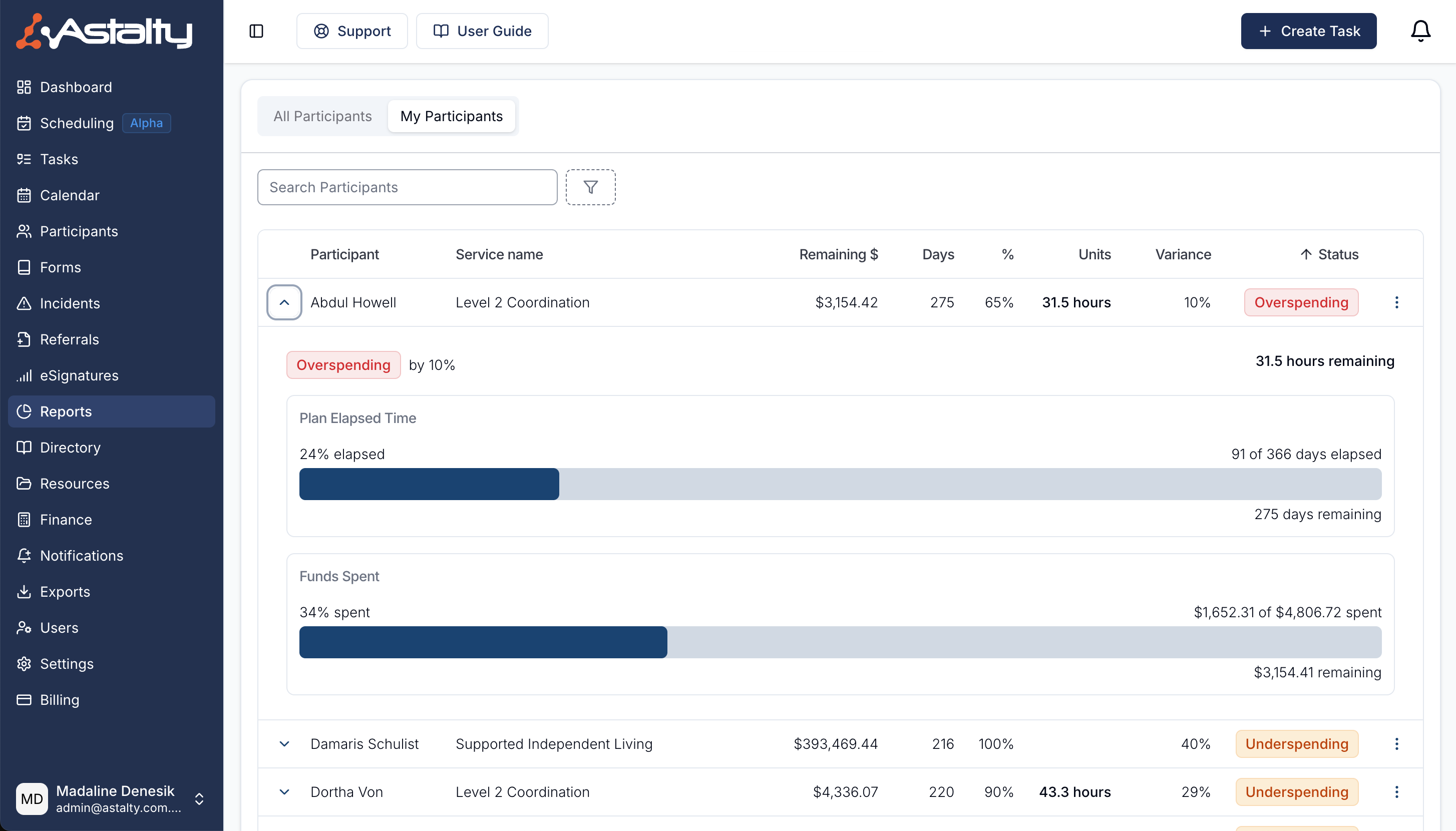
The row's action menu has View Participant, which opens the Participant's profile.
To download utilisation data, use the Utilisation Export.