- Day-to-Day
- Charges & Finance
Charges & Finance
Tasks can have many charges but you may have already assigned a Primary Charge on the Task Board when you created the Task.
What is the Primary Charge?
The Primary Charge represents the Charge Item that makes up most of the work done for a Task. This is often something like Level 2 or Level 3 Support Coordination.
It must be Hourly
The time input on the Task Board and on the right hand side when viewing a Task is always in minutes - therefore, the Primary Charge must always be an hourly Charge Item.
Charging for Kilometres
If you need to charge for something that is not billed by the hour - for example, kilometres, you can do this within the Finance Tab.
Finance Tab
Once you've opened a Task from the Task Board, you can navigate to the Finance tab. This is where you will see all charges for a Task, including the Primary Charge, which is marked P.
The table shows each charge's Name, Quantity, Total cost and Claim Type.
Anyone who can open the task sees its Finance tab and the charge totals, whether or not they have access to the Finance pages. Adding, changing or deleting charges needs you to be able to edit the task: it must be yours, or you must be an Admin or Manager.
Quantity vs Time
The duration input on the Task Board and on the right hand side when viewing a Task is always in minutes however in the Finance Tab, the quantity is entered as a decimal. So 90 minutes would be shown as 1.5.
You will notice that if you update the duration for a Task the quantity for the Primary Charge will automatically update and vice versa.
You can also type a fraction into Quantity, such as 1/3, and Astalty converts it to a decimal. The quantity saves when you press Enter or click away.
Additional Charges
It's common to have to charge for more than 1 thing as part of a Task - you might need to charge for travel time, kilometres or something else.
To add additional charges, navigate to the Finance tab within a Task and click Add Charge.
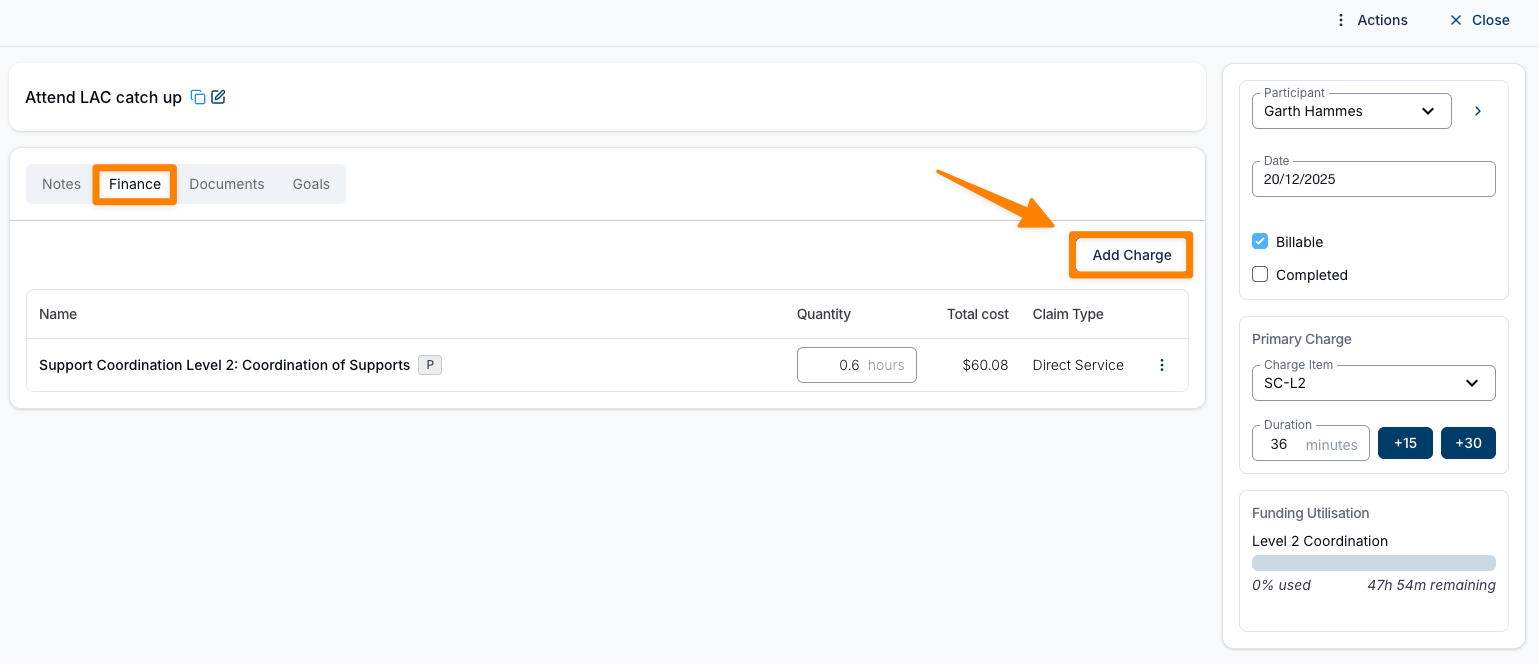
You will then be prompted to select the Charge Item you need and adjust the quantity.
- Add Charge needs a Participant on the task.
- The list offers Charge Items on the Participant's services that are active on the task's date.
- If the task has no charges yet and you pick an hourly Charge Item, it becomes the Primary Charge with the task's duration as its quantity. Every other new charge starts at a quantity of 0.
Changing the Claim Type
You can change the claim type for a charge to something other than the default. For example you may need to change the Claim Type to Provider Travel or Non-Face-to-Face-Services.
On the Finance tab, select the Claim Type value for a charge and choose the correct option.
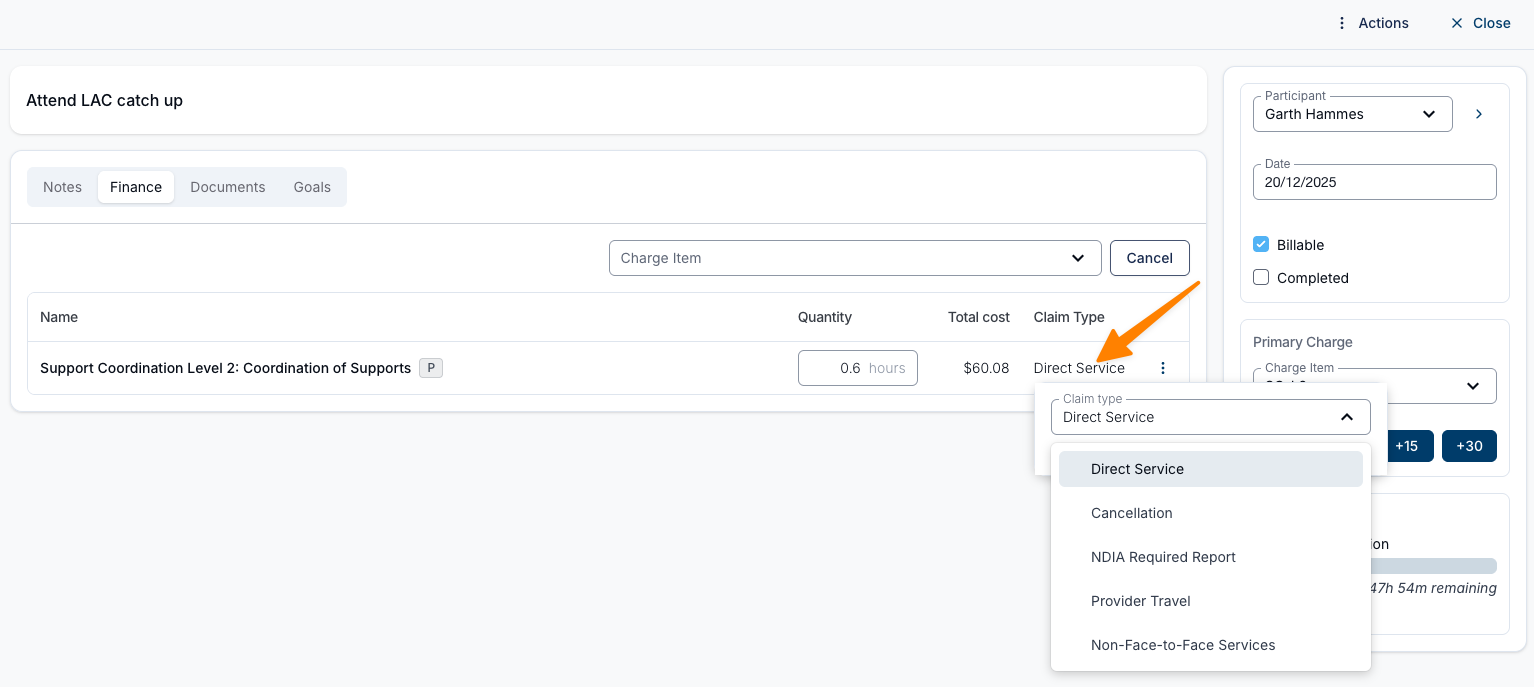
- A new charge starts with the Charge Item's default claim type, or Direct Service if it has none.
- Choosing Cancellation also asks for a cancellation reason, which starts as Other.
- A lock icon means the Charge Item's number is linked to its claim type, so the claim type can't be changed. For a Cancellation charge you can still change the cancellation reason.
Deleting a Charge
Click the three dots at the end of the charge's row, select Delete, then confirm with Remove. Deleting the Primary Charge leaves the task without one until you set it again on the Task Board or in the Task View.
A charge can't be deleted once it has been invoiced, or when a payment has been allocated to it.
When a Charge Locks
- Invoiced: an invoiced charge can't be changed, overridden or deleted. The task itself locks too. See Invoiced Tasks Are Locked.
- In an invoice batch: while a charge is in an invoice batch that is processing or finalised, it can't be changed. Charges in a draft invoice batch can be changed, and the batch total updates.
- Charge Item price changes: when a Charge Item's price changes, whether an Admin edits it or it updates automatically, charges dated before that day keep the price they had. Charges dated that day or later use the new price, unless their price has been overridden.