- Administration
- Settings
- Users Settings
Users Settings
User Groups and Roles
Introduction
At first, the difference between a user group and a user role may be unclear, but we have built both of these into Astalty for future expansion around fine-grained user permissions and communications. However, for now, they do still serve an important purpose.
Roles
User roles control what a user can do. These roles are pre-defined, and you cannot edit or create roles. There are 3 roles;
- Admin
- Manager
- Team Member
INFO
For those users that were using Astalty when we had user roles, The Support Coordinator user role was migrated to the Team Member user role.
Throughout this guide, you will see references to which roles can perform particular actions. By default, any new users will be created as Team Members. Currently, a user can have multiple roles; however, the permissions are hierarchical. That means that;
- An Admin can do everything a Manager can do
- A Manager can do everything a Team Member can do
The reason we have allowed for multiple roles is so that in the future, we can easily implement further user interface customisations and permissions based on a User's type, or combination of roles.
INFO
It is on our roadmap to provide the ability for user permissions to be controlled at a finer level.
Account Owner
Alongside the user roles above, there is one special designation that isn't selected from the user roles dropdown - and that is the Account Owner.
The Account Owner is the user who initially signed up to Astalty. There are a few things that only the Account Owner can do, such as managing the subscription and deactivating/reactivating users. We will outline these types of tasks that require the Account Owner throughout the user guide.
The Account Owner can be transferred to another Admin user from within Astalty - see Updating the Account Owner for the steps.
User Groups
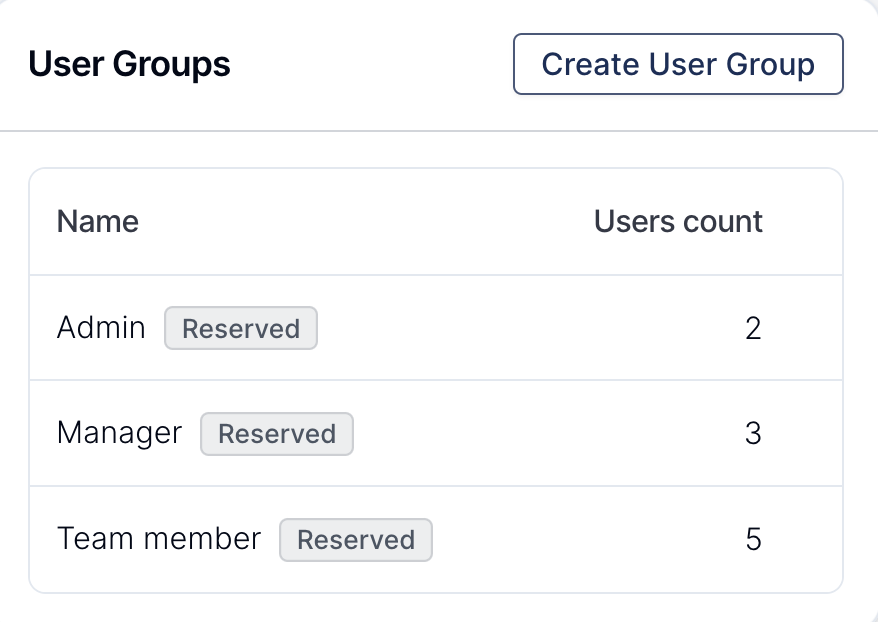
User Groups have been implemented to allow you to define how your business is structured and the groups of users that make up your business. You will see there are 3 pre-defined groups that will update automatically when you change a user's role. For example, if you assign someone the Manager role, they will also be assigned to the Manager group.
Team Member Default Group
When a user is added to Astalty, they will be assigned the Team Member user role as well as the Team Member group. You are free to change this after they have signed up.
You are free to create and assign as many User Groups as you like.
User roles can also be used to create groups of users, so you can have control over which groups are notified for particular notifications.
An Example
For Utilisation Notifications, you may want to set up multiple notifications.
- At a Utilisation Variance of 10%, you may want to notify the Primary Coordinator, as well as all Managers
- At a Utilisation Variance of 20%, you may want to notify the Support Coordinator Manager (you could create a group for this)
- At a Utilisation Variance of 30%, you may want to notify everyone in the Admin group
Staff Name Display
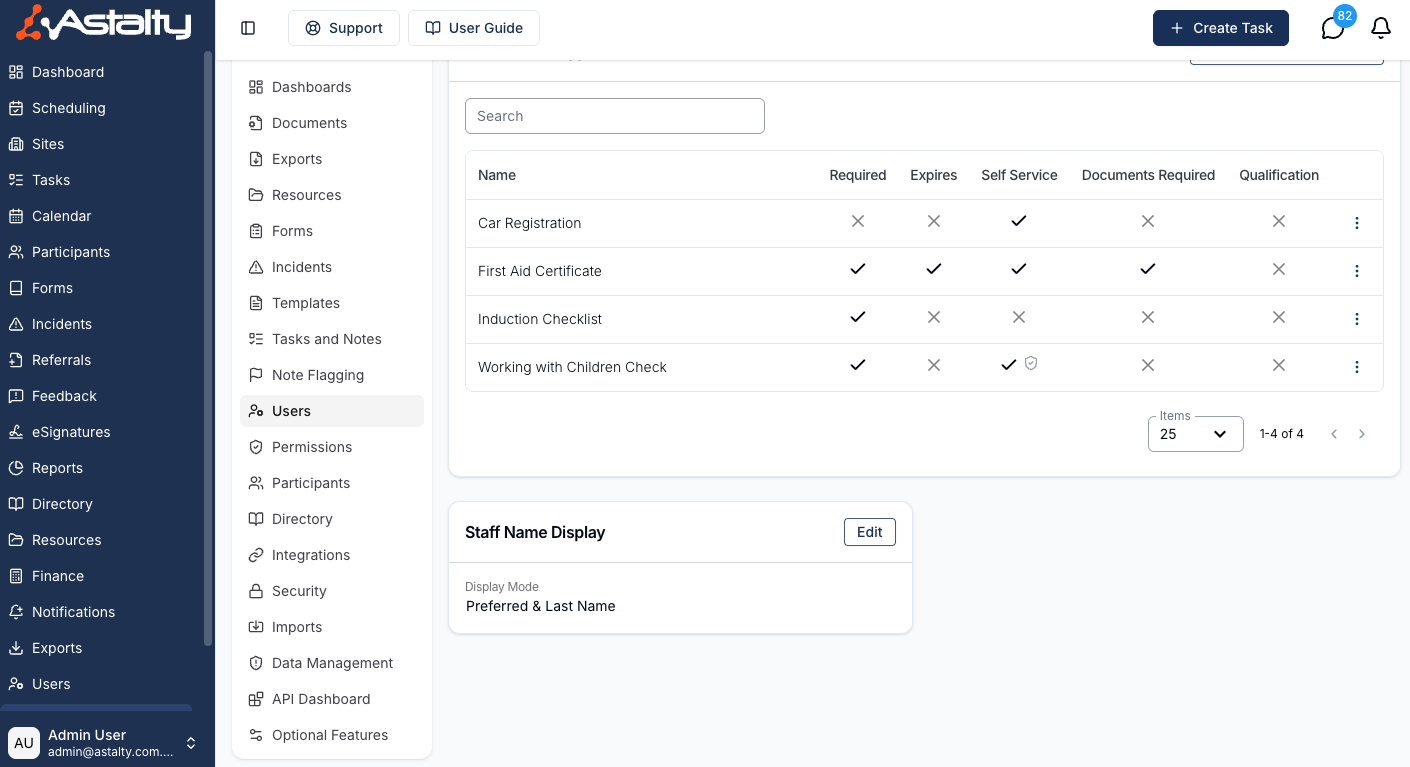
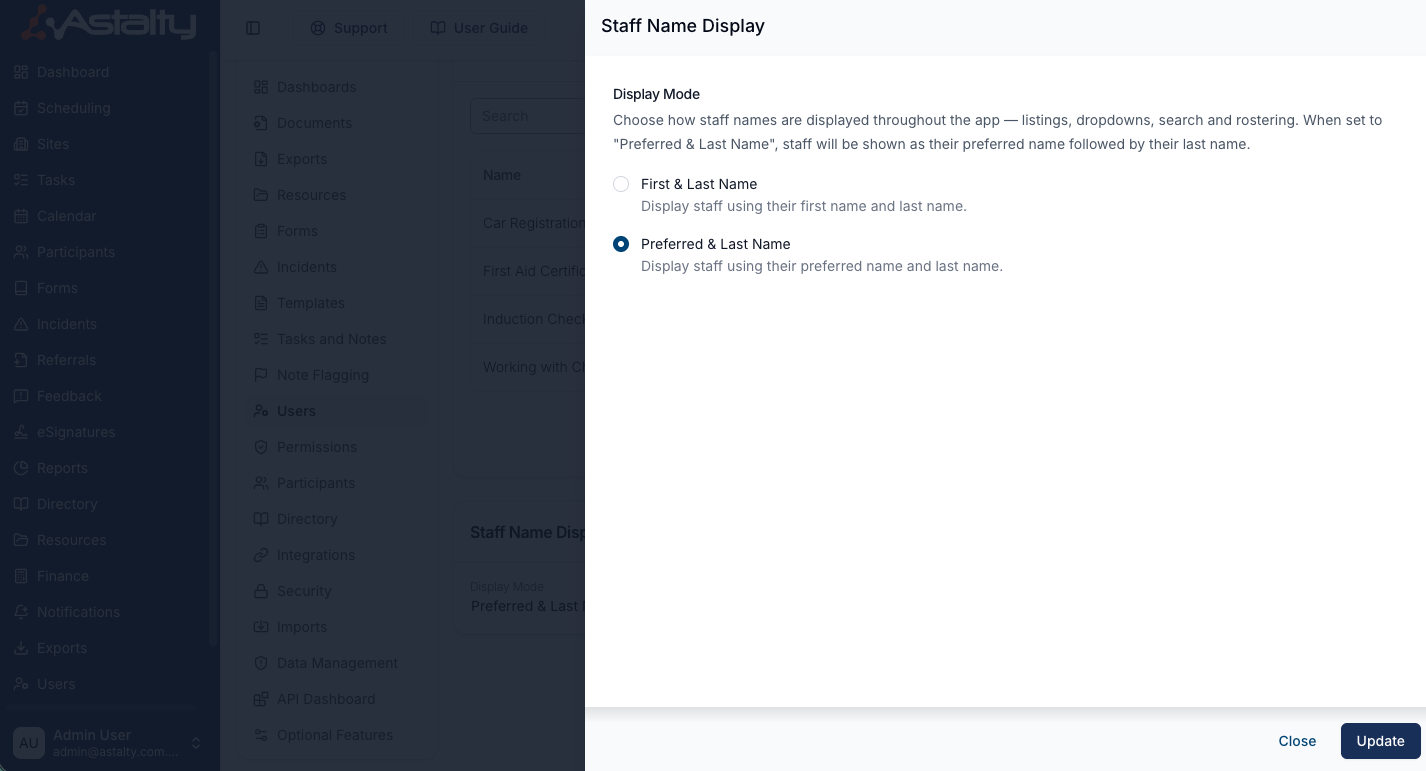
The Staff Name Display setting controls how staff names appear throughout the app — in the user list, dropdown menus, search results, rostering, teams and attendee pickers. This works the same way as the Participant Name Display setting, but for your staff. It changes only how names are displayed — it does not change or overwrite any stored staff data.
The setting applies to all staff at once and defaults to First & Last Name, so nothing changes until an admin opts in.
To access this setting, navigate to Settings → Users and scroll down to the Staff Name Display card, then click Edit.
Display Mode Options
First & Last Name
Staff are displayed using their first name followed by their last name.
Example:
If a staff member's profile contains:
- First Name: Benjamin
- Preferred Name: Ben
- Last Name: Smith
They will display as: Benjamin Smith
Preferred & Last Name
Staff are displayed using their preferred name followed by their last name. If no preferred name is recorded, the system will default to the first name.
Example:
If a staff member's profile contains:
- First Name: Benjamin
- Preferred Name: Ben
- Last Name: Smith
They will display as: Ben Smith
Skills
The Skills card on Settings → Users is where you build your organisation's catalogue of worker capabilities — things like Auslan or Meal Preparation. Once a skill exists in the catalogue, you can record it against a worker's profile and add it to a Participant's desired skills, and Astalty will show how well each worker fits when you roster.
Skills are deliberately not a compliance tool — they have no expiry date and never block a shift. For the full walkthrough, including how to create, rename, and archive skills, see Skills.
Exit Reasons
The Exit Reasons card holds the list of reasons you can record against a team member when you deactivate them. Every organisation starts with five, and only Admins can change the list. For the full walkthrough, see Exit Reasons.