- Administration
- Imports
- Services Import
Services Import
Overview
This user guide article outlines how to prepare and complete the Unscheduled Services import. Use it to bring services and their Charge Items into Astalty for Participants who already have a current plan — including remaining balances and, where needed, funding schedules for PACE plans.
Accessing the Import
Head to the Import option within the Settings menu, then select Unscheduled Services.
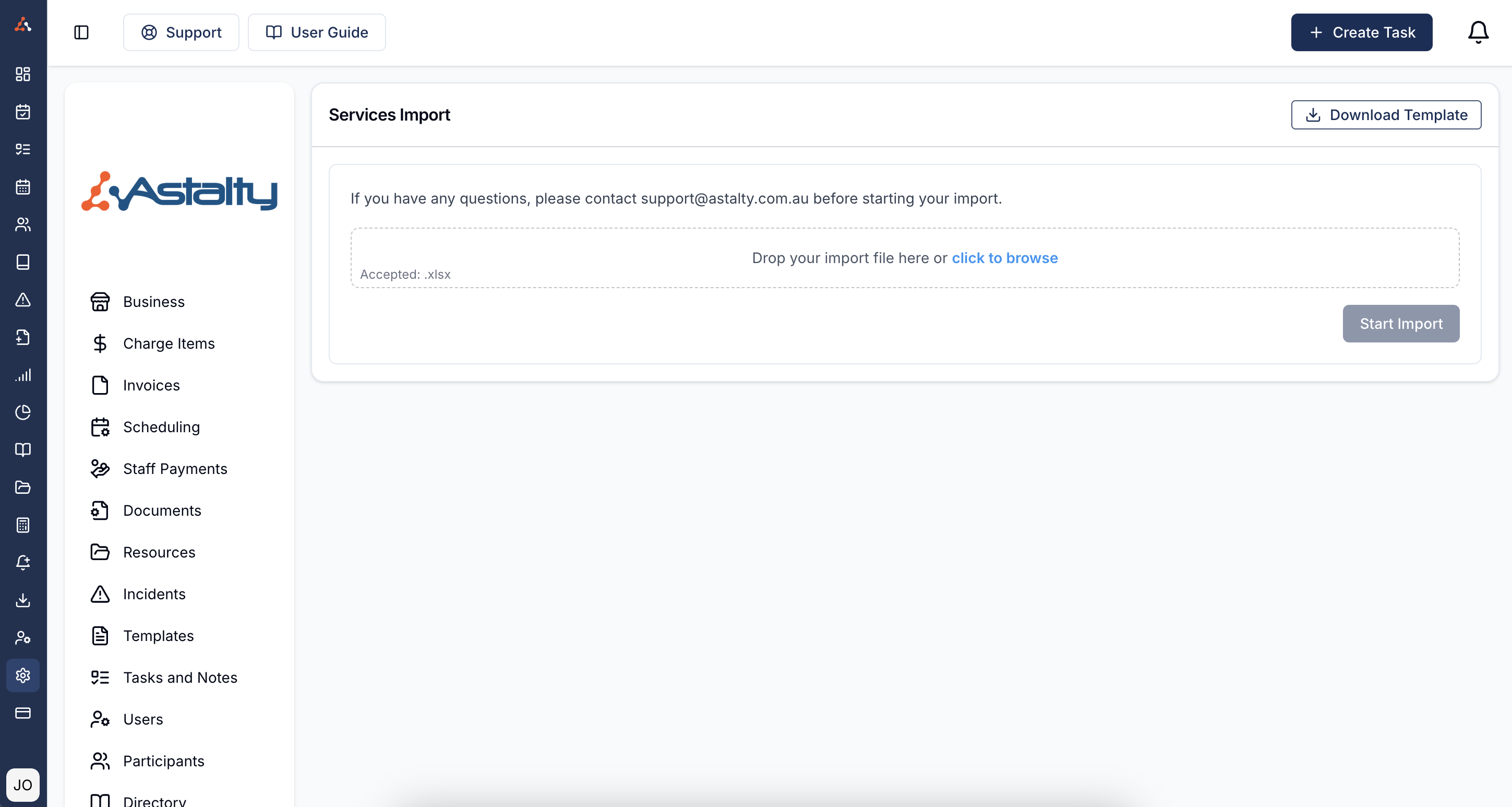
If you have any questions, please contact imports@astalty.com.au before starting your import.
Completing the Import
How to use the Services Import
- Read the Import Requirements below.
- Confirm every Participant you are importing services for already exists in Astalty and has a current plan.
- Confirm any Users who should appear as Service Coordinators (or Primary Coordinators) already exist in your organisation.
- Download the Services Import Template from the Services Import page. Optionally use Download Charge Items for a list of Charge Items already on the account.
- Populate the template (remove the example rows before you submit):
- Service Data Import — one row per service.
- Service Charge Item Mapping — the Charge Items for each service name.
- Funding Periods — only if a service has a funding schedule.
- Remaining Amount and Reconciled Date — together, when the balance needs to reflect spend before Astalty.
- Email your completed file to imports@astalty.com.au, or contact that address to arrange sharing it securely via your preferred cloud storage provider.
- Once the import is complete, you will receive an email from Astalty.
Import Requirements
The template is an Excel workbook (.xlsx) with up to three sheets:
- Service Data Import — one row per service
- Service Charge Item Mapping — the Charge Items that make up each service
- Funding Periods (optional) — one row per funding period, used when a service has a funding schedule
Service Name links the first two sheets. Charge Items are matched to a service only when the Service Name matches exactly (including spelling and capitalisation).
Service Data Import
These fields are required for every row:
- NDIS Number — must match an existing Participant who has a current plan. Always use the Participant's NDIS number. If they do not have an NDIS number, contact imports@astalty.com.au before importing.
- Service Name
- Service Amount — must be a number (for example
5000.50) - Management Type — must be one of ndia, plan, or self
- Service Coordinator — when provided, must be a valid email that matches a User in Astalty. If it is blank or does not match, the Participant's Primary Coordinator is used instead.
These fields are optional:
- Participant Name — for your reference only
- Service Import Key — a unique reference for the row (for example
SVC-0001). Required when Has Funding Schedule is Yes, so the Funding Periods sheet can link periods to this service - Has Funding Schedule (Y/N) — set to Yes or Y to create the service with funding periods from the Funding Periods sheet. Only available when the Participant's current plan is a PACE plan
- Period Count — if provided, must match the number of Funding Periods rows for that Service Import Key
- Remaining Amount and Reconciled Date — see Remaining balance and reconciliation below
Remaining balance and reconciliation
Remaining Amount and Reconciled Date must be filled in together, or both left blank.
- Reconciled Date — the cutover date in dd/mm/yyyy. For a migration, use the day before the client started using Astalty. Astalty only counts its own bookings after this date. The date must fall inside the Participant's current plan. For services with a funding schedule, it also cannot be in the future.
- Remaining Amount — how much budget is still left as at that date. This is what Astalty will show as the client's remaining balance after import.
Reconciliation works differently depending on whether the service has a funding schedule.
Services without a funding schedule
Remaining Amount is based on the full service budget:
Total funded − total utilised = Remaining Amount
Leave Remaining Amount blank only if the full Service Amount should show as available (for example a brand-new plan with no spend yet).
Services with a funding schedule
Remaining Amount is based on the funding period your Reconciled Date falls in — not the full service budget.
- Find which funding period the Reconciled Date sits in (the current period).
- Add up the funding released so far — that period's amount plus every period before it.
- Subtract what has already been utilised.
- Enter that result as Remaining Amount.
Do not include funding from periods that start after the Reconciled Date. That funding is added to the remaining balance when each later period is released, which is why it is left out of the reconciliation calculation. Remaining Amount also cannot be higher than the funding released so far.
If you leave Remaining Amount blank on a funding-schedule service, Astalty still imports it but warns that the service will show 100% of its budget as available.
Example
Total service budget (Service Amount): $1,000
Plan runs across four funding periods
By period three (where your Reconciled Date falls), $750 has been released
You've already used $150 of the Participant's funding
| Scenario | Calculation | Remaining Amount |
|---|---|---|
| Services without a funding schedule | Total funded ($1,000) − total utilised ($150) | $850 |
| Services with a funding schedule Reconciled in period 3 | Released so far ($750) − total utilised ($150) | $600 |
With a funding schedule, the remaining $250 is not included in the reconciliation figure. It will be added to the remaining amount when it is released in the next funding period.
Funding Periods
Complete this optional third sheet when any Service Data Import row has Has Funding Schedule = Yes. Every column is required on each period row.
Enter each period's funded amount in Funding Period Amount — the full amount allocated to that funding period. Do not reduce these figures for what has already been spent. Spend is handled separately by Reconciled Date and Remaining Amount on the Service Data Import sheet (see Remaining balance and reconciliation).
| Column | Notes |
|---|---|
| Service Import Key | Must match a Service Data Import row that has Has Funding Schedule = Yes |
| Period Sequence | Must run from 1 upward without gaps or duplicates (maximum 60 periods) |
| Funding Period Start | dd/mm/yyyy |
| Funding Period End | dd/mm/yyyy |
| Funding Period Amount | The funded amount for that period (zero or greater). Do not subtract utilised spend |
Period rules:
- Each period must span at least 2 days
- Periods must follow on with no gaps or overlaps (each next period starts the day after the previous ends)
- Together, periods must cover the Participant's current plan exactly — first period starts on the plan start date, last period ends on the plan end date
- Period amounts must add up exactly to the service's Service Amount
- Funding schedules are PACE-plan only — non-PACE plans will fail validation if Has Funding Schedule is Yes
For more on how funding periods work in Astalty after import, see Funding Periods.
Service Charge Item Mapping
Every column is required for each Charge Item row:
- Service Name — must match a Service Name used on the Service Data Import sheet
- Number — NDIS line item number (for example
07_002_0106_8_3) - Name — Charge Item name
- Reference — matches an existing Charge Item in Astalty by exact reference. If no match exists, a new Charge Item is created — unless that NDIS Number already exists under a different reference, in which case the row fails (use the existing reference exactly, or rename the existing Charge Item first). Charge Items that belong to a Charge Item set cannot be used.
- Units — a valid unit code (for example H for hour, E for each)
- Price — a number between 0 and 999,999.99
- Claim Type — a valid claim type (for example Direct Service, Provider Travel)
Additional rules:
- All Charge Items mapped to a single Service Name must belong to the same support category (their Number must share the same leading digits). Mixing categories under one service name fails the import.
- A service will not be created if one of its Charge Items is already on the Participant's current plan.
Troubleshooting
If you encounter any issues during the import process, please contact imports@astalty.com.au for assistance.