- Insights
- Notifications
- Referral Follow Up Notifications
Referral Follow Up Notifications
Overview
Referral Follow Up notifications alert your team when a referral has been sitting in the same status for a set number of days without progressing — so referrals stop quietly stalling between acceptance and completion.
This is different from Referral Notifications, which alert your team the moment a new referral is submitted. Referral Follow Up notifications are about referrals that have already been received and haven't moved since.
By default, Admins can create and manage these notifications. Managers can see the Referral Follow Up list, but creating, editing, cloning, or deleting a notification needs the Referral Follow Up notification permissions (or an Admin). Team Members and Support Workers don't see the page at all.
Finding the notification
- Go to Notifications in the main menu.
- Open the Forms group.
- Select Referral Follow Up (just below Referrals).
Creating a Referral Follow Up notification
On the Referral Follow Up page, click Create Notification.
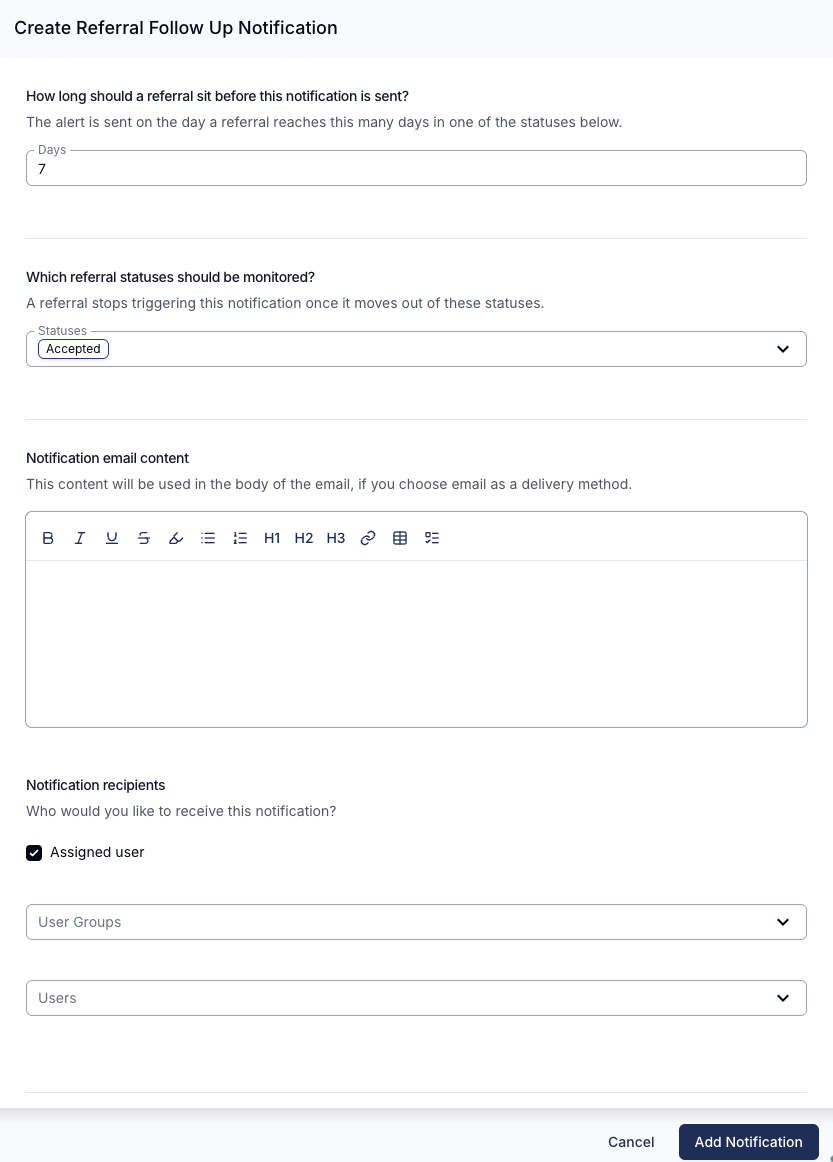
Days
Enter how many Days a referral can sit in one of the monitored statuses before Astalty alerts you. The default is 7, and you can enter anything from 1 to 365.
The count starts from the last time the referral's status changed — not from when the referral was created. Moving a referral to a new status resets the clock.
Statuses
Choose which referral statuses to monitor. You must select at least one. The available statuses are:
- New
- Under Review
- Waitlist
- Accepted
- Declined
- Completed
A referral stops triggering the notification once it moves out of the statuses you've selected.
Notification email content
Optional. If you send email notifications, this rich-text content is added to the email body (for example, the steps your team should take when chasing a stalled referral). It doesn't replace the standard message, and it doesn't appear in the in-app notification.
Notification recipients
Select at least one of:
- Assigned user — the user the referral is assigned to. On by default.
- User Groups — one or more staff User Groups
- Users — specific team members
Notification methods
- Within Astalty — in-app notification. On by default.
- Email — email to each recipient.
You can enable either or both, but at least one is required.
When you are ready, click Add Notification (or Update Notification if you are editing an existing one).
Managing notifications
You can create more than one Referral Follow Up notification — for example, one for Under Review at 3 days and another for Accepted at 14 days.
The list shows each notification's Threshold, monitored Statuses, Methods, and Recipients. There's no name field — rules are identified by their threshold and statuses.
From the actions menu on a notification you can:
- Edit — change the days, statuses, recipients, methods, or email content
- Clone — start a new notification from an existing one
Delete is available inside the edit drawer. There's no way to pause a notification, so delete it if you no longer want it to run.
What recipients see
In Astalty
The in-app notification is titled Referral Follow Up. The message reads "Referral {reference} has been {status} for {number} days and needs following up." with a View Referral link that opens the referral.
The email subject is Referral Follow Up - {reference}. The body carries the same message, followed by any custom content you configured, and a View Referral button.
Deactivated users are not included as recipients, even if they are in a selected user group. Recipients are also de-duplicated by email address, so a user who is both the assignee and in a selected group only gets one notification.
Things to know
- Archived referrals are skipped — they never trigger a follow up notification.
- Referrals that existed before this feature shipped use the last time their record was updated as the starting point, rather than a true status-change date. Because the alert only fires on the exact day a referral reaches your Days threshold, an older referral that was already past that threshold won't trigger one — it will only start behaving normally after its status changes again.
Related
- Referral Notifications — alert your team when a new referral is submitted.
- Referral Follow Up — how to work through and progress a referral.
- Waitlist — park referrals you can't take on straight away.
- Incident Follow Up Notifications — the same idea for incidents that stop progressing.