- Administration
- Settings
- Regions
Regions
Regions let you group your Participants, staff and sites by area — Brisbane North, Gold Coast, Northern Rivers, and so on — and then filter by that grouping across lists, the schedule, reports and exports. A Region is just a name: you create the ones that match how your organisation is split up, tag records to them, and use them as a lens over your data.
What a Region is — and what it isn't
A Region is a label with a name and nothing else. There's no description, colour, hierarchy, postcode or boundary, and Regions can't be archived. You can tag a Participant, staff member or site to as many Regions as you like, or none at all.
Only participants, staff and sites can be assigned to a Region. Teams, Charge Item Sets, cost codes and organisations can't.
Setting up Regions
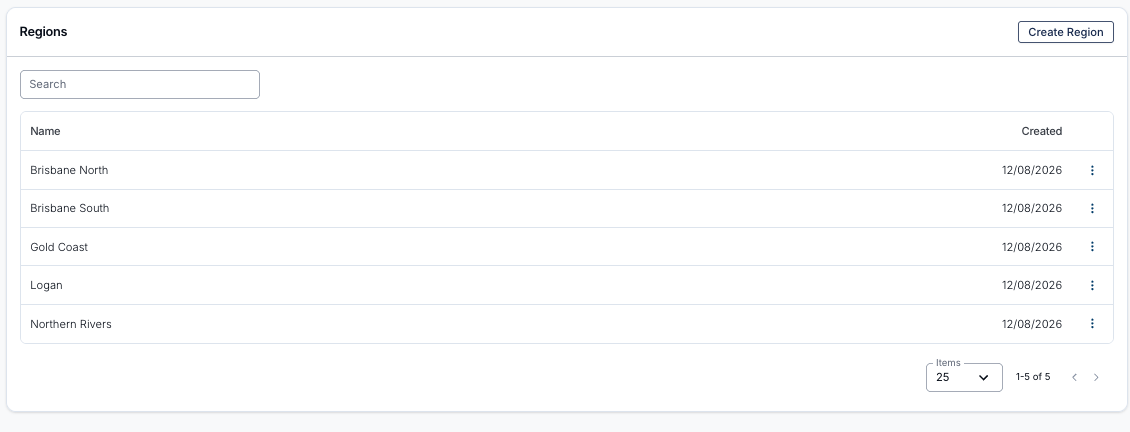
Regions are managed at Settings → Regions. The page lists every Region on your account with its Name and the date it was Created, and you can search by name or sort either column.
Creating a Region
Click Create Region, enter a Name, and click Create. Region names must be unique within your account, so you can't have two called Gold Coast.
There's no limit on how many you create, but Regions work best when there are few enough to be a useful filter — think of the handful of areas your organisation actually reports on rather than one per suburb.
Renaming a Region
Click the actions menu at the end of a Region's row and choose Edit, change the Name, then click Update.
Renaming only changes the label. Everything tagged to the Region stays tagged to it, and any saved filters keep working.
Deleting a Region
Deleting is done from the same Edit drawer — open the Region and click Delete at the bottom, then confirm.
Assigning Regions to Participants, staff and sites
Regions are assigned from a Regions card on each record's detail page:
- Participants — the Participant's profile page
- Staff — the staff member's profile page
- Sites — the site's detail page
The card shows the record's current Regions as chips, or No regions assigned. if there aren't any. Click Edit, tick the Regions you want in the Select Regions list, and click Update Regions. It's a checkbox list, so a record can belong to several Regions at once — a Participant who moves between two service areas, for example.
Who can edit each card depends on the record type — see Permissions below. In particular, changing a staff member's Regions is an Admin-only action by default, even though Managers and Team Members can see the card.
Where the Region filter appears
A Region filter shows up throughout Astalty for anyone whose role can view all Regions. Selecting one or more Regions narrows the view to records in those Regions.
Lists
- Participants
- Staff
- Sites
Finance
- The Invoices list
- The Invoice Batches list
- The charge list on Create Invoice Batch, before you generate a draft batch — the batch that's generated only includes charges for Participants in the selected Regions
Scheduling
- The schedule calendar
- All Shifts, Unassigned Shifts, Unpublished Shifts and the Shift Board
- Shift Approvals, Shift Alerts and Schedule Alerts
- Unavailability Requests
- The worker suggestion picker when adding a shift, and the worker picker for group supports
Reports
- Shifts Report
- Shift Clashes Report
- Supports Report
- Tasks Report
- Billable Charges Report
- Billable Hours Report
- Team Billables Report
- Capacity Report
- Award Pay Report
- Utilisation Report
- Participant Records Report
- User Records Report
- Participant Goal Report
- Participants Without Goals Report
- Participant Plans Report
- Participant Alerts Report
The "My" versions of these reports (My Tasks, My Participants, and so on) use the same Region filter.
Exports
- Shifts Export
- Participant Records Export
- User Records Export
- Team Billables Export
- Team Billable Hours Export
On exports the field is labelled Regions (optional). Leave it blank and the export isn't restricted by Region.
Filtering by Unassigned
Most Region filters include an Unassigned option, which finds records that aren't in any Region — handy for spotting Participants or staff you haven't tagged yet.
Unassigned isn't available on shift-based views: the schedule calendar, the shift lists and Shift Board, the Shifts, Shift Clashes and Supports reports, and the Shifts Export. That's because a shift doesn't have a Region of its own — see below.
How shifts get their Region
Shifts and supports aren't tagged to a Region directly. A shift is treated as belonging to a Region if any of the following is in that Region:
- the worker assigned to the shift,
- the site the shift is at, or
- the Participant the shift is for (including Participants on a group support).
So a shift can appear under two different Regions at once — for example, a Gold Coast worker covering a shift for a Logan Participant shows up when you filter by either. Because a shift's Region comes from these three sources rather than a single tag, "unassigned" isn't a meaningful option on shift-based views.
Permissions
These are the defaults for each role. Individual permissions can be adjusted per user — see Roles & Permissions.
| Permission | Admin | Manager | Team Member | Support Worker |
|---|---|---|---|---|
| View Regions and use the Region filters | ✅ | ✅ | ✅ | ✕ |
| Create, rename & delete Regions | ✅ | ✕ | ✕ | ✕ |
| Assign Regions to staff | ✅ | ✕ | ✕ | ✕ |
| Assign Regions to Participants † | ✅ | ✅ | ✅ | ✕ |
| Assign Regions to sites ‡ | ✅ | ✅ | ✕ | ✕ |
† Uses the same permission as updating a Participant.
‡ Uses the same permission as updating a site.
Support Workers see no Regions at all — no Regions page in Settings, no Regions card on records, and no Region filters.